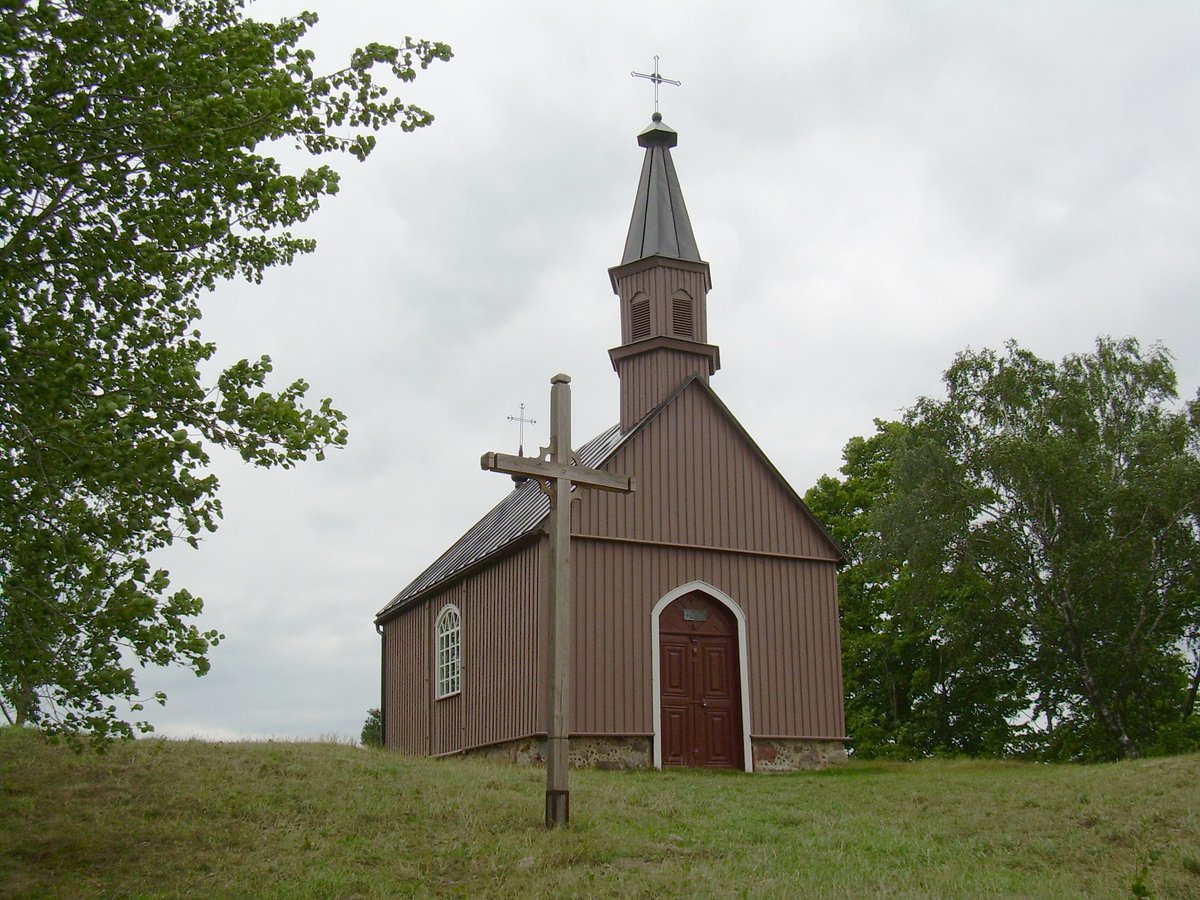
A hill, known as Žemaičių Kalvarijos piliakalnis, stands between a church and a fork in the road in the town of Žemaičių Kalvarija, western Lithuania. This hill is located 200 meters west of the center and can be found on the left side of Varduva street by turning left from Varduva turn. The hill was once home to a historic Gardų pilis castle. This was the first site of St. John’s relics. Today, two cross paths are standing on the hill. The archaeological site was built in 1637-1639, surrounded by a wall 40m by 35m in size, 2.5m deep and 2.5m high.[^1] Four stone crosses were erected in the site, one in the east bearing the inscription ‘God Jesus gathers’, another in the rear rampart bearing the inscription ‘Jesus heals Alyvų sode’, and a third sculpture of Christ’s ascension.[^2] Holy pilgrimages[^3] were conducted at the site, with a small chapel built nearby in the late 19th century.
In 1.5 hectares of land nearby, various pottery artifacts were found.[^4] An archaeological excavation was conducted in 2002, [revealing](https://en.wikipedia.org/wiki/Reveal) an IX to XIII-century fortification.[^5] The archaeological research conducted in 1903 and 1964 by Liudvikas Kšivickis and Lietuvos istorijos institutas [dated](https://www.merriam-webster.com/dictionary/date) the site to the I millennium BC to XIII AD (2004).[^6] Bronius Dakanis discovered a 4m² platform at the rear of the cross path in 2004, revealing horizontal lines of ceramics.
Sources: Wikipedia, OpenStreetMap, Wikidata, Wikimedia Commons
Written by Nicolo Ciampini
Discuss this with the author and others
No comments yet. Be the first to start the conversation.