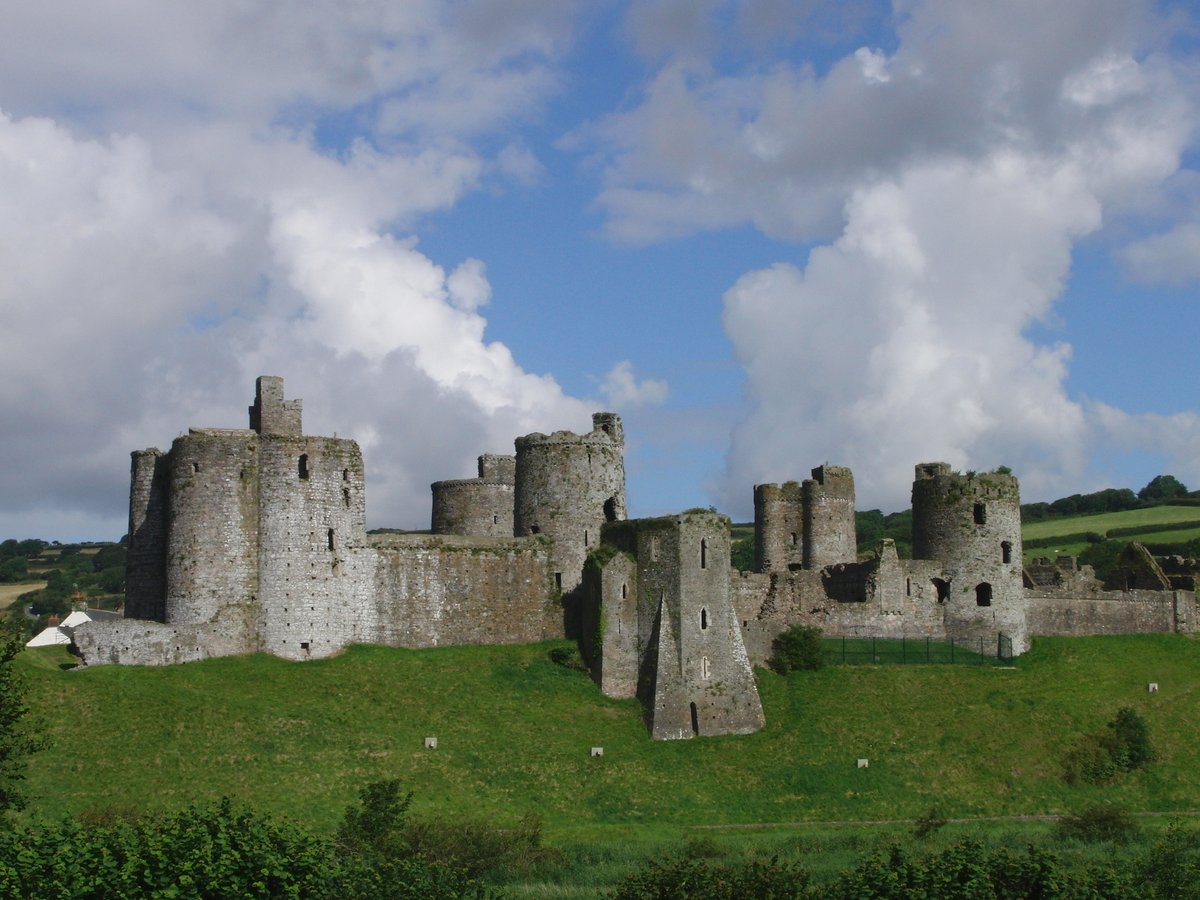
Kidwelly Castle, overlooking the River Gwendraeth and the town of Kidwelly, Carmarthenshire, Wales, is a testament to the complicated history of the region. Its story begins in 1106 when Roger, bishop of Salisbury was made lord of the cantref of Kidwelly after the Norman conquest of the area. The castle and adjoining walled town and priory were built soon after, supporting Norman rule in south Wales through military, economic and spiritual means. During this period, the original structure was an earth and timber ringwork, of which the semicircular outer ditch remains. This castle was just one of several built or rebuilt by Roger (including Old Sarum, Sherborne, Devizes and Malmesbury), reflecting his position as chancellor and justiciar of England, one of the most powerful men in the realm.
The castle fell to the Welsh several times in the twelfth century. In 1136, Welsh princess Gwenllian ferch Gruffudd was beheaded after being captured in a battle near the castle. At this time Maurice de Londres was lord of the castle. Rhys ap Gruffudd, prince of Deheubarth and son of Gwenllian (later known as the Lord Rhys) took Kidwelly Castle in 1159 and was recognised by King Henry II of England as the ruler of the region. With the fluctuations of Welsh and English power, he later lost the castle but retook it c.1190, and may have undertaken building work. Upon his death, it passed back to the Anglo-Normans.
About this time, the outer ward appears to have been walled in stone, though little of this work now survives. The castle was captured and razed by Llywelyn the Great in 1215, and again in 1231. However, it was back in English hands by 1244.
The present stone castle is most likely to have been begun in the 1270s by Payn de Chaworth, Edward I’s commander in south Wales. He built the square inner ward, which closely resembles that of Edward’s castle at Flint, as well as the marcher stronghold of Goodrich, with large round corner towers. A royal loan of £360 in 1277 suggests that Edward I regarded the castle as an important part of his campaign against Llywelyn ap Gruffudd, the prince of Wales.
After Payn died in 1279, the castle passed through an infant heiress and the marcher lord William de Valence to the Duchy of Lancaster. Construction of the outer ward occupied much of the 14th century (though it is also possible that it was largely built by Payn de Chaworth), and the gatehouse was still incomplete at the time of the Glyndŵr Rising. The castle was rapidly made defensible as the threat of rebellion increased, with a new ditch being dug, thorn hedges repaired and a timber tower constructed.
The small garrison was unsuccessfully besieged by Welsh forces led by Henry Dwnn in August 1403 with assistance from soldiers from France and Brittany, who captured Kidwelly town and sacked it twice. The castle was again attacked in 1404. The gatehouse was finally completed in 1422.
After the accession of Henry VII in 1485, the castle was granted to Rhys ap Thomas, one of the new king’s key allies at the Battle of Bosworth. He modernised the accommodation by building a new great hall. The castle reverted to the Crown in 1531, and gradually fell into ruin before being taken into state care in 1927. It is now managed by Cadw.
In local folklore, the surrounding countryside is reputedly haunted by the headless ghost of Gwenllian ferch Gruffudd.
Kidwelly Castle was used as a location for the 1975 film Monty Python and the Holy Grail.
Sources: Wikipedia, OpenStreetMap, Wikidata, Wikimedia Commons
Written by Nicolo Ciampini
Discuss this with the author and others
No comments yet. Be the first to start the conversation.