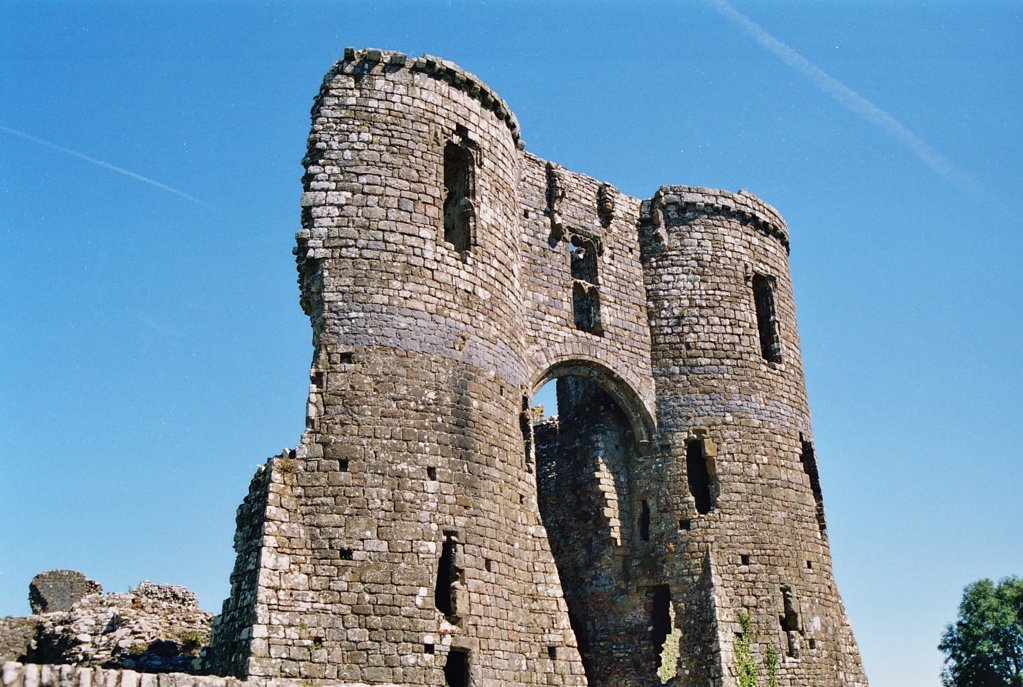
Llawhaden Castle, nestled within the village of Llawhaden, Pembrokeshire, presents a captivating sight that bridges the gap between history and architecture. Commissioned by the first Norman Bishop, Bernard, this episcopal stronghold serves as a residence and administrative center for the Bishops of St. Davids, whose ambitions are evident in the castle's grand design elements. Notable features include the towering gatehouse, flanked by colossal circular towers, and the complex hall block, equipped with spacious undercrofts, a kitchen, and private chambers. These areas each boast noteworthy architectural elements, such as impressive vaulted ceilings, intricate carvings, and luxurious latrines. Though mostly abandoned today, Llawhaden Castle gazes down upon the Cleddau valley with history hidden within its walls.
Llawhaden Castle's creation spans several centuries, with a ringwork fortification initially established on the hilltop site. This was later replaced by a stone curtain wall in the early 13th century. The most significant construction period took place between 1280 and 1293, during which the castle was substantially rebuilt, featuring the aforementioned hall block, undercrofts, kitchen, buttery, pantry, and private chambers. For nearly four centuries, the castle remained the property of the Diocese of St. David's, wielding significant influence as a powerful seat for the bishops in medieval Wales.
Today, Llawhaden Castle acts as an integral part of Pembrokeshire's medieval landscape, managed by Cadw, the Welsh Government's historic environment service, and open to the public free of charge.
Sources: Wikipedia, OpenStreetMap, Wikidata, Wikimedia Commons
Written by Nicolo Ciampini
Discuss this with the author and others
No comments yet. Be the first to start the conversation.