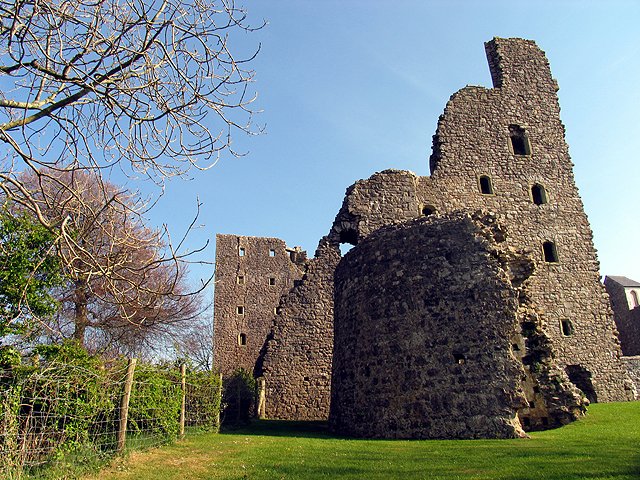
Nestled on a wooded headland overlooking Oxwich Bay on the Gower Peninsula, Castell Oxwich is a historic gem that defies cliché. Despite its imposing structure, this Grade I listed castle was only built in the 16th century, making it a youngster compared to the area's Roman roots. The existing buildings consist of a Gateway, built between 1520 and 1538, leading to a courtyard, a Hall at the east of the courtyard opposite the Gateway, which was built between 1559 and 1580, and a South Range, built between 1520 and 138.
Standing sentinel at the corner of the Hall and the South Range is the six-story South-East Tower. For those with knowledge of the extensive history of the area, the coats of arms on the Gateway may look familiar, as they belong to the Mansel, Penrice, and Scurlage families, with whom many local stories are intertwined. The East Range boasted a large Hall, making it suitable for hosting grand soirees and reverential gatherings, while the South Range had a kitchen for less formal affairs.
Castell Oxwich was built by Sir Rice Mansel, who also owned Old Beaupre Castle. After his death, the property was passed down to his son, Sir Edward Mansel. However, a peek into the castle's past reveals that it was not always a symbol of prosperity and power. The Great House, built over the older castle around the 13th century, was a grand attempt to create a magnificent structure capable of housing a large number of guests and retainers, but it came at a steep price - Sir Edward Mansel went bankrupt during its construction.
By 1632, the castle was already leased out by the Mansell family, and parts of the building collapsed in the 18th century. In the 20th century, the castle continued to be used as a farmhouse, but it was saved from demolition in 1949 and is now under the care of Cadw. A surprising secret discovered during maintenance works in 1968 added a layer of intrigue to this already storied castle: a gold brooch was found, believed to be a rare fine example of medieval British jewellery, dating back to the 14th century.
Although this Welsh castle hides a surprising secret, it serves as a testament to a grand chapter in the region's history, offering a glimpse into its past and the many families who shaped the area. As you stand on a wooded headland looking out over Oxwich Bay, you cannot help but feel a sense of awe and reverence for this historic gem.
Sources: Wikipedia, OpenStreetMap, Wikidata, Wikimedia Commons
Written by Nicolo Ciampini
Discuss this with the author and others
No comments yet. Be the first to start the conversation.