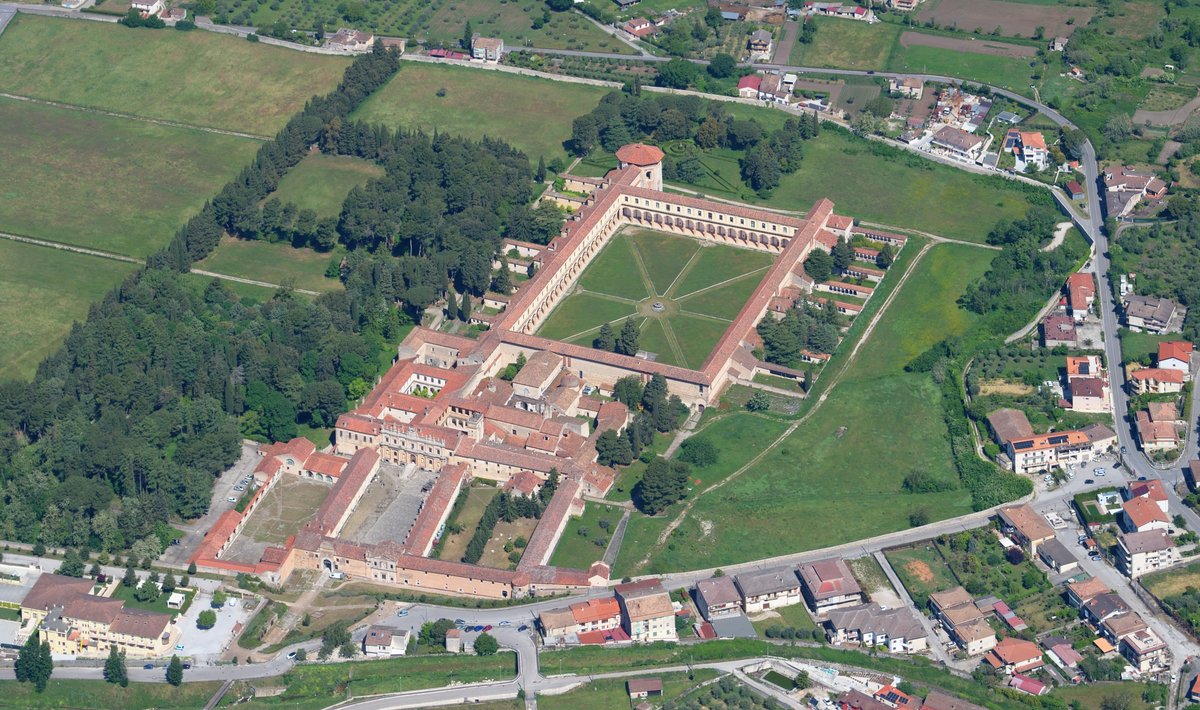

The Certosa di San Lorenzo is a large Carthusian monastery in the town of Padula, located in the Cilento National Park in Southern Italy. Founded by Tommaso di San Severino on 27 April 1306 on the site of an earlier monastery, it is dedicated to Saint Lawrence. The architectural structure of the monastery supposedly recalls the griddle-iron upon which the saint was burnt alive. The monastery is the largest in Italy, with a building history covering 450 years and principal parts in Baroque style.
The monastery comprises 51,500 m2 (12.7 acres) and includes 320 rooms and halls. It features the biggest cloister in the world, covering 12,000 m2 (2.97 acres) and surrounded by 84 columns. Inside an annex, a famous spiral staircase of white marble leads to the large library. The layout follows strict Carthusian distinctions, separating peaceful areas like the cloisters, library with Vietri ceramic tiled floor, and chapels with 18th-century scagliola work from productive areas like the kitchen, wine vats, laundries, and external yards.
The monastery also houses the archaeological museum of Western Lucania, which preserves finds from the necropolis of Sala Consilina and Padula ranging from protohistory to the Hellenistic Age. Historically, the building served as French headquarters during the Napoleonic Wars, a base for Garibaldi's Southern Army during the Risorgimento, and an internment camp during the World Wars. It was here that the Czechoslovak Legion in Italy was established in 1917.
Sources: Wikipedia, OpenStreetMap, Wikidata, Wikimedia Commons
Written by Nicolo Ciampini
Discuss this with the author and others
No comments yet. Be the first to start the conversation.