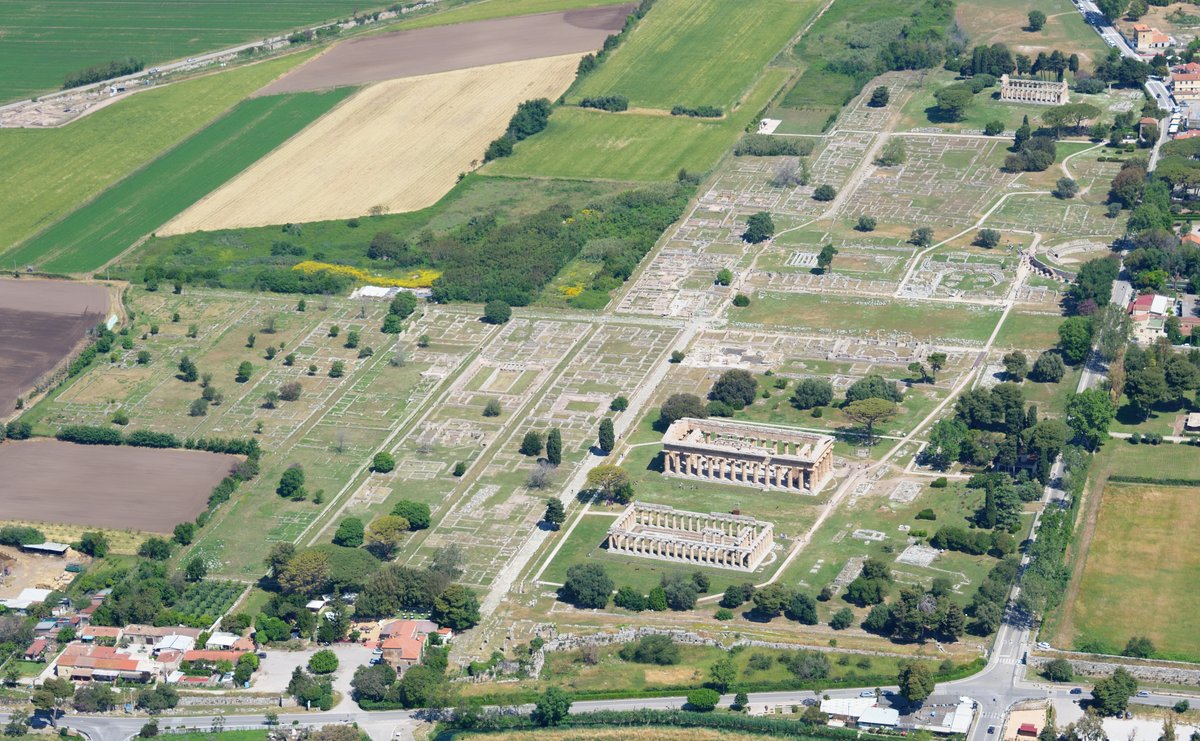

Poseidonia is an archaeological site found in Campania, Italy. It was established in 600 BCE as a Greek colony by settlers from Sybaris. For almost two centuries, the city grew and witnessed the birth of democracy. Without warning, it was seized by the Lucanians in 400 BCE, then by the Romans in 273 BCE who renamed it Paestum and created a Latin colony. Eventually, Poseidonia's decline came with shifts in trade routes and the onset of flooding and marsh formation.
Buried and forgotten for many years, the site was rediscovered in the 18th century. Today, the remains of Poseidonia are located in the modern frazione of Paestum, which is part of Capaccio Paestum in the Province of Salerno. The site is famous for its three ancient Greek temples, dating back to 550-450 BCE. These remarkable structures are in the Doric style, which was popular at the time. The Temple of Athena is the largest of the three and was once thought to be dedicated solely to Athena.
However, new research indicates that it housed three deities: Athena, Ceres, and Poseidon, the Greek god of the sea. The Temple of Hera is the oldest of the temples, revealing a strong curvature - entasis - in its columns distinct for the early construction period. Two other deities may have been worshipped here, but their identities remain a mystery. The second Temple of Hera stands apart, being wider than other Greek temples and characterized by larger columns and smaller intervals between them.
Sources: Wikipedia, OpenStreetMap, Wikidata, Wikimedia Commons
Written by Nicolo Ciampini
Discuss this with the author and others
No comments yet. Be the first to start the conversation.