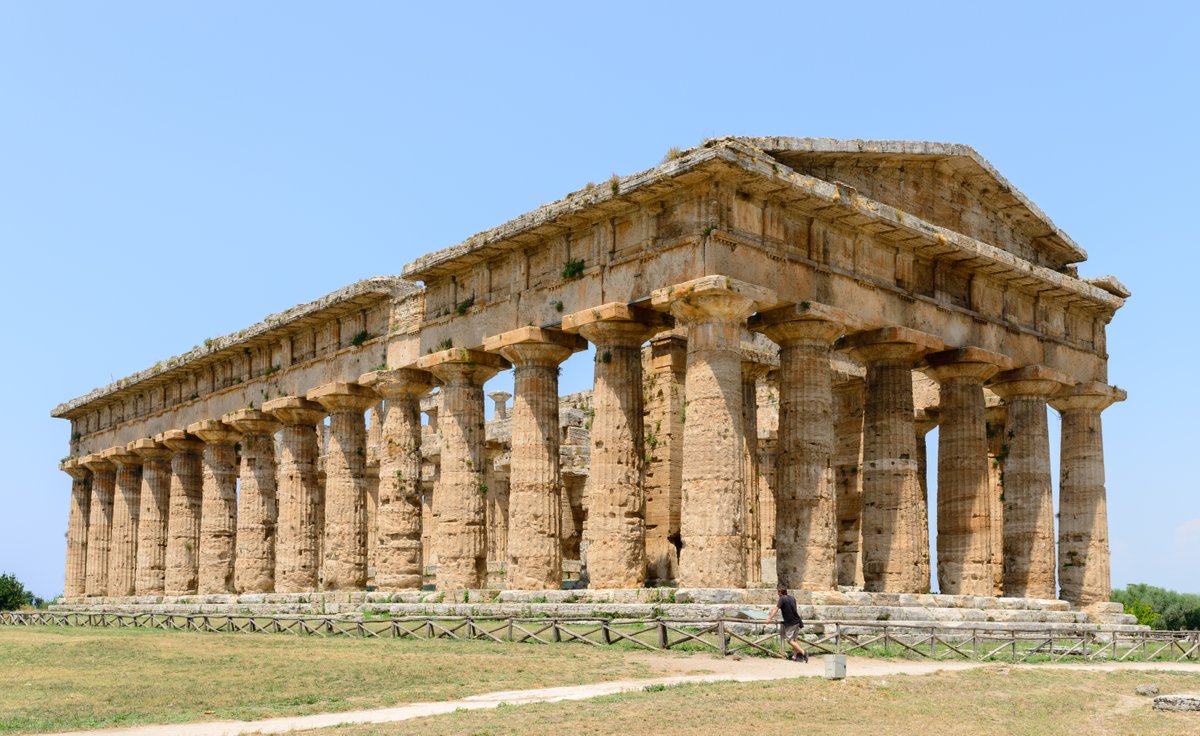

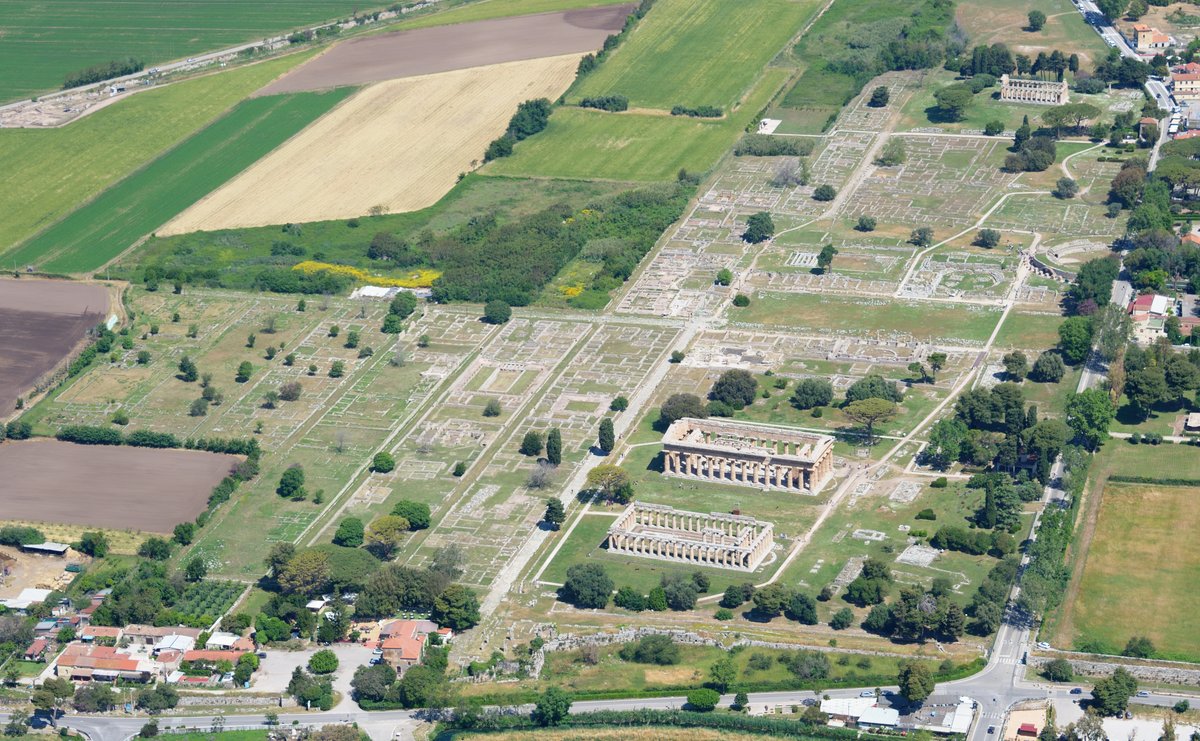
The Temple of Hera II, constructed in the Doric order around 460-450 BC, is located in Paestum, Campania, Italy. It is considered one of the best preserved early Greek temples and was listed as a UNESCO World Heritage Site in 1998. The temple is aligned with a double-peaked mountain considered to be sacred by the Greeks.
The temple measures 24.46 by 59.98 metres, with six external columns along its shorter sides and fourteen columns along its longer sides. These columns are 8.88 metres high and taper from a diameter of nearly 7 feet at the bottom to about 5 feet at the top. This gives a ratio of height to lower diameter of 4.25:1, which is unusually low for the period.
Constructed of local very porous limestone, the temple was originally concealed by a powdered marble stucco. The large external columns feature 24 flutes, while the smaller lower columns in the cella have 20 flutes, and the upper ones on the architraves have 16. The temple served as a place to worship Hera, and possibly Poseidon, as well as Zeus and another deity of unknown identity.
Sources: Wikipedia, OpenStreetMap, Wikidata, Wikimedia Commons
Written by Nicolo Ciampini
Discuss this with the author and others
No comments yet. Be the first to start the conversation.