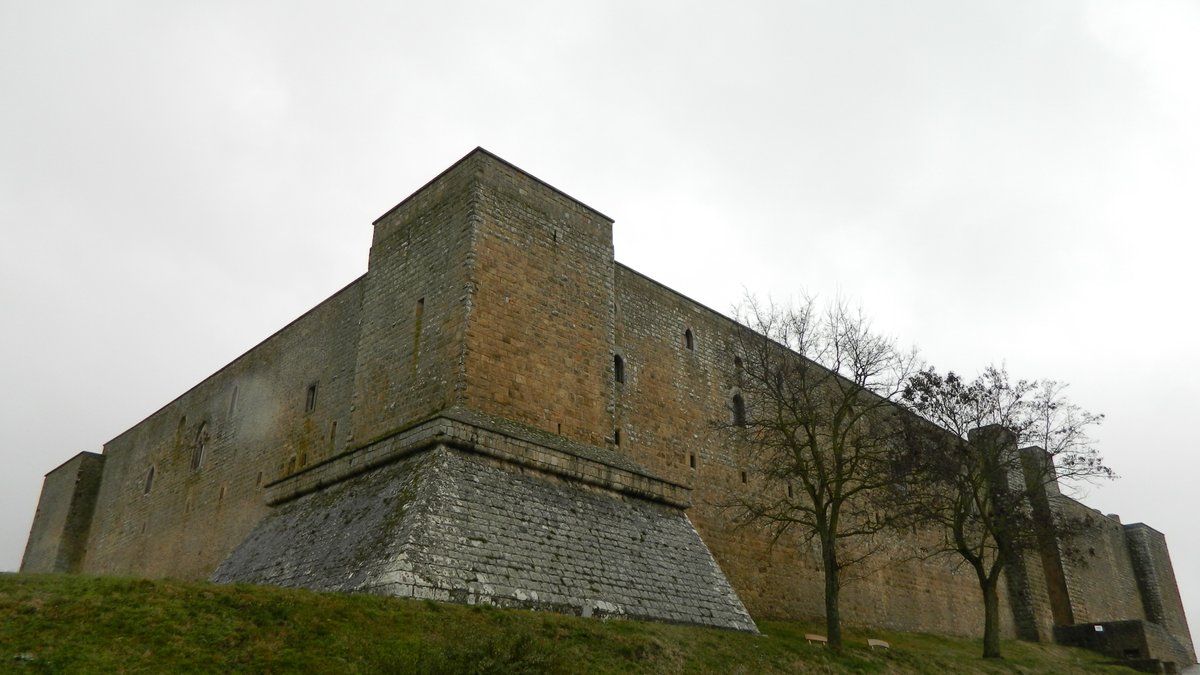

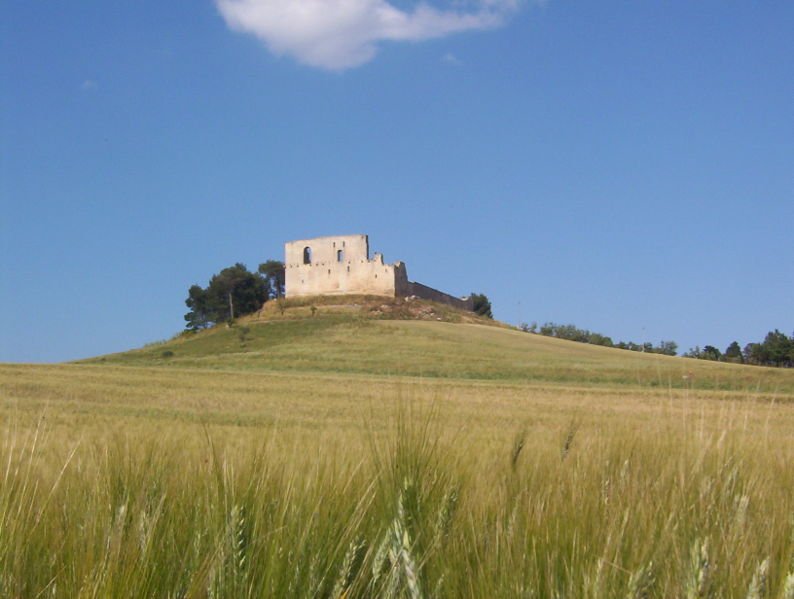
Castel Lagopesole stands on a hilltop in Basilicata between the Ofanto and Bradano rivers. It is a compact fortress with walls so thick they provide only three narrow slits for defense on the south, east, and west sides. The only possible access is on the north side, about four meters from the floor level, where two large stone brackets likely served as bases for a drawbridge.
The history of the castle reflects various transformations. It began with a Normanno-svevo military site which was later expanded in 1242. Carlo I d'Angiò transformed the building into a summer residence, which marked the only period of prosperity for the castle. During this time, it hosted the reception of Elena Angelo Comneno di Epiro. In the 1800s, the castle became a refuge for brigands led by Carmine Crocco, who occupied it with 400 men in 1861.
The castle features two courtyards. The smaller courtyard, of Altonormann era, contains a square keep that sits off-axis from the rest of the structure, indicating it is likely older than the main building. The keep features rusticated masonry in the upper part, typical of Swabian architecture. Two carved heads of a man and a woman are also sculpted there. The larger courtyard includes a large cistern and a chapel. This chapel is a peculiarity of the castle, as it is the only example of a place of worship within all structures attributed to the imperial era of the Swabian period.
Sources: Wikipedia, OpenStreetMap, Wikidata, Wikimedia Commons
Written by Nicolo Ciampini
Discuss this with the author and others
No comments yet. Be the first to start the conversation.