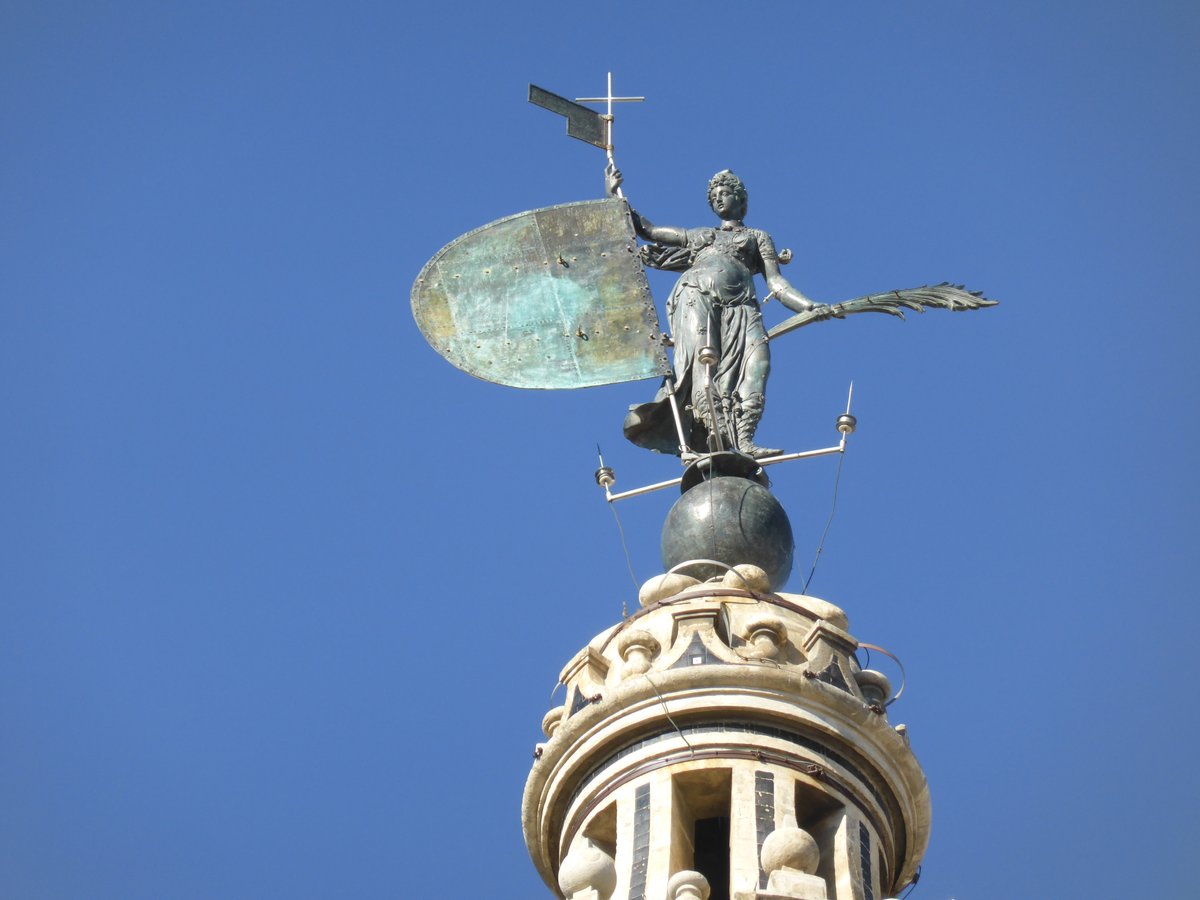

The Giralda, a landmark in Seville, Spain, is adorned by the renowned statue known as the Giraldillo. Commissioned by the Seville Cathedral and created in 1568 by Bartolomé Morel and possibly Luis de Vargas or Hernán Ruiz el Joven, this representation of Faith stands atop a bronze ball and embodies the architectural renovations of the minaret during the Renaissance period. Strikingly depicted with a large shield or banner as a mast in the right hand and a palm in the left, the statue stands 3.47 meters tall, weighing an impressive 1.2 tons.
At first, the statue was named for its ability to rotate with the wind direction, a characteristic that eventually came to symbolize the tower itself. With similarities to various artworks, ranging from ancient Greek-Roman fountain reliefs to contemporary statues in other cities, the Giraldillo's unique design showcases the blend of artistic influences inscribed within. The statue's influences can be found in various sources. Some believe its helmet resembles that of Perseo's statue by Benvenuto Cellini, while others point to similarities with a woman depicted in a Nuernberg silver fountain.
The statue's design also shares resonances with Minerva in the Hildesheim treasury, Dresden's statues of Daphne, and more. Throughout history, the Giraldillo has undergone changes, with restoration work done on the original lasso and the addition of rococo elements in the 18th century. Today, the Giraldillo remains a vibrant emblem, symbolizing the spiritual journey and growth experienced throughout the city.
Sources: Wikipedia, OpenStreetMap, Wikidata, Wikimedia Commons
Written by Nik Frost
Discuss this with the author and others
No comments yet. Be the first to start the conversation.