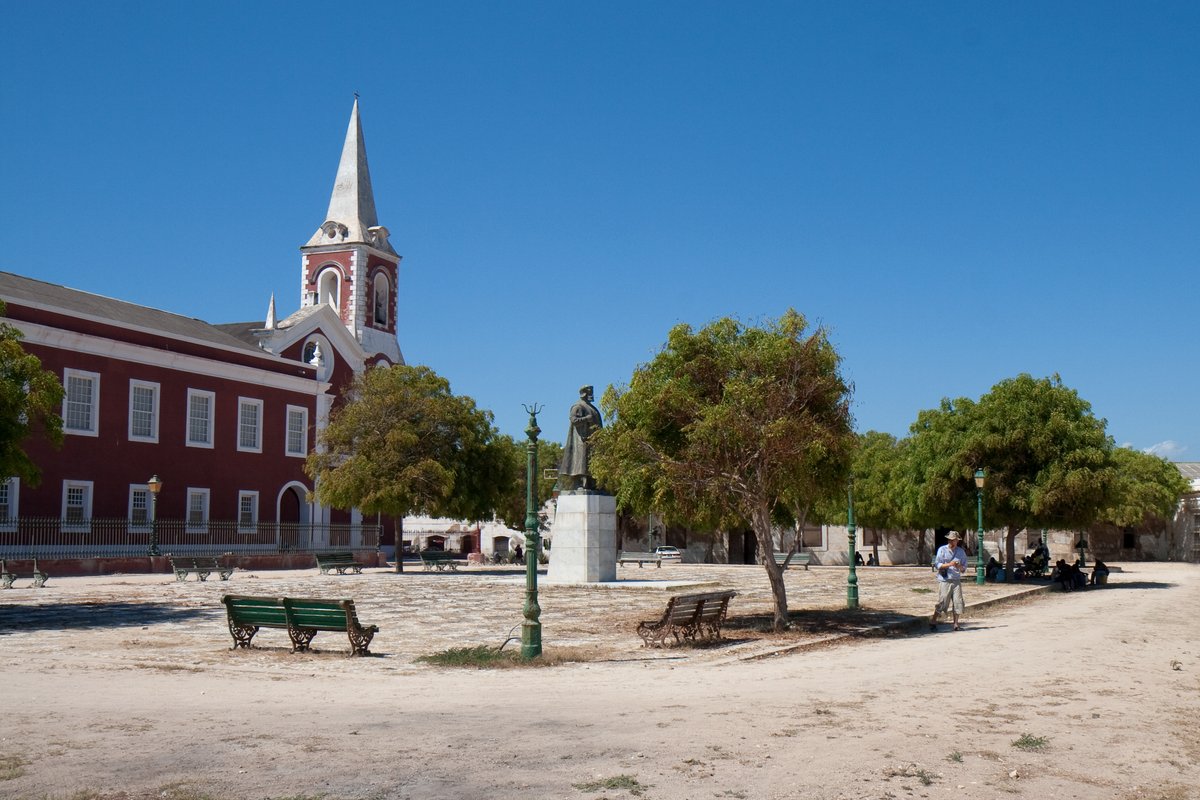

In 1610, the Palácio dos Capitães-Generais, also known as Palácio de São Paulo, was built on the island of Mozambique as the Colégio da Companhia de Jesus. It was constructed on the site of a primitive chapel built by the Portuguese in 1507, which had been destroyed during a Dutch attack in 1608. The building was consumed by a fire in 1670 and rebuilt four years later. During the Pombaline Reforms in 1759, the property was adapted into a palace to serve as the residence of the Governor and Capitão-General of Mozambique, a role it maintained until 1898 when the capital of the colony moved to Lourenço Marques.
From that time, the Palácio de São Paulo was occupied by the Governor of the District of Mozambique until 1935, when the district capital moved to Nampula. It remained vacant until 1956, when it served as a residence for the president of Portugal and his ministers during visits to the colony. In 1969, the building was remodeled for the inauguration of the bridge connecting the island to the mainland. In 1975, the palace was transformed into a museum to preserve its rich heritage after an incident involving the destruction of a valuable wicker armchair.
The palace currently houses two museums: the Museu da Marinha on the ground floor and the Museu-Palácio de São Paulo on the upper floor, which features one of the world's largest collections of Indo-Portuguese furniture. Adjacent to the palace is the Church of São Paulo, a Baroque building notable for its gilded wood carving altarpiece and polychrome wood pulpit. Next to it is the Church of Misericórdia, which functions as a Museum of Sacred Art.
Sources: Wikipedia, OpenStreetMap, Wikidata, Wikimedia Commons
Written by Mutabor
Discuss this with the author and others
No comments yet. Be the first to start the conversation.