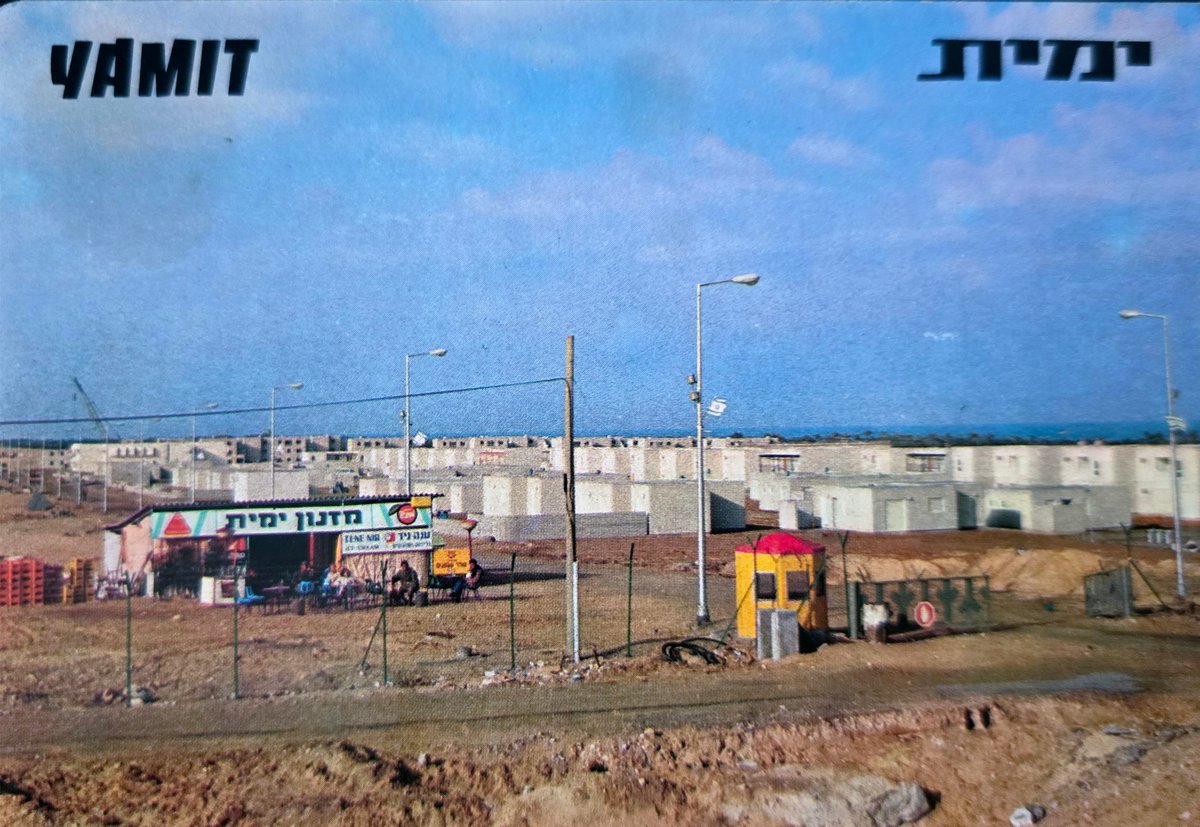

Before the machines arrived, the Rafah Plain was farmed by Bedouin who grew almond, peach, olive, and castor-oil trees, as well as wheat. They herded sheep and goats, living in tents, tin shacks, and concrete houses. In 1972, Ariel Sharon ordered the expulsion of the Bedouins from about 18 square miles of land. Bulldozers were employed to remove all structures that remained, and orchards and water wells were destroyed.
Upon this land, Yamit was envisioned as a large city for 200,000 people that would create a buffer zone between the Gaza Strip and the Sinai Peninsula. Construction began in January 1975. When the first fifty residents arrived, there were no buildings, roads, electricity, or water. Nevertheless, ambitious plans were drawn up for a port, a flour mill, a Dead Sea canal, a hotel, and a university. A cornerstone was laid for a yeshiva, and by the second year, the population reached 100.
After the signing of the Egypt–Israel peace treaty in 1979, it became clear that Yamit's days were numbered. Most residents accepted compensation and relocated, while others chose to stay. When the order came to evacuate, the remaining residents barricaded themselves inside their homes, while others climbed up to their roofs as soldiers broke down their doors. By April 1982, when the land was handed over to Egypt, all the homes were evacuated and bulldozed.
Yamit was established on a 140,000 dunam area from which some 1,500 Bedouin families of the Al-Ramilat tribes were ordered to leave. While the population of the town was about 2,500 at its peak, the project was intended to be a metropolis. Today, the land remains where the Bedouin once grew their crops and tended their livestock.
Sources: Wikipedia, OpenStreetMap, Wikidata, Wikimedia Commons



Written by Mutabor
Discuss this with the author and others
No comments yet. Be the first to start the conversation.