

The synagogue is named after Rabbi Yitzhak Abuhav (Abuav), a famous 15th-century Spanish rabbi. Tradition holds that he designed the synagogue while still in Spain, incorporating Kabbalistic symbols into the design. When they arrived in Israel, his students built the synagogue according to their teacher’s plan. Some say the synagogue was built in Spain, but after the expulsion, it miraculously moved overnight to Safed, the holy Jewish city located on the hills of Galilee. There were two well-known rabbis by that name. A certain Yitzhak Abuhav is credited with writing "Meorat HaMaor," an important book on ethics. However, it is more likely that the synagogue was named after Rabbi Yitzhak Abuhav, a great sage of 15th-century Castile and a member of the rabbinical court of Toledo. This rabbi headed a yeshiva for the study of Kabbalah and Jewish philosophy. One of his students was Rabbi Yaakov Beirav, who later became one of the great sages of Safed.
It is believed that Rabbi Yaakov Beirav brought the famous synagogue scroll to Safed. The Abuhav synagogue scroll is the oldest in Safed and is associated with many legends and traditions. This precious scroll is kept locked in the synagogue’s Torah ark and is used only three times a year—on Rosh Hashanah, Yom Kippur, and Shavuot. The synagogue also houses a second precious Torah scroll, brought to the synagogue by the 16th-century Moroccan Kabbalist Rabbi Solomon Ohana.
It is believed that Abuhav designed the synagogue while still in Spain, before traveling to Safed. The design was created according to the principles of Kabbalah. Kabbalah is an esoteric school of Judaism that includes the study of numerology, where there is a mystical connection between numbers, our lives, and events. For this reason, every element of the synagogue’s design has numerical significance—1 bimah, 2 steps, and 3 Torah arks. Using Kabbalistic symbolism, the bimah consists of six steps representing the six days of creation before ascending to the upper level, symbolizing Shabbat, the Torah, and spiritual enlightenment.
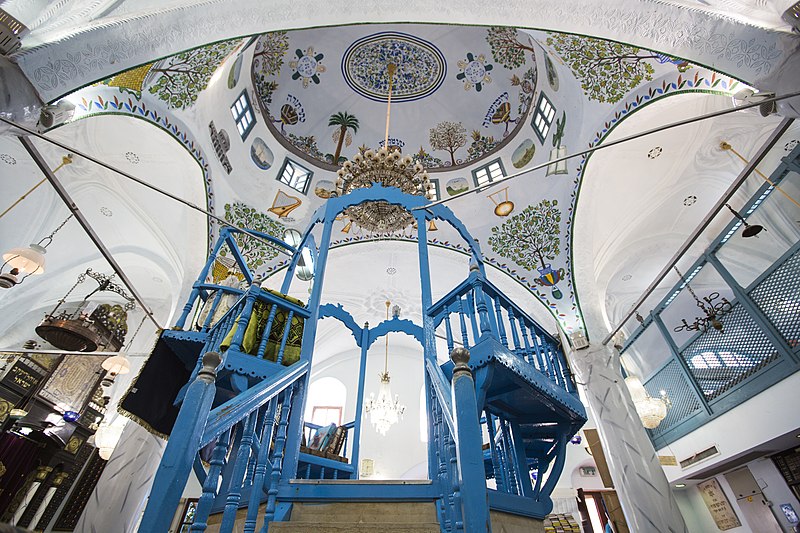
The interior of the synagogue is dominated by blue, traditionally used to paint houses or architectural elements in Safed. It symbolizes closeness to the sky and thus reminds a person of God. The walls and dome are decorated with colorful paintings depicting crowns, musical instruments from the time of the Temple, and symbols of the tribes of Israel.
Like the Holy Temple that once stood in Jerusalem, the entrance to the synagogue has outer and inner gates separated by an inner courtyard. The distance between the inner and outer gates allows the worshiper to gather their spirit and enter the synagogue in the proper mood.
Upon entering the synagogue, Kabbalists would recite the formula: “I accept upon myself the positive commandment to love my neighbor as myself” (Leviticus 19:18). They sought to draw closer to God not only through prayer but also by coming closer to their fellow men. After reciting the formula, they were expected to act according to their statement by making charitable donations.
Today, only the southern wall of the ancient synagogue remains, facing Jerusalem. It is the only part that survived earthquakes and military operations. The earlier building was destroyed in the earthquake of 1837. In imitation of the Jerusalem Temple, the synagogue has outer and inner gates. Passing through them, worshipers can better focus on prayer. Inside, along the southern wall, stand three Torah arks. The ark on the right holds two Torah scrolls, one of which was written by Rabbi Abuhav in Spain, and the other by a student of the Ari in the 16th century. This ark is opened only three times a year: on Yom Kippur, Shavuot, and Rosh Hashanah. Although the Abuhav Torah is over 500 years old and used infrequently, the letters remain legible (this is probably the oldest Torah scroll in the world still in use).

The Torah scrolls kept in the middle ark are used regularly throughout the week. If you ask the guard, he will open the ark for you. It is unclear why the third ark was built. There is an opinion that when the Turks ruled Israel, they demanded that Jews keep a copy of the Quran in the synagogue; perhaps this ark was built for that purpose. Today it is used as a genizah (a place where worn-out sacred books are stored before burial).
As you approach the synagogue, you will see the outer entrance, then the inner courtyard, and then the inner entrance. The elongated entrance and inner courtyard are designed to give the visitor time to collect their thoughts and prepare to enter the place of worship. The synagogue has three Torah arks (special cabinets where Torah scrolls are kept) along the southern wall, which is the only surviving part of the original building.
Other parts of the synagogue were destroyed by earthquakes and wars and were subsequently restored. Opposite the southern wall and the arks is Elijah’s chair, an intricately decorated chair used during the circumcision ceremony. The adult sits in the chair, and the child is seated in a small chair attached to the large Elijah’s chair.
In the center of the synagogue is a raised platform, or bimah, on which the community leader reads excerpts from the Torah. The benches for the worshipers are arranged along the edges of the room, not in rows as in a modern synagogue or church. The inner surface of the domed ceiling of the synagogue is decorated with images of musical instruments that the Levite choir would have played in the ancient temple; symbols of the 12 tribes of Israel; and four crowns—the Crown of the Torah, the Crown of Sovereignty, the Priestly Crown, and the Crown of the Coming Redemption.
Source:
https://www.worldjewishtravel.org/listing/abuhav-synagogue/
https://www.jewishvirtuallibrary.org/the-abuhav-synagogue
https://www.myascent.org/about-2/about-tzfat/tzfat-synagogues/the-abuhav-shul/


Written by Jermaine
Discuss this with the author and others
No comments yet. Be the first to start the conversation.