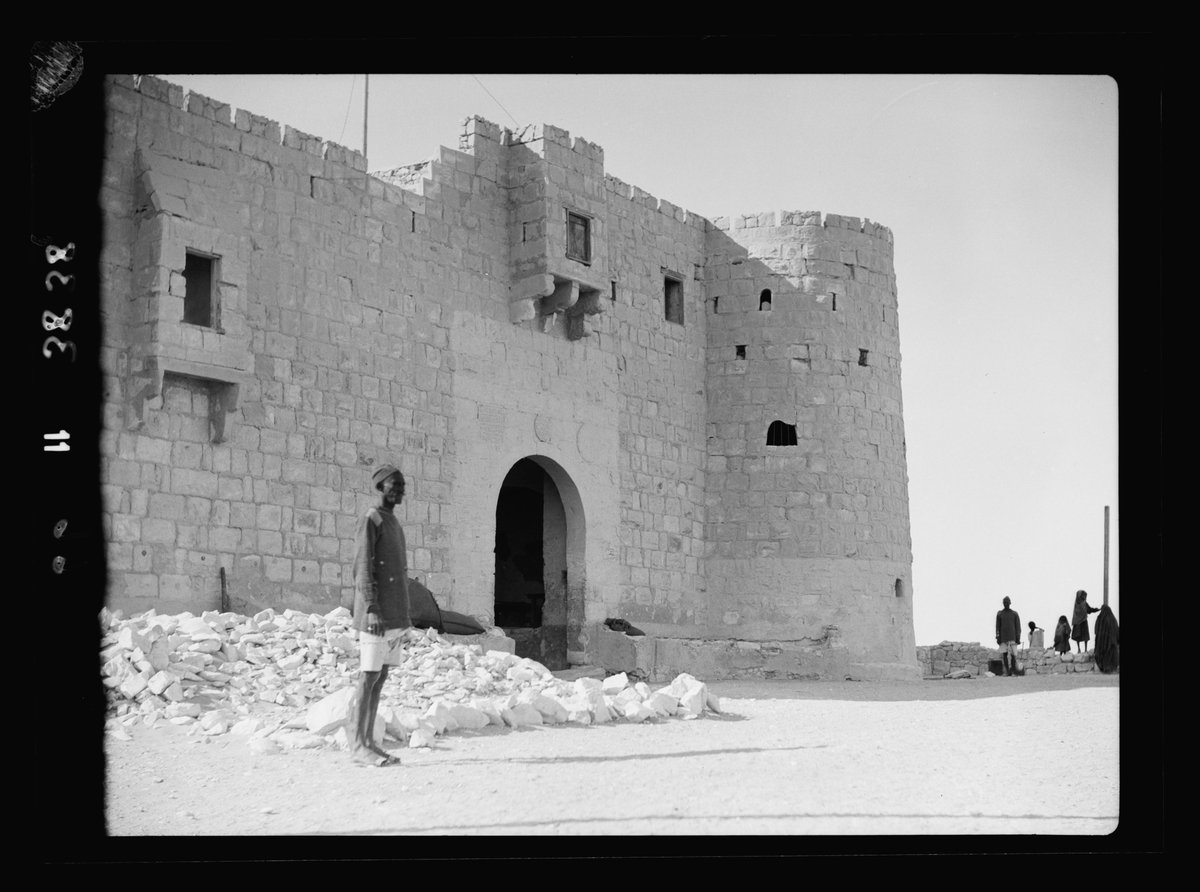

Located at the exact center of the Sinai Peninsula, the Fortress of an-Nekhel is a Ksar that holds a strategic location. Excavations at the site have revealed remains dating from Ancient Egypt. It has historically been an important stop and staging ground for Muslim pilgrims undertaking the Hajj or Umra, holy Muslim pilgrimages.
A fortress was built on the site by the Circassian Mamluk sultan Al-Ashraf Qansuh al-Ghawri. A group of Christian pilgrims, including Felix Fabri, recorded a great well at an-Nekhel in 1483 which was called the "Well of the Sultan" because the Sultan employed a man with two camels to draw water all day for the pilgrims. In the sixteenth century, Sultan Selim built the existing fortress following his invasion of Egypt in 1517. "Moorish" soldiers were stationed there to protect the pilgrims who came from Egypt, Morocco, Algiers and Spain.
During the Mohammed Ali era in the first decade of the 19th century, Johann Ludwig Burckhardt reported a large building with stone walls and no habitations around it. There was a large reservoir for the pilgrims filled from a brackish well. The garrison consisted of about fifty soldiers and the fort was used as a magazine to provision the Egyptian Army in its expeditions against the Wahabis. In the nineteenth century, the road was infested with hyenas and dabba, which fed on dead camels. Residents of an-Nekhel kept dogs to frighten off the scavengers.
Around 1900 the pilgrimage route switched to the shores of the Gulf of Suez, and an-Nekhel went into decline. In 1915, the Lebanese Druze leader Shakib Arslan arrived at the fortress with 120 volunteers but returned after the failure of the Turkish offensive against the Suez Canal. In 1917, British cavalry and aeroplanes approached the site to find it abandoned. T. E. Lawrence wrote of passing near the fort ruins in July 1917. By 1930, visitors found three policemen and one villager at the site. In 1969, Haidar Abdel-Shafi, a Palestinian political leader, was exiled to an-Nekhel for three months. The site was added to the UNESCO World Heritage Tentative List in 2003.
Sources: Wikipedia, OpenStreetMap, Wikidata, Wikimedia Commons





Written by Mutabor
Discuss this with the author and others
No comments yet. Be the first to start the conversation.