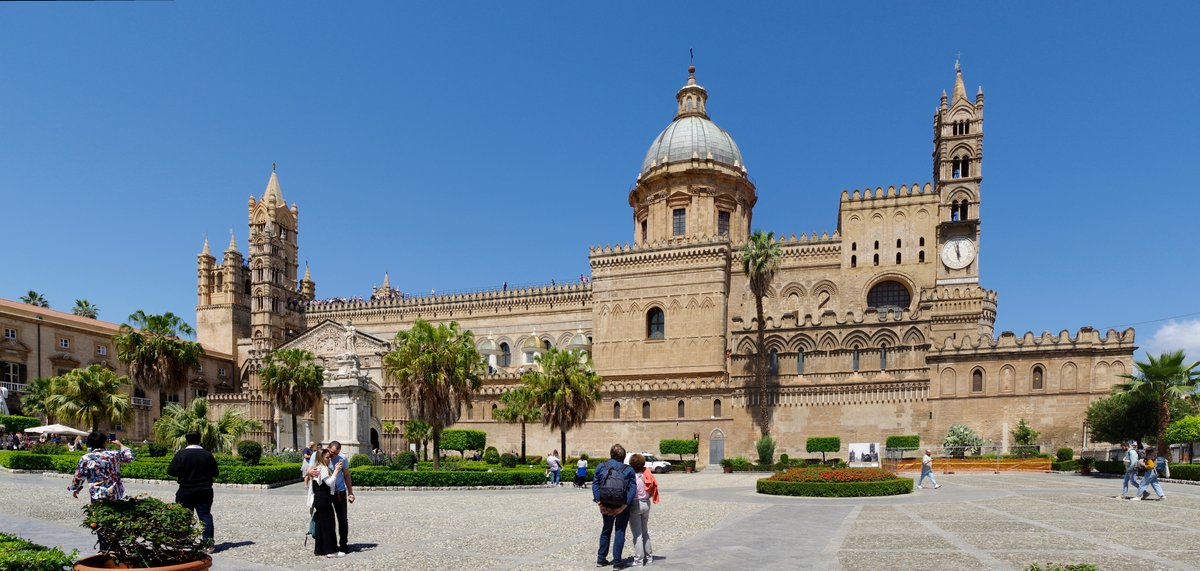

Built in 1185, Palermo Cathedral is a grand architectural complex nestled in Palermo, Sicily. Dedicated to the Assumption of the Virgin Mary, this holy place is a testament to the interwoven histories of the Roman Catholic Church, the Norman, Islamic, Gothic, Baroque, and Neoclassical epochs. As one of the key sights in the city, it stands as a symbol of Palermo’s historical significance.
Starting life as a Byzantine basilica founded by Pope Gregory I, the site has been a hub of religious worship for centuries. The Normans continued construction on the site in the 12th century, and it became a mosque under Arab rule. It was only during the 18th century that the Cathedral was transformed into the Neoclassical masterpiece we see today.
Ferdinando Fuga, an Italian architect, was tasked with this transformation. He began the work in 1781 and finished in 1801. During this period, the sculptures from Gagini’s great retable were moved to different parts of the basilica. The present neoclassical appearance dates back to Fuga’s work.
The western entrance of the cathedral is a striking example of Gothic architecture. The entrance was set in the 14th and 15th centuries and is composed of a Gothic portal and a 15th-century Madonna. The south side of the cathedral boasts outstretching turrets and a Gothic-Catalan style portico, in addition to the original 12th-century column belonging to the original basilica and subsequent mosque.
Inside, the interior of Palermo Cathedral has a Latin cross plan with a nave and two aisles divided by pilasters. Notable features include the tombs of emperors and royal figures such as Henry VI, Frederick II, and Peter II of Sicily. Constance of Aragon, Frederick’s wife, is buried in a Roman sarcophagus in the cathedral. The tombs of Roger II and his daughter Constance are located under the mosaic baldachins. These were formerly housed in the transept of the Cathedral of Cefalù.
Other significant sites within the cathedral include the Sacrament chapel, adorned with precious stones and lapis lazuli, and the chapel of Saint Rosalia, patron saint of Palermo, which is located in the presbytery and is closed by a richly ornamental bronze gate. The Relics Chapel contains the relics of St. Christina, St. Ninfa, St. Cosma, St. Agatha, and St. Mamilianus.
Sources: Wikipedia, OpenStreetMap, Wikidata, Wikimedia Commons
Written by Nicolo Ciampini
Discuss this with the author and others
No comments yet. Be the first to start the conversation.