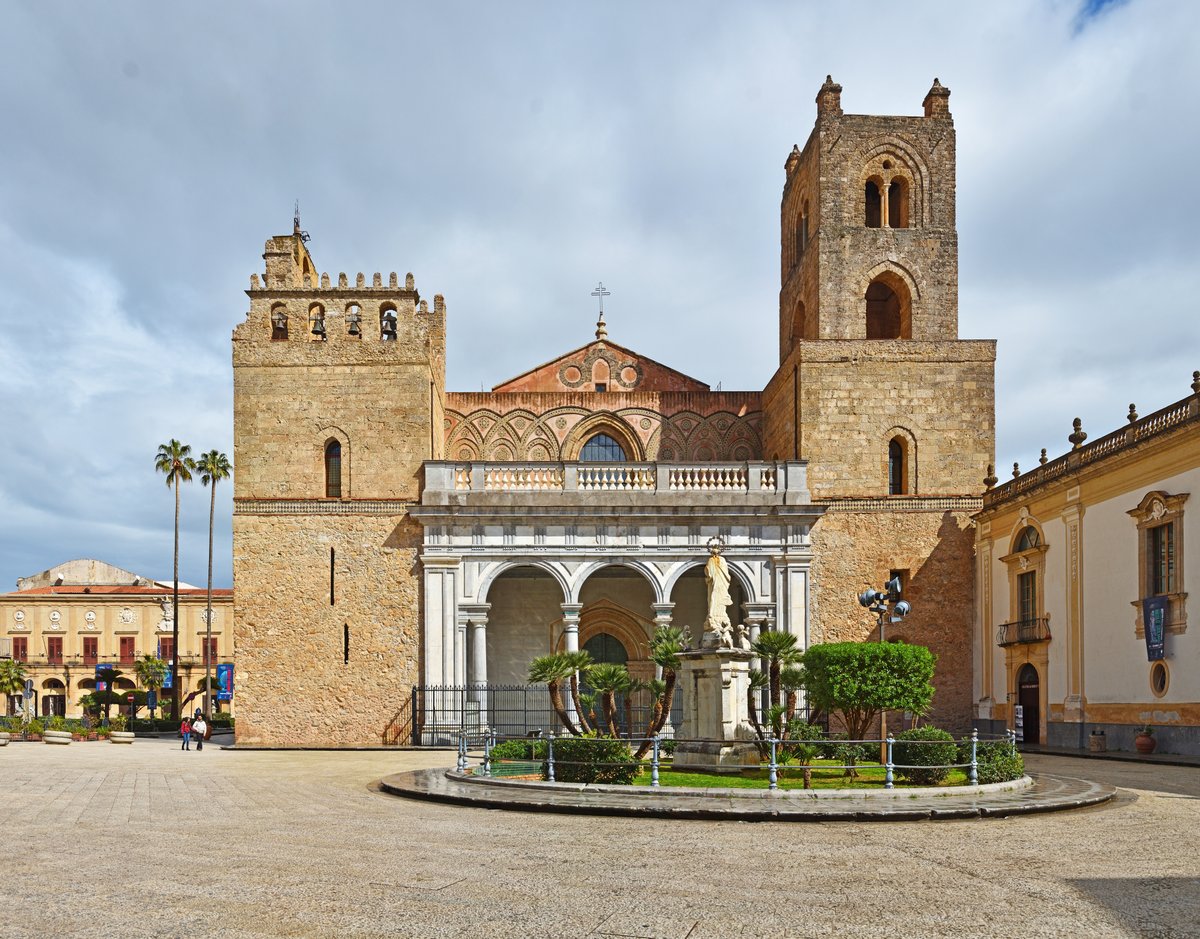

Monreale Cathedral, a National Monument of Italy since 2015 and part of the UNESCO World Heritage Site, is a staggering Norman-era church that stands as a testament to the art, architecture, and history of medieval Sicily. Established between 1172 and 1267 by William II of Sicily and consecrated in the presence of Pope Clement IV the same year, this cathedral is one of the most impressive examples of Norman architecture in existence. It was constructed as a rival to the Cathedral of Palermo but quickly surpassed its counterpart in grandeur and scale. The cathedral is 102 meters long and 40 meters wide, featuring three apses and dedicated to the Nativity of the Virgin Mary.
The cathedral's most striking feature is its mosaic ceiling, a collage of over 6,000 square meters of gold leaf and semi-precious stones. The mosaics display scenes from the Old and New Testaments, the lives of saints, and the history of the Norman Kingdom of Sicily. The mosaics were crafted by Byzantine, Arab, and Norman artists and are considered to be among the most beautiful and well-preserved mosaics in the world.
In addition to its mosaics, the Monreale Cathedral is notable for its intricate architecture, which combines Cistercian, Romanesque, and Byzantine styles. The cathedral's facade is flanked by two towers, similar to Cefalù Cathedral, and the basilica's plan is based on models of Clunian origin from northern France. The cathedral's interior features pointed arches, alternating plain and decorated columns, and capitals carved with foliage, biblical scenes, and allegories.
The Monreale Cathedral was originally part of a monastery, and the annexed abbey was elevated to the rank of cathedral in 1182. The cathedral was home to a community of Benedictine monks until 1866.
Sources: Wikipedia, OpenStreetMap, Wikidata, Wikimedia Commons
Written by Nicolo Ciampini
Discuss this with the author and others
No comments yet. Be the first to start the conversation.