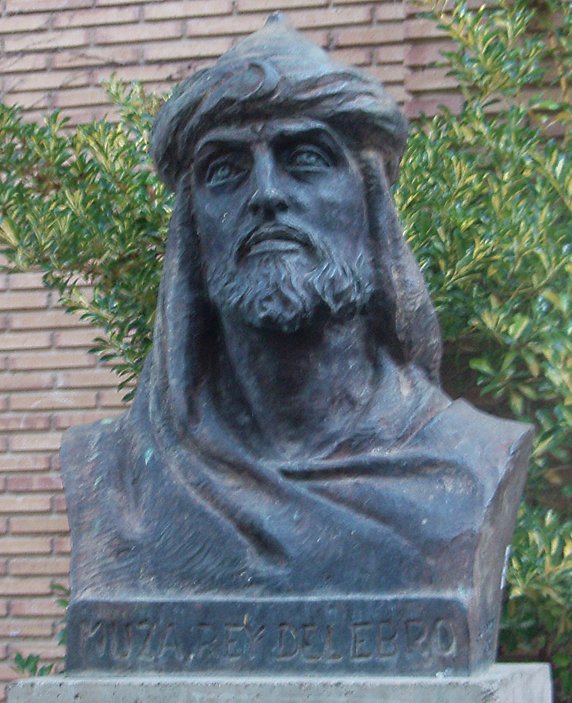

Musa ibn Musa al-Qasawi, leader of the Muwallad Banu Qasi clan and ruler of a semi-autonomous principality in the upper Ebro valley in modern day northern Spain, died on September 26, 862. Musa's early years are obscure, although he is presumed to have supported the Basques against the Franks in the Second Battle of Ronceveaux, a battle generally credited as giving birth to the nascent Kingdom of Pamplona. Likewise it is claimed that in 839 his son Furtun ibn Musa led a campaign that resulted in a rout of the 'king of the Gallaecians'.
It is in 840/41 that we first hear of Musa ibn Musa himself. In response to attacks on the lands of his half-brother, Íñigo Arista, and the expulsion of kinsman Abd al-Jabbar al-Qasawi by the brothers Abd Allah and Amir ibn Kalayb, governors respectively of Zaragoza and Tudela, Musa and Íñigo rose in rebellion against emir Abd ar-Rahman II. This led to a reprisal campaign under the leadership of the emir's son, Mutarrif, and general Abd al-Wahid ibn Yazid Iskandarani.
In 842, Musa was in charge of the vanguard of the emir's army marching against Cerdanya, but believing himself mistreated by the commanding general, Musa again rebelled and along with his nephew, García Íñiguez of Pamplona, defeated a Cordoban army. Musa ibn Musa and Íñigo Íñiguez again joined forces to ambush and capture one of Abd ar-Rahman's commanders in 843, al-Harit, but the consequence was a massive military response from Córdoba, led by the Emir in person, resulting in the defeat of the allies and the taking of slaves in the vicinity of Pamplona.
Sources: Wikipedia, OpenStreetMap, Wikidata, Wikimedia Commons
Written by Nicolo Ciampini
Discuss this with the author and others
No comments yet. Be the first to start the conversation.