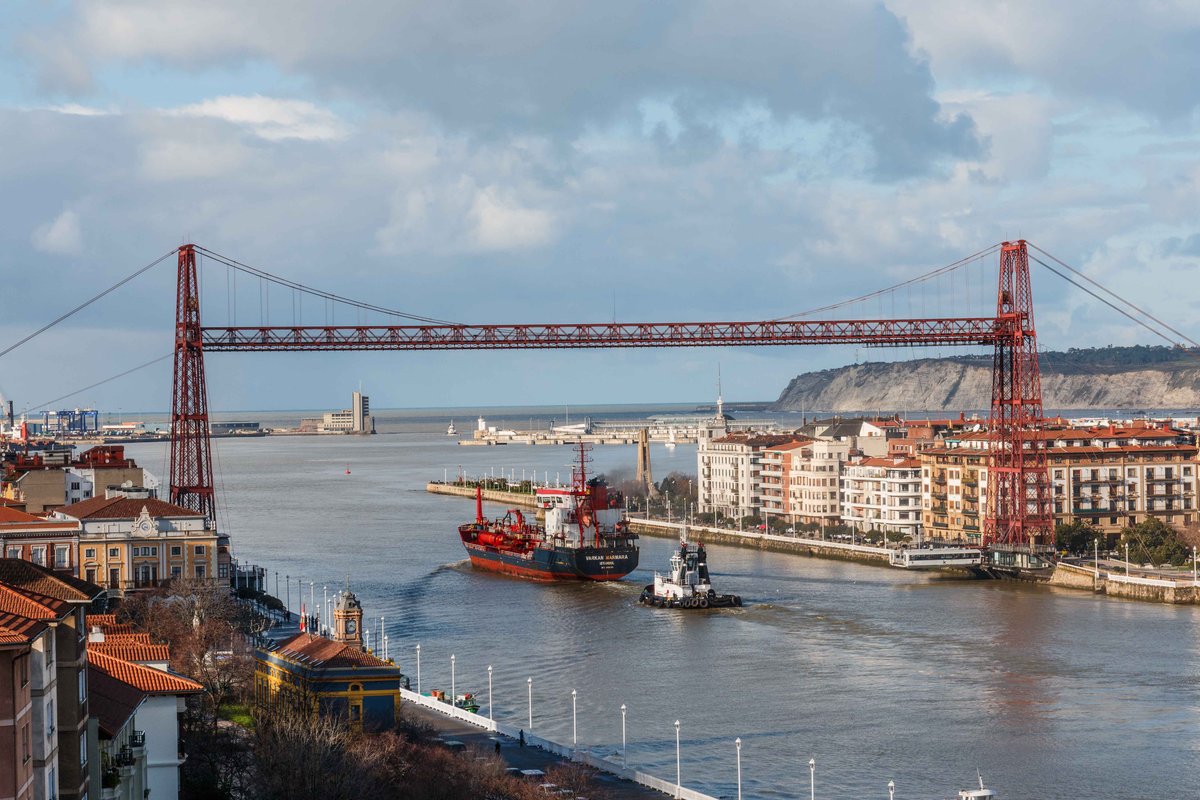

The Vizcaya Bridge, known as Puente Colgante by the locals, sits at the mouth of the Nervion River in Spain. It serves as a transporter bridge linking the towns of Portugalete and Las Arenas. Declared a UNESCO World Heritage Site in 2006, it is the only monument in Spain's Industrial Heritage category. Completed in 1893, the bridge was designed by Alberto Palacio, a disciple of Gustave Eiffel. It was the first to use a combination of iron technology and new steel cables, a method of construction that was later imitated throughout the world.
To solve the problem of connecting the two towns without disrupting maritime traffic in the Port of Bilbao, engineer Ferdinand Joseph Arnodin provided a solution that avoided building a massive structure with long ramps. Palacio wanted a bridge that could transport passengers and cargo while allowing ships to pass through. His shuttle bridge design was adequate and could be built for a reasonable price. The bridge was funded by Santos Lopez de Letona and represents the growth of the mining and shipping industries in Vizcaya.
The structure is 160 metres long and stands 45 metres high. It features four 61-metre towers and a horizontal crossbeam supported by 70 suspension cables. A gondola 25 metres long moves along rails through the crossbeam, transporting six cars and several dozen passengers in one and a half minutes. It operates every 8 minutes during the day and every hour at night, year-round. Visitors can also use new lifts in the 50-metre-high pillars to walk along the bridge's platform for views of the port and Abra bay.
Sources: Wikipedia, OpenStreetMap, Wikidata, Wikimedia Commons
Written by Nicolo Ciampini
Discuss this with the author and others
No comments yet. Be the first to start the conversation.