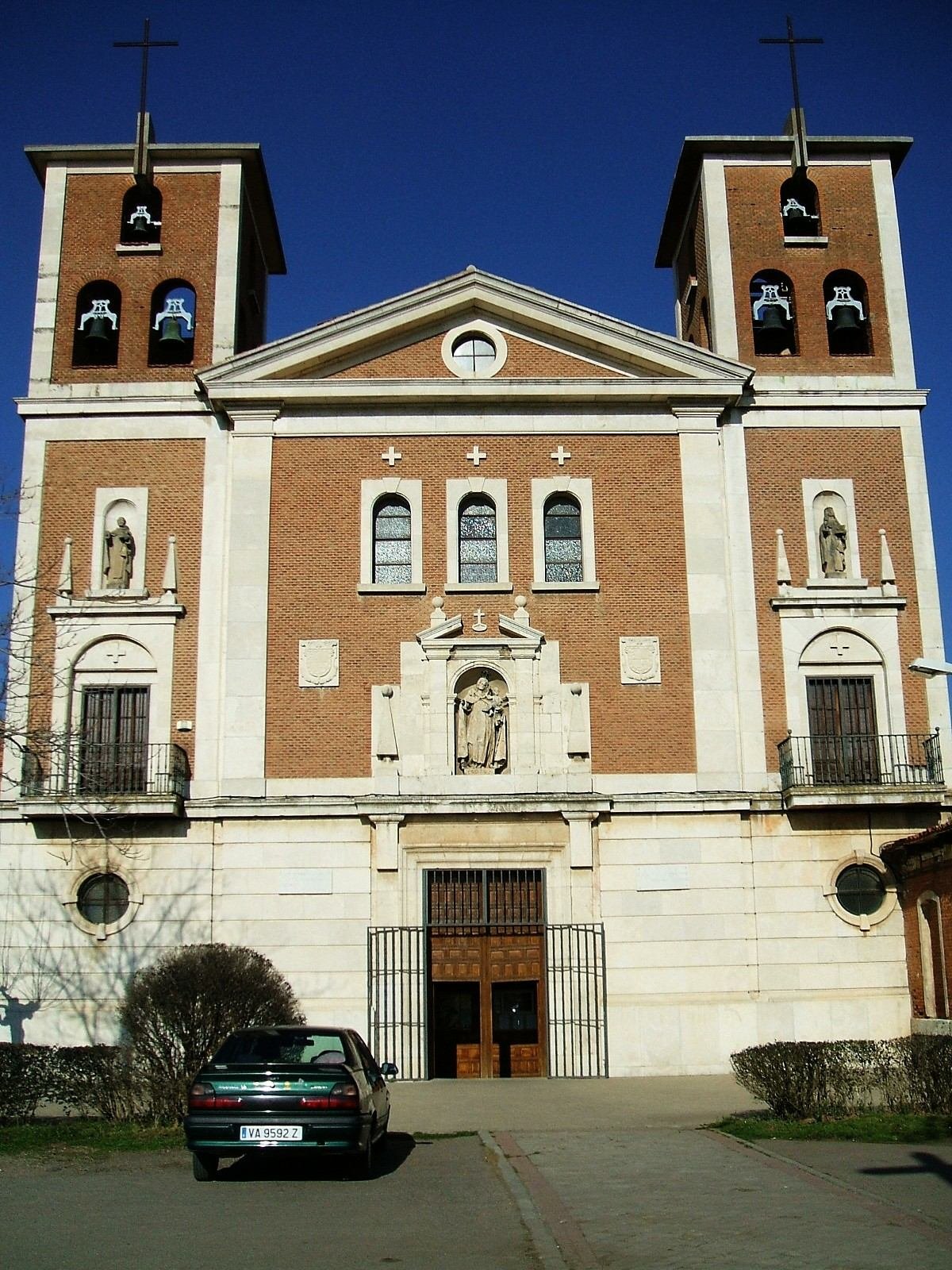

Standing outside the city walls of Valladolid, Spain, the sanctuary of the Virgin of Carmen Extramuros dates back to the 16th century. Originally part of the Carmen Descalzo convent, the church was built between the 16th and 18th centuries. In 1583, construction began under the direction of architect Diego de Práves, although the church's founders, San Juan de la Cruz and Santa Teresa de Jesús, both passed away before seeing its completion. The church was built outside the city walls, near the meander of the Río Pisuerga.
Its facade was renovated in the 1960s, but the interior retains its original Baroque charm. The building is adorned with plaster rosettes and intricate geometric patterns, and its single nave and transept are covered with barrel vaults and a dome. The church has an important amount of mobiliario, despite losses during the Desamortización. Notable items include a statue of the Immaculate, created by Gregorio Fernández in 1634, a statue of Santa Ana, a late work of Juan de Juni, and two works by Gregorio Fernández, a Santa Teresa and a Crucifix, located in the south arm of the transept.
On the opposite side of the transept, before entering the capilla de San Joaquín, Santa Ana y Nuestra Señora de la Mano, is the Retablo de San Juan de la Cruz. The retablo de San Juan de la Cruz belonged to the antigua capilla de don Antonio de Camporredondo or de San Juan Bautista. The capilla de San Joaquín, Santa Ana y Nuestra Señora de la Mano was added in 1738 as an extension of the north arm of the transept. The church's huerta, part of the convent, was converted into the municipal cemetery of Valladolid in 1840.
Today, the church is known as a sanctuary of the Virgin del Carmen and is the site of a popular annual romería mariana. The church has the status of a monument of historical-artistic national interest, as decreed by Royal Decree on November 23, 1983.
Sources: Wikipedia, OpenStreetMap, Wikidata, Wikimedia Commons
Written by Nicolo Ciampini
Discuss this with the author and others
No comments yet. Be the first to start the conversation.