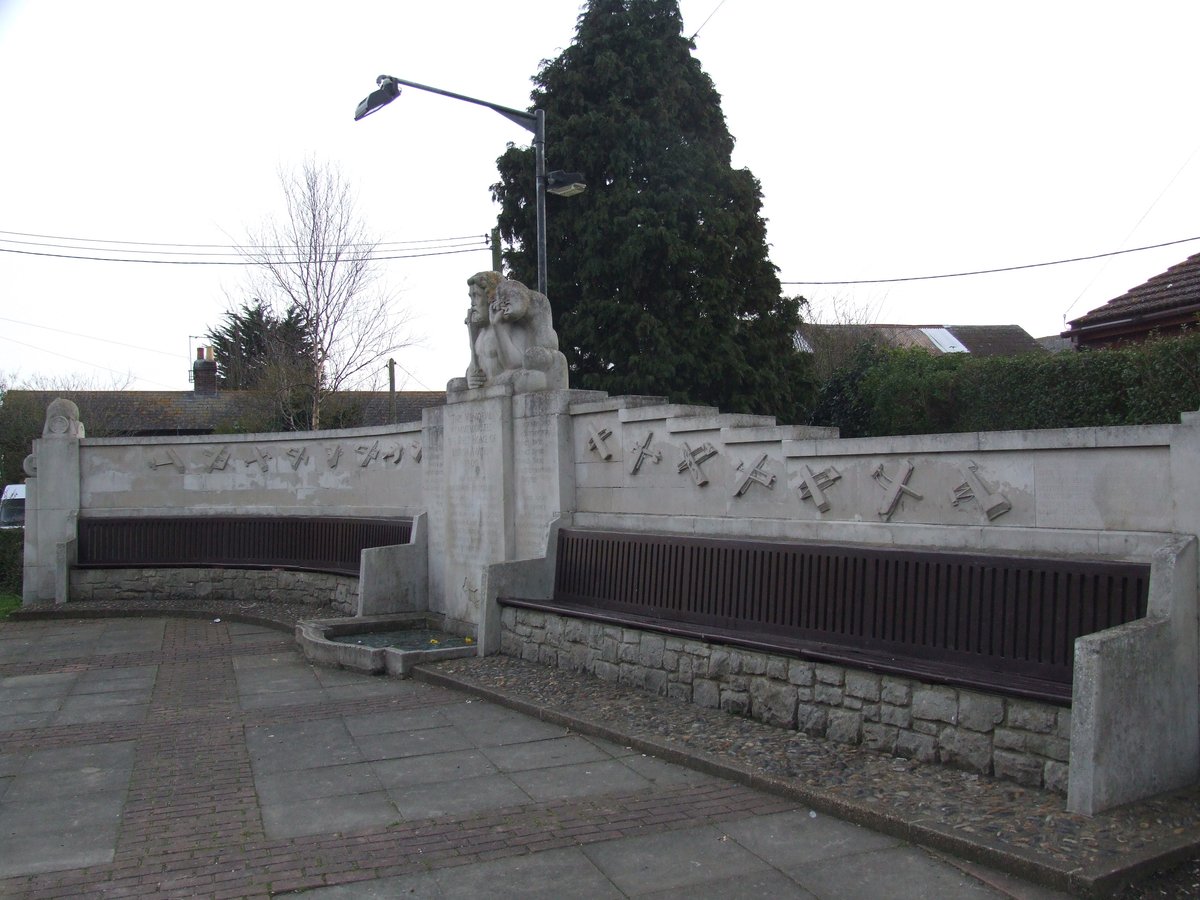

Why does a piece of stone have a curve like an aeroplane wing? It was designed by Sidney Loweth to celebrate the moment British aviation found its first home. Standing in Eastchurch, the memorial marks the area where the Aero Club began its experiments in 1909, just as the Short Brothers were setting up the country's first aircraft factory.
It is a heavy, deliberate piece of masonry. The white Portland stone panels are supported by Kentish ragstone, creating a structure that feels both rooted and aerodynamic. If you look closely at the carvings by Hilary Stratton, you can see the evolution of flight through stone. One wall displays the Avro Triplane and the Cody 1, while the other catalogs the various Short biplanes that defined the era.
There is a bit of a theatrical touch in the center. A bust of Zeus looks down from a plinth, which depicts a Short Flying Boat appearing to land on a patch of blue glass setts. It is a frozen moment of 1911 history, capturing the transition from experimental hobby to the birth of the Royal Naval Air Service.
Today, it sits quietly opposite All Saints Church. It is a Grade II* listed reminder of the pilots who first took to the air near these fields. Most people just see a beautiful monument, but for those who know the names carved into the base, it marks the location of the first home of British aviation.
Sources: Wikipedia, OpenStreetMap, Wikidata, Wikimedia Commons
Written by Nicolo Ciampini
Discuss this with the author and others
No comments yet. Be the first to start the conversation.