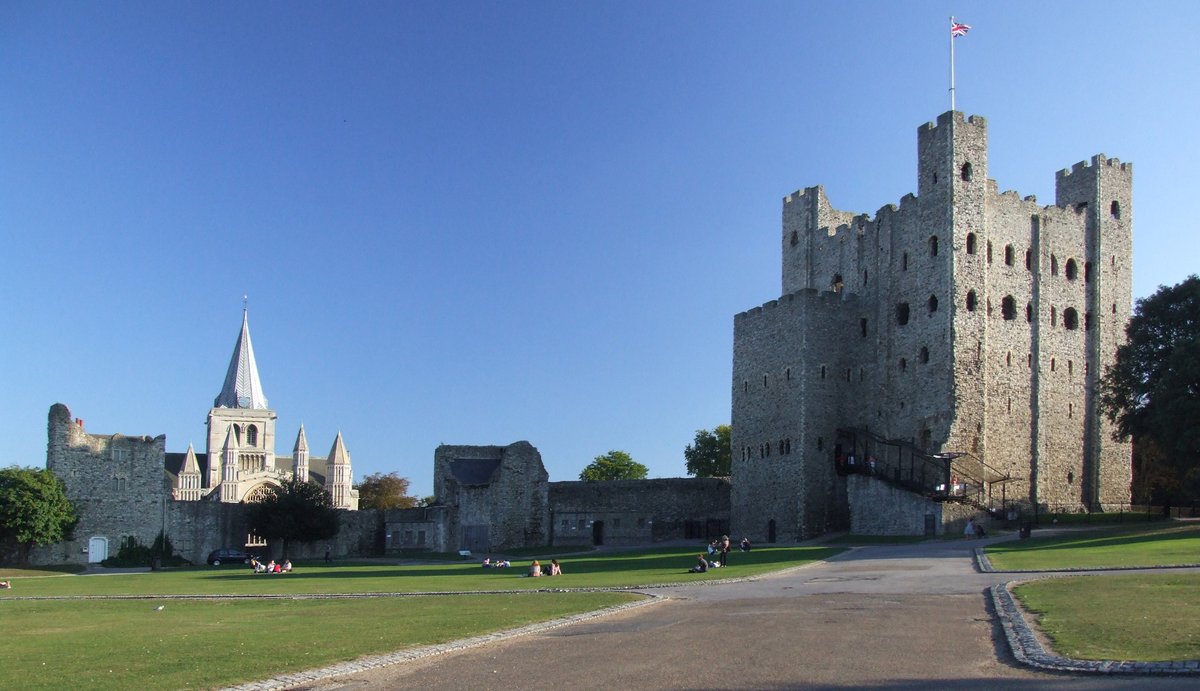

In 1086, the Domesday Book recorded that the Bishop of Rochester was given land in Aylesford as compensation for the land taken to build Rochester Castle. Of the 48 castles mentioned in the survey, Rochester is the only one for which property owners were reimbursed when their land was taken. This reflects the site's strategic importance at the junction of the River Medway and Watling Street. The castle-guard was a feudal obligation, and Rochester's guard consisted of 60 knights fees, marking it as a particularly important fortification.
The first castle at Rochester was founded in the aftermath of the Norman Conquest, likely given to Bishop Odo by his half-brother William the Conqueror. During the Rebellion of 1088, Odo supported Robert Curthose against William Rufus. The castle first saw military action during this conflict when the city and castle were besieged after Odo made Rochester a headquarters for the rebellion. After the garrison capitulated, this first castle was abandoned.
Between 1087 and 1089, Rufus asked Gundulf, Bishop of Rochester, to build a new stone castle, establishing the current extent of the site. In 1127, King Henry I granted the castle to the Archbishop of Canterbury in perpetuity. William de Corbeil built the massive keep that still dominates the castle today. Throughout the 12th century, the castle remained in the custody of the archbishops.
During the First Barons' War, baronial forces captured the castle from Archbishop Stephen Langton. A chronicler remarked that the age had not known a siege so hard pressed nor so strongly resisted. After resisting for just over seven weeks, the garrison surrendered. The castle was later captured by the French Prince Louis in 1216. In 1264, the castle was besieged again by rebel armies led by Simon de Montfort and Gilbert de Clare, but the defenders held until Henry III arrived with relief. The castle saw military action for the last time in 1381 when it was captured and ransacked during the Peasants' Revolt.
As Rochester Castle fell out of use, its materials were reused elsewhere and custodianship was relinquished by the Crown. The castle and its grounds were opened to the public in the 1870s as a park. Today, the ruins are in the guardianship of English Heritage and open to the public.
Sources: Wikipedia, OpenStreetMap, Wikidata, Wikimedia Commons


Written by Nicolo Ciampini
Discuss this with the author and others
No comments yet. Be the first to start the conversation.