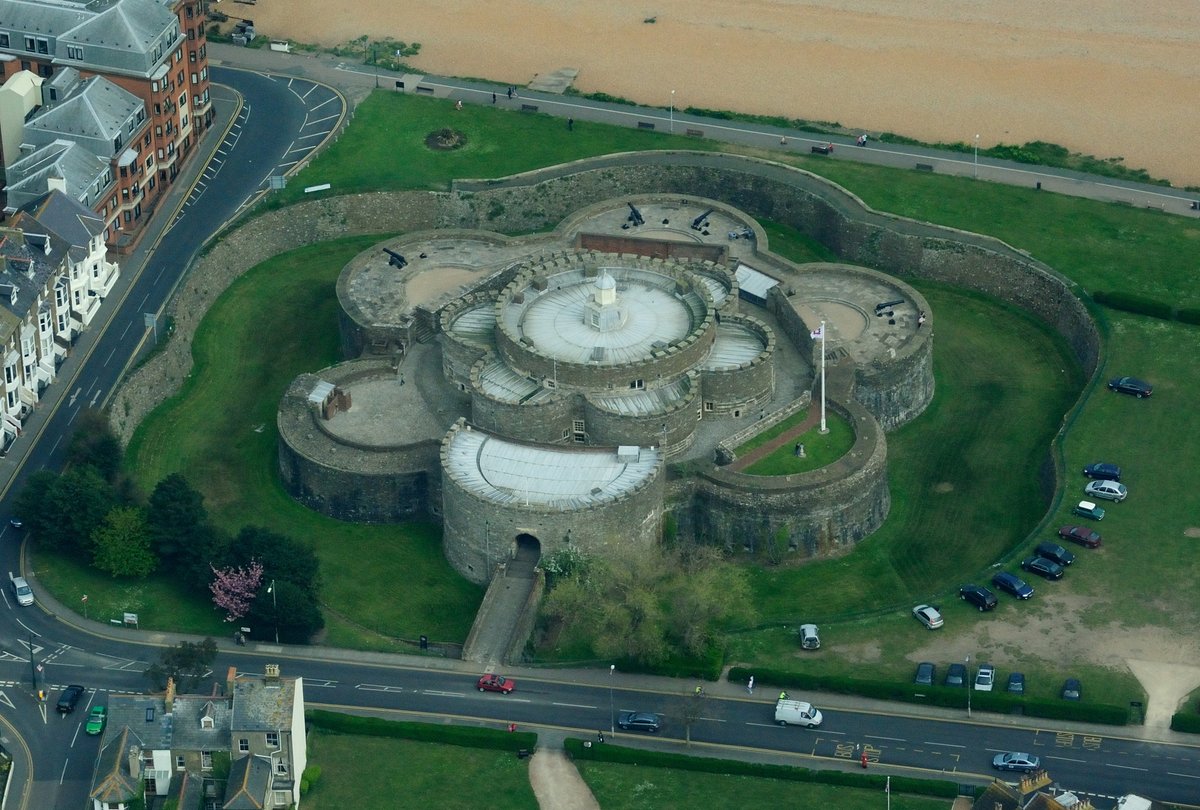
Deal Castle, hidden in Deal, Kent, England, was part of a line of coastal defences commissioned by Henry VIII. Constructed between 1539 and 1540, it was one of the three stone castles built as part of the King's Device programme. Comprising a keep with six inner and outer bastions, the moated castle covered 0.85 acres (0.34 ha) and had sixty-six firing positions for artillery. It cost the Crown a total of £27,092 to build the three stone castles of Deal, Sandown and Walmer, which lay adjacent to one another along the coast and were connected by earthwork defences.
It was originally built to protect against invasion from both France and the Holy Roman Empire. Despite the original threat passing, during the Second English Civil War of 1648–49, pro-Royalist insurgents seized the castle and were only retaken by Parliamentary forces after several months' fighting.
Despite being seized, the castle was eventually adapted by Sir John Norris and Lord Carrington during the 18th and 19th centuries to form a more suitable private house for the castle’s captain, which was by now an honorary position.
In 1904, the War Office concluded that the castle no longer had any value either as a defensive site or as a barracks and it was opened to the public when the captain was not in residence. Early in the Second World War, the captain's quarters were destroyed by German bombing, forcing the then-captain to move to Hampton Court Palace and the castle became an observation post for an artillery battery placed along the shore line. The castle was not brought back into use as a residence and was restored by the government during the 1950s to form a tourist attraction.
Today, Deal Castle is operated by English Heritage, receiving about 25,000 visitors each year.
Sources: Wikipedia, OpenStreetMap, Wikidata, Wikimedia Commons
Written by Nicolo Ciampini
Discuss this with the author and others
No comments yet. Be the first to start the conversation.