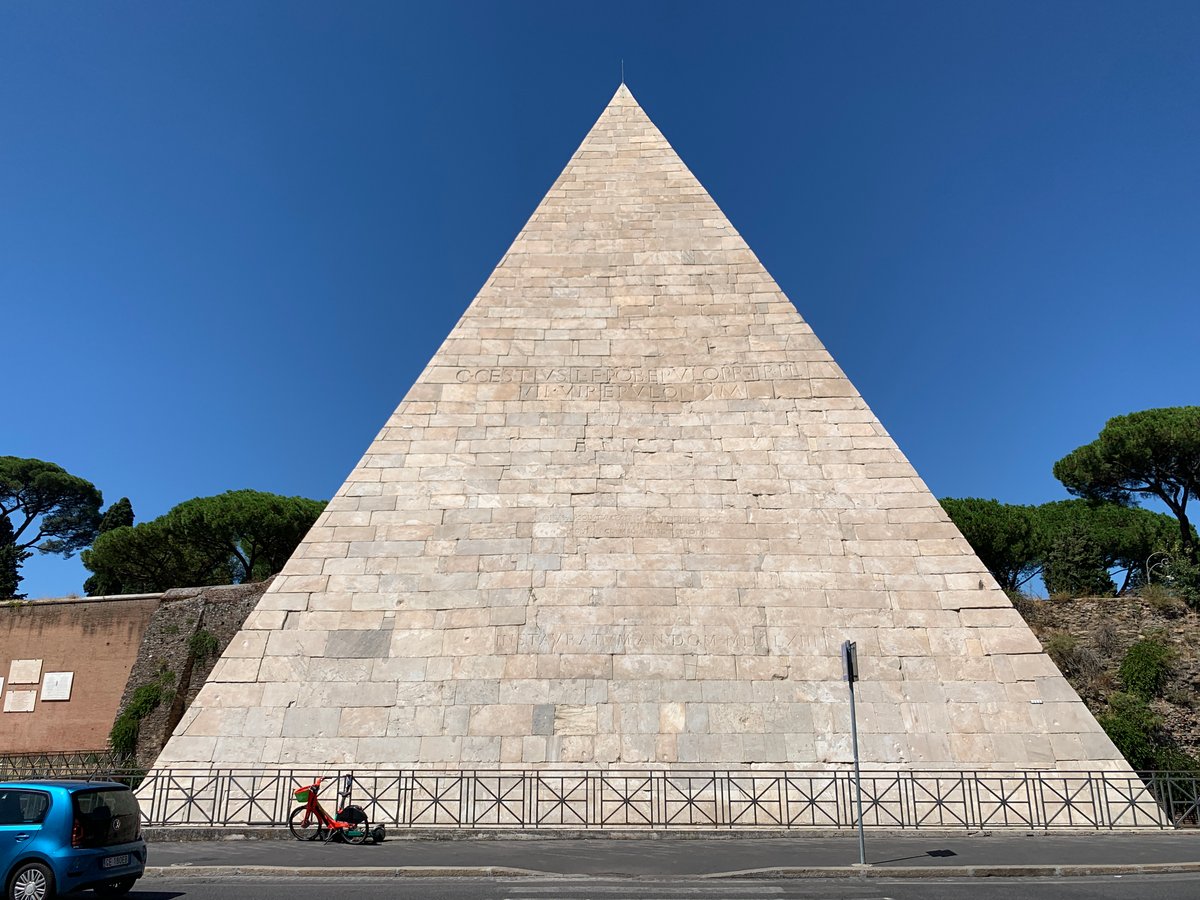

The Pyramid of Cestius stands on Via Raffaele Persichetti in Rome. Built between 18 and 12 BC, it was a tomb for Gaius Cestius, a magistrate and member of the Septemviri Epulonum religious corporation. The pyramid, made of brick-faced concrete covered with white marble slabs on a travertine foundation, measures 100 Roman feet square at the base and stands 125 Roman feet high.
Its interior has a simple barrel-vaulted rectangular cavity measuring 5.95 metres long, 4.10 m wide and 4.80 m high. Sealed when built, it was plundered at some point thereafter, probably during antiquity. Restored in 1663 under Pope Alexander VII, the pyramid's exterior is distinctly "egyptianizing," while the interior displays classic Roman fresco paintings and a barrel vaulted ceiling.
The sharply pointed shape of the pyramid is strongly reminiscent of the pyramids of Nubia, in particular of the kingdom of Meroë. This similarity suggests that Cestius had possibly served in the Roman campaign against Meroë in 23 BC and perhaps intended the pyramid to serve as a commemoration.
Sources: Wikipedia, OpenStreetMap, Wikidata, Wikimedia Commons


Written by Nicolo Ciampini
Discuss this with the author and others
No comments yet. Be the first to start the conversation.