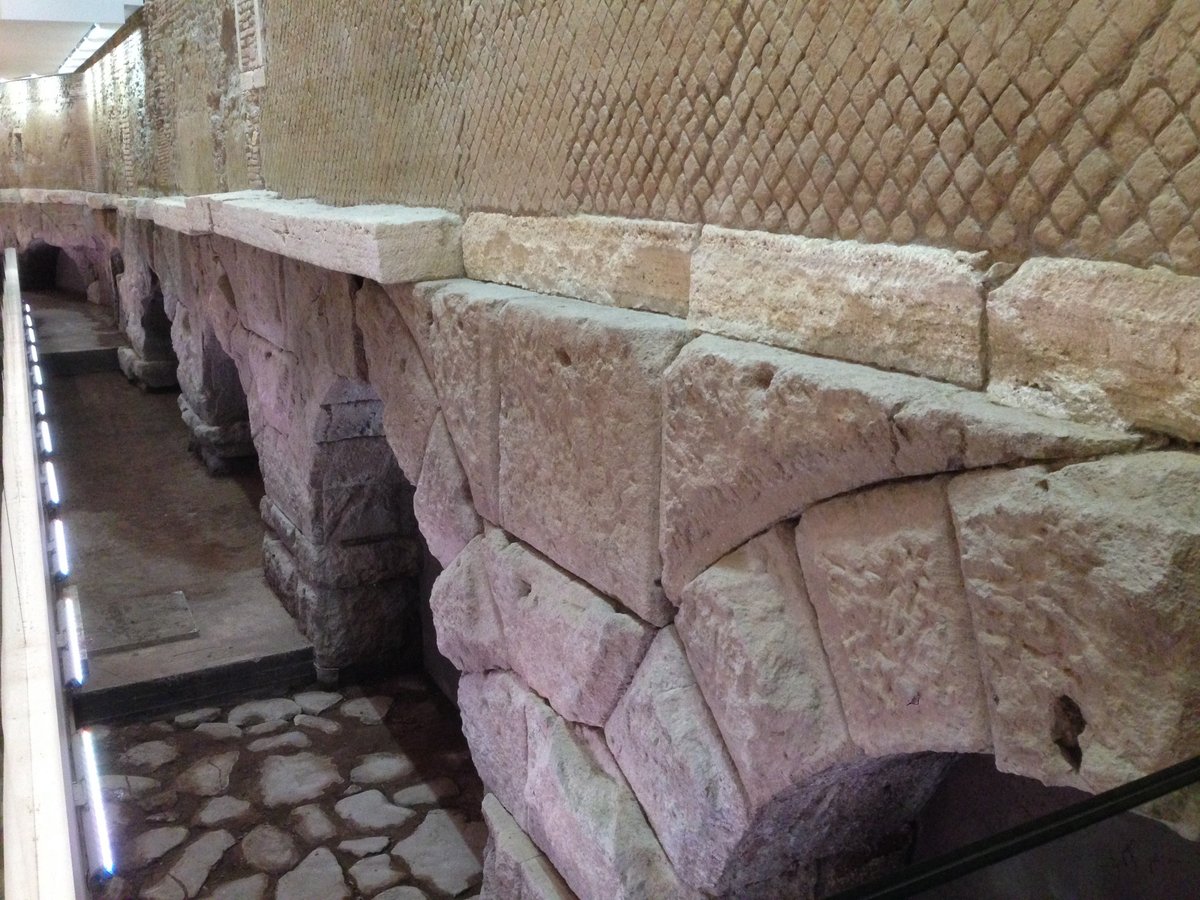

In ancient Rome, a young girl led thirsty soldiers to a spring, which was used as the source for the Aqua Virgo. Built by Marcus Agrippa in 19 BC during the reign of Emperor Augustus, the aqueduct was constructed mainly to supply the contemporaneous Baths of Agrippa in the Campus Martius. The structure was 20.5 km (12.7 mi) long and dropped only 4 m (13 ft) along its length to its terminus in the centre of the Campus Martius.
Two sections of the last stretch of the aqueduct remain today. The route made a very wide arc, starting from the east and entering the city from the north. It ran along via Collatina up to the Portonaccio area, passed via Nomentana to via Salaria, and then turned south and entered the city under the Horti Lucullani and crossed 1.2 kilometres (0.75 miles) to the area of the Pincian Hill and current Villa Medici.
The aqueduct was capable of supplying 100,160 m3 (131,000 cu yd) of water per day. It was designed to serve the northern suburb of the city by taking a wide arc to avoid steep slopes, as the low level source was only 24 metres (79 ft) above sea level.
Sources: Wikipedia, OpenStreetMap, Wikidata, Wikimedia Commons



Written by Nicolo Ciampini
Discuss this with the author and others
No comments yet. Be the first to start the conversation.