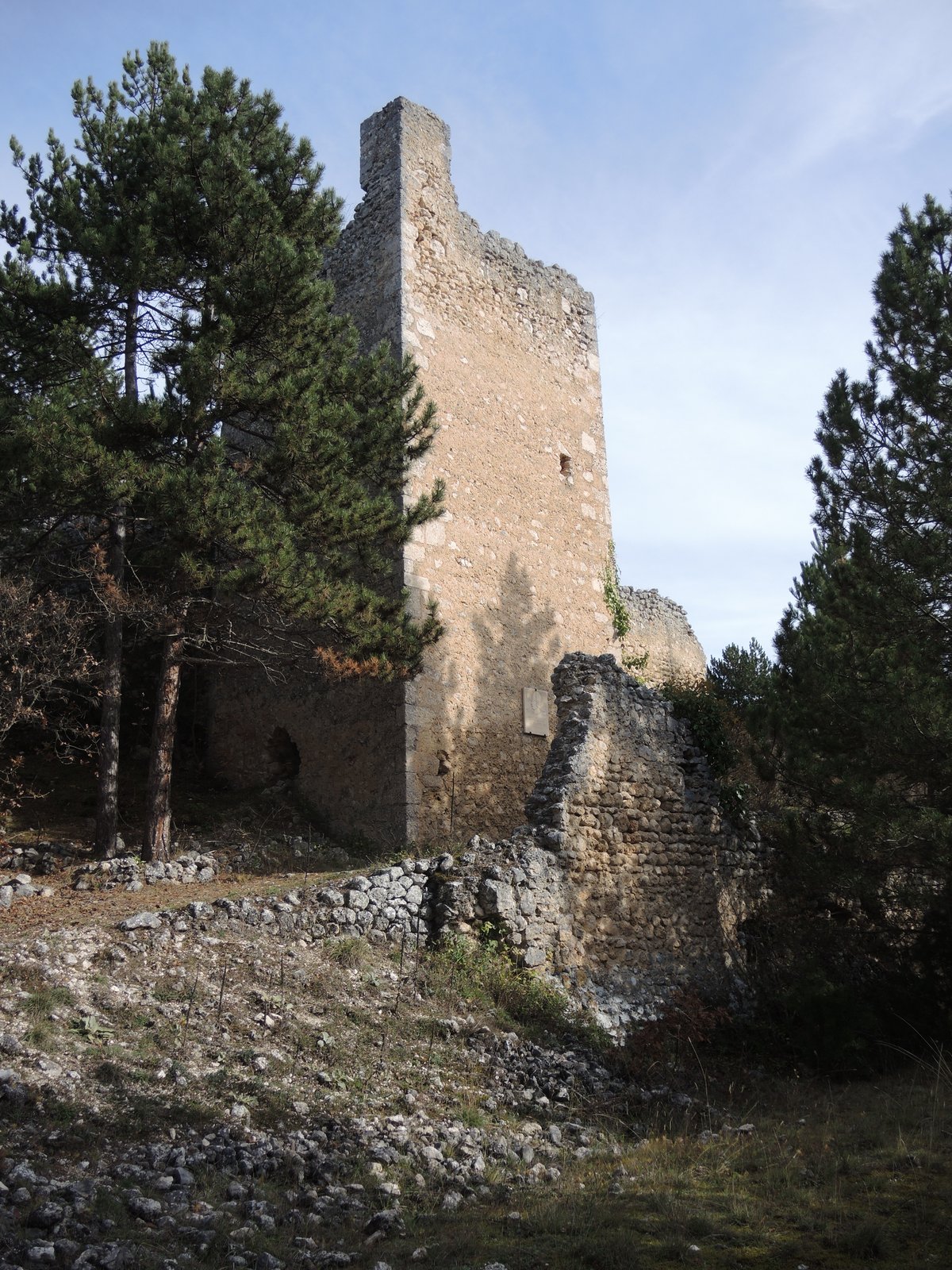

The Castle of Barisciano, situated in Barisciano, the province of L'Aquila in Abruzzo, Italy, was once a strategic fortress. Built around the 8th century (Wikidata), it was positioned at 1,500 meters (4,900 feet) on the Selva mountain to protect the village of Barisciano. In the 13th century, it was transformed into an enclosure castle, designed to house the villagers in case of danger. However, during the siege of L'Aquila by the condottiero Braccio da Montone in 1424, the castle was attacked and destroyed (Wikidata).
It was still included as part of L'Aquila until 1529, when it became a fief of aristocratic families. Around the 16th century, it lost its defensive role and was abandoned. However, in memory of the epidemic that occurred in 1526, a church of Saint Roch was built close to one of the Castle of Barisciano's towers. This church houses a wooden statue of the saint and some frescoes. The castle, like the church, has undergone significant archaeological and architectural changes over the years.
It features a rectangular enclosure with a perimeter of about a kilometer. The main pentagonal tower was placed in the top apex, while other towers were placed along the curtain wall, for a total of eight towers. Inside the walls, there are remains of other structures, yet like the castle, they were not permanently inhabited. Today, the Castle of Barisciano serves as a reminder of the history and architecture of the Middle Ages. Despite being abandoned, it continues to draw visitors to its mysteries.
Sources: Wikipedia, OpenStreetMap, Wikidata, Wikimedia Commons
Written by Nicolo Ciampini
Discuss this with the author and others
No comments yet. Be the first to start the conversation.