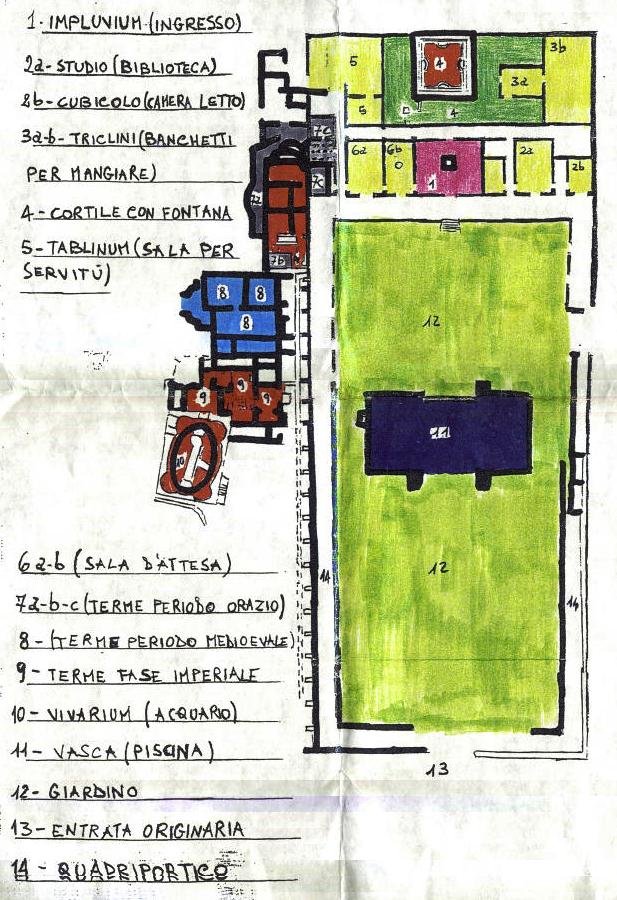

Horace's villa is nestled in a climate similar to Tarentum. It was a luxury villa, built in the Republican era and late empire, and boasts a shady valley with a spring large enough to name the river amidst fruit trees, oaks, and ilex for food and shade. The waters of this spring, known as fons Bandusiae, are said to have inspired Horace's famous poetry. Horace’s villa was next to the sanctuary of Sabine goddess Vacuna. The excavations on the site were done in 1911–14 under Pasqui, and more recently in 1997–2003.
The site of Horace’s villa is unusual, as it was terraced to create level surfaces and extraordinary views. The spring Horace loved, fons Bandusiae, is likely the one that still pours out above the villa. The Orsini family owned the site from the 12th century and transformed the spring into a nymphaeum in the 17th century. The villa's overall plan is a rectangle of about 43 x 113 m. The garden area is attached to a residential area on a higher level to the north by the so-called veranda.
A remarkable feature of the villa is the Rosone Lacunare, a beautiful marble ceiling rose carved with acanthus leaves, frogs, and crabs.
Sources: Wikipedia, OpenStreetMap, Wikidata, Wikimedia Commons
Written by Nicolo Ciampini
Discuss this with the author and others
No comments yet. Be the first to start the conversation.