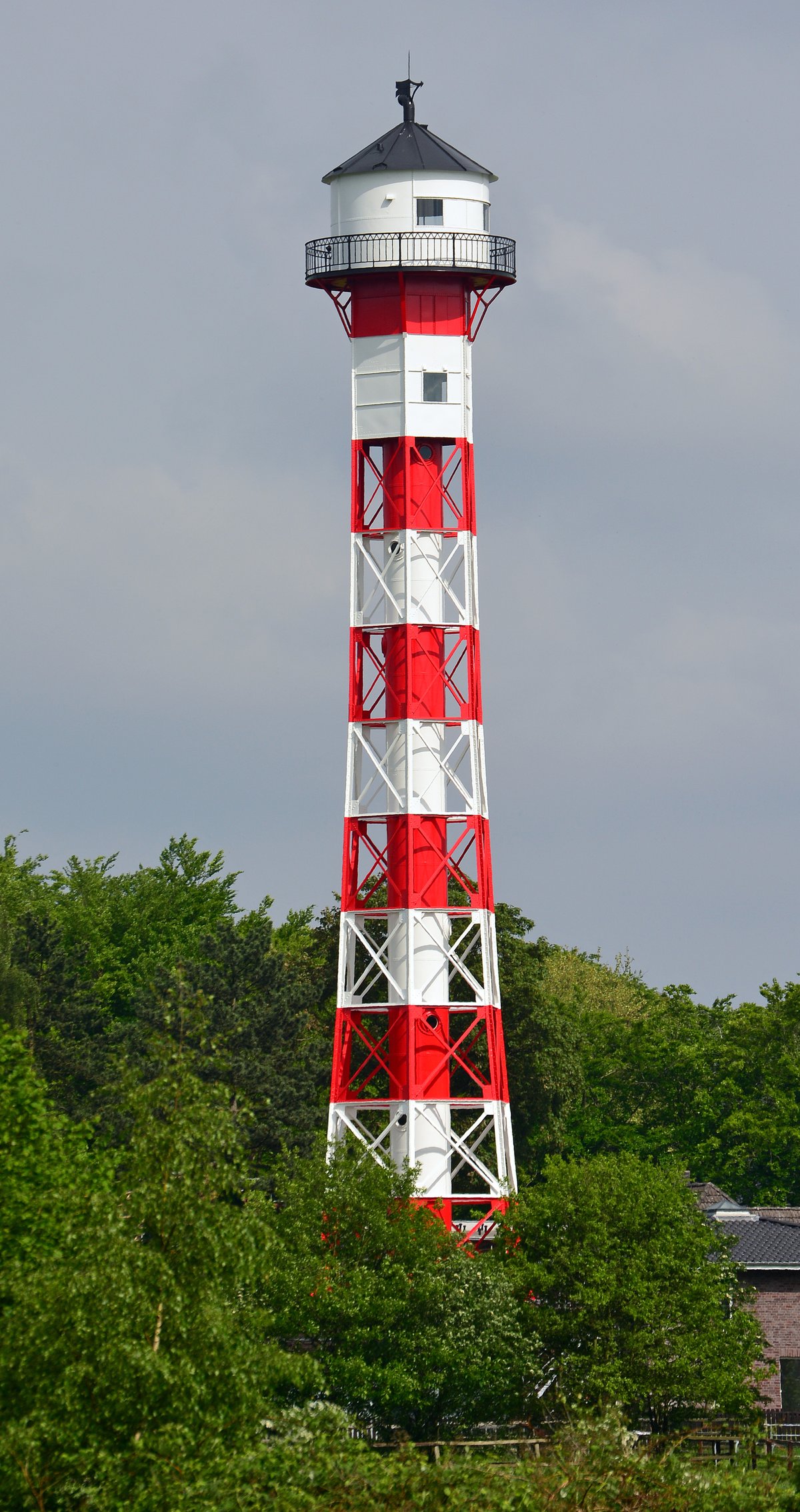
Oberfeuer Tinsdal stands as a skeletal spire of steel, its red stripes cutting against the grey of the Hamburg sky. It is a 42-meter-high lattice tower, rising from an elevation of 14 meters above sea level to guide vessels along the Elbe. While it appears solitary today, it was built to be part of a larger visual conversation with the water.
Construction began in 1899. The tower was designed using a specific staircase tube and ridge brace construction, a method that makes it one of the oldest steel lighthouses of its kind. For much of its life, it functioned as the upper light in a coordinated dance with the lower light at Leuchtturm Wittenbergen, which sits about 800 meters away. Together, they formed a leading light line, a precise invisible thread for sailors to follow.
From 1899 until 1960, the tower served an even more complex role in the maritime landscape. It was paired with Leuchtturm Billerbek, a third light situated 730 meters away above the old Tinsdal powder factory. When Billerbek was decommissioned in 1960, the tower's responsibilities narrowed, but its importance to the local navigation remained constant. It transitioned from a kerosene-burning lamp to a liquid gas lantern in 1927, a move that improved visibility for transverse marks and both leading light lines.
The tower received its current aesthetic in 1928, wearing the distinctive red stripes that remain its signature today. Technology continued to move inward as the outside remained still. It was electrified in 1966 and began to operate under remote control in 1979. By 1988, the light source had been updated again to double signal lanterns, capable of being seen from 16 nautical miles away. These incremental upgrades allowed the structure to adapt to a modern era without losing its historic silhouette.
Today, the tower is a protected monument, a piece of industrial heritage preserved under the gaze of the city. It sits as a quiet observer of the Rissen district, no longer tethered to the powder factory's smoke but still anchoring the coastline. You can see its geometry clearly from the shore - a rhythmic pattern of steel and color that has functioned as a steady point of reference for over a century.
Sources: Wikipedia, OpenStreetMap, Wikidata, Wikimedia Commons
Written by Aurora
Discuss this with the author and others
No comments yet. Be the first to start the conversation.