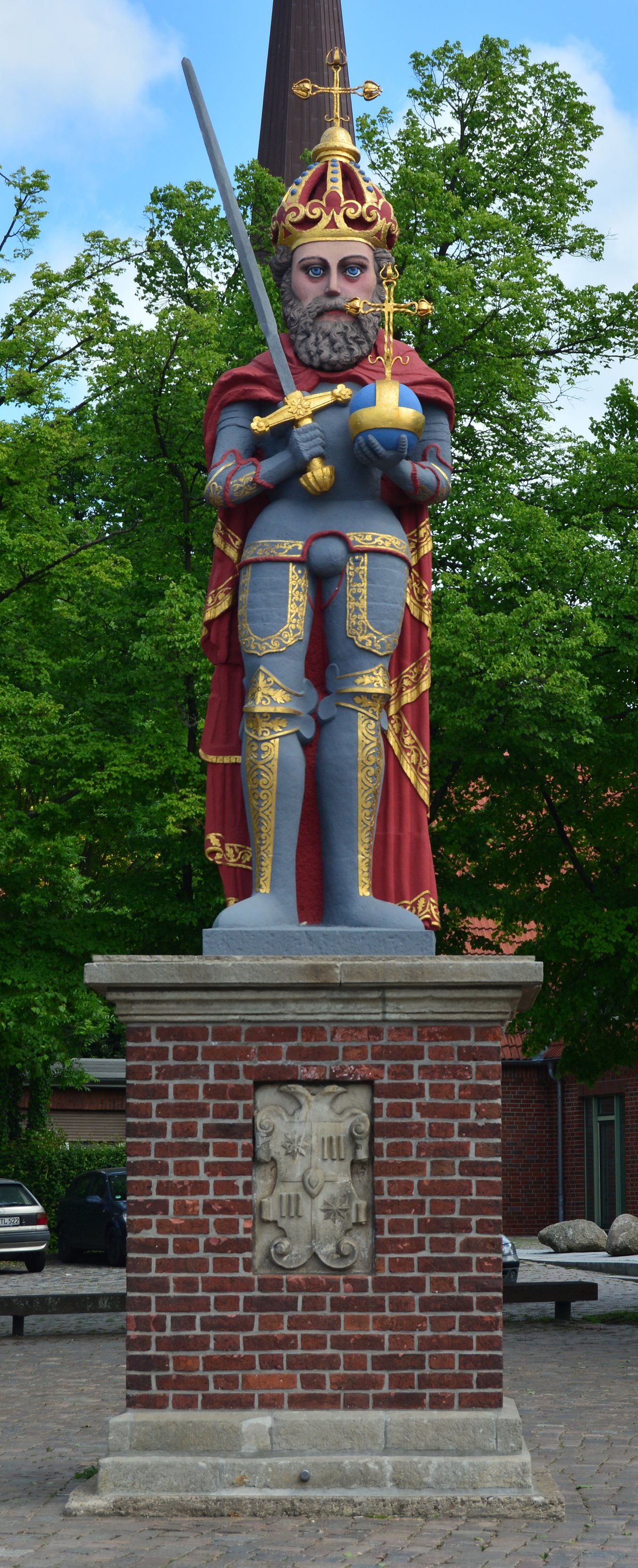
The Roland of Wedel stands as a silent guardian of the marketplace, a polychromed nobleman in a Gothic plate harness, crowned and draped in a red cloak that flows into the very pillar supporting his weight. This towering figure of 4.5 meters is carved from 32 blocks of Obernkirchener sandstone.
He was not always so sturdy. A sandstone statue was erected in 1558 to replace a decayed previous marker. By 1652, the community of Wedel requested financial aid from the Danish King to re-erect the fallen statue. He granted them 100 Reichstaler on the condition that the people of Wedel perform the labor.
Time has left its mark on the sandstone. By 1692, a contemporary writer described the figure as an antiquity hurrying almost daily to ruin, sitting on a weathered, grass-grown masonry base with broken frieze parts. During a restoration between 1835 and 1836, the statue was painted uniformly grey because funds were insufficient for a colored finish.
Today, the Roland stands in his full, vibrant colors. His sword, crown, and the crosses on his imperial orb are forged from wrought iron. The base features a round sandstone relief from 1856 and a heart on the coat of arms that likely replaced the traditional Schauenburg nettle leaf during repairs in the 1840s.
Sources: Wikipedia, OpenStreetMap, Wikidata, Wikimedia Commons
Written by Aurora
Discuss this with the author and others
No comments yet. Be the first to start the conversation.