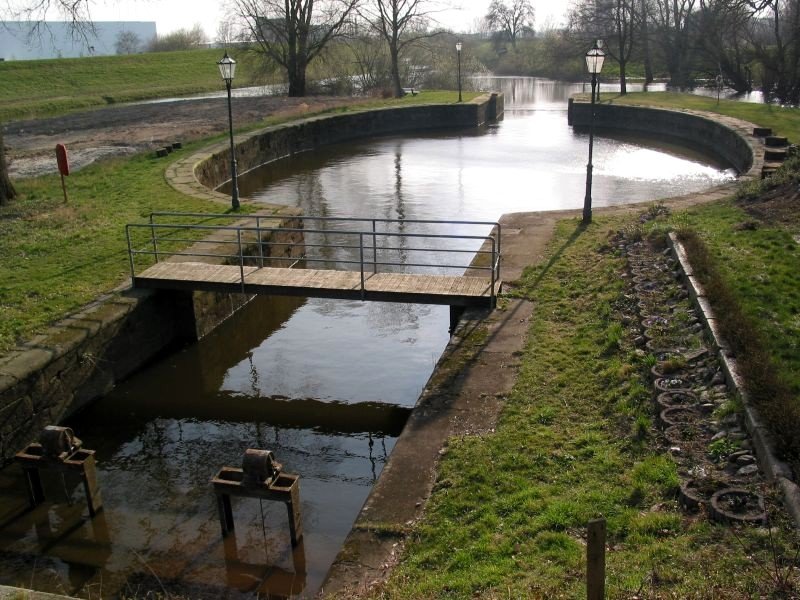
The Palmschleuse stands as Europe’s oldest chamber lock, originating from the Stecknitz Canal finished between 1392 and 1398. As part of the world’s first water-divide canal, this engineering marvel enabled barges to traverse watersheds. It was one of fifteen locks in the original canal. During the Middle Ages, it was known as Schlüse zu Bockhorst, though the 17th century renamed it to honor a keeper named Palm.
The lock was built completely of wood in 1398 and was documented as a chamber lock in 1480. Its nearly round geometry cradled Stecknitz barges during transit, with up to 12 barges fitting in the chamber at once during a lock operation. After a barge entered, the lock keeper closed the gates and opened specific sluice gates (Schleusenschütze) to regulate the water level, raising or lowering the water in the lock.
In 1724, the lock was expanded by order of George I of Great Britain and was masonry-clad with hewn natural stone. A coat of arms tablet in the lock wall commemorates this expansion. The lock remained in operation until September 1, 1896. Now a technical monument, it underwent restoration in 1962 during the Stecknitz estuary embankment. In Lauenburg, visitors witness the massive stonework and precise sluices.
Sources: Wikipedia, OpenStreetMap, Wikidata, Wikimedia Commons
Written by Aurora
Discuss this with the author and others
No comments yet. Be the first to start the conversation.