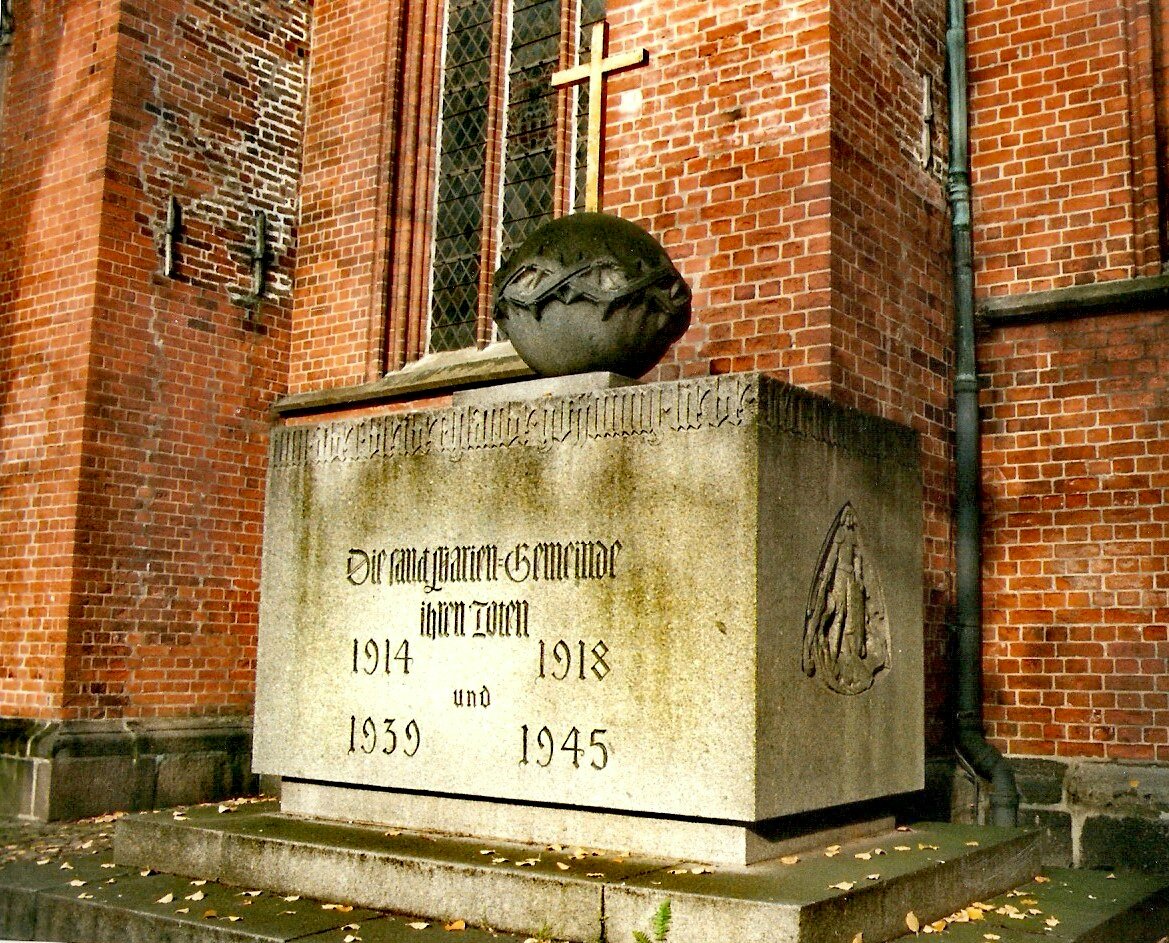
The stone here belongs to a specific community rather than a city. In the 19th century, monuments in Lübeck generally honored the fallen of the whole municipality. By the time the St. Marien community began preliminary work on their memorial in 1920, the focus had shifted. Reflecting the separation of the municipal and church communities after the end of sovereign church government, the memorial focused only on the dead of the specific church community - a total of 318 fallen members.
Designers gathered their thoughts and submitted nearly fifty different visions for the space. A public competition saw 38 applicants offer 48 designs, which the church displayed in the Bürgermeisterkapelle for the public to see. A jury narrowed these down to three concepts, including the 'Pyramide der Toten.' Yet, none of these finalists were eventually chosen, and negotiations with the top candidates failed. Instead, the church board chose a memorial for the exterior of the church by local sculptor Hermann Joachim Pagels.
There were also moments of high drama during the selection process. The church once considered an expressionistic sculpture of a crucified Christ by Ludwig Gies. It caused such a scandal in the Lübeck Cathedral that the figure was eventually decapitated. Following this, the community moved forward with the exterior project. The final memorial project was completed through particularly accelerated work in the final weeks of 1929.
The procurement of the stone was a matter of logistical friction. The church looked to Bavarian, Baden, and Saxon quarries, but those inland works refused the order due to the difficulties of transport. The community eventually turned to the Karlshälla Works near Karlshamn, Sweden. The granite was chosen because it would eventually darken to match the color of the church's 13th-century foundation stone. The light grey stone, mixed with mica, reflects the evening light.
The block arrived in the port of Lübeck on June 25, 1929, aboard the motor vessel Henny after a three-day voyage. It took a 40-ton crane perched on the tip of the Wallhalbinsel to lift the stone, which weighs 23,000 kg and has a volume of approximately 7.6 cubic meters. The memorial was inaugurated on Totensonntag in 1929, marking the completion of a project that began in 1920.
Sources: Wikipedia, OpenStreetMap, Wikidata, Wikimedia Commons

Written by Aurora
Discuss this with the author and others
No comments yet. Be the first to start the conversation.