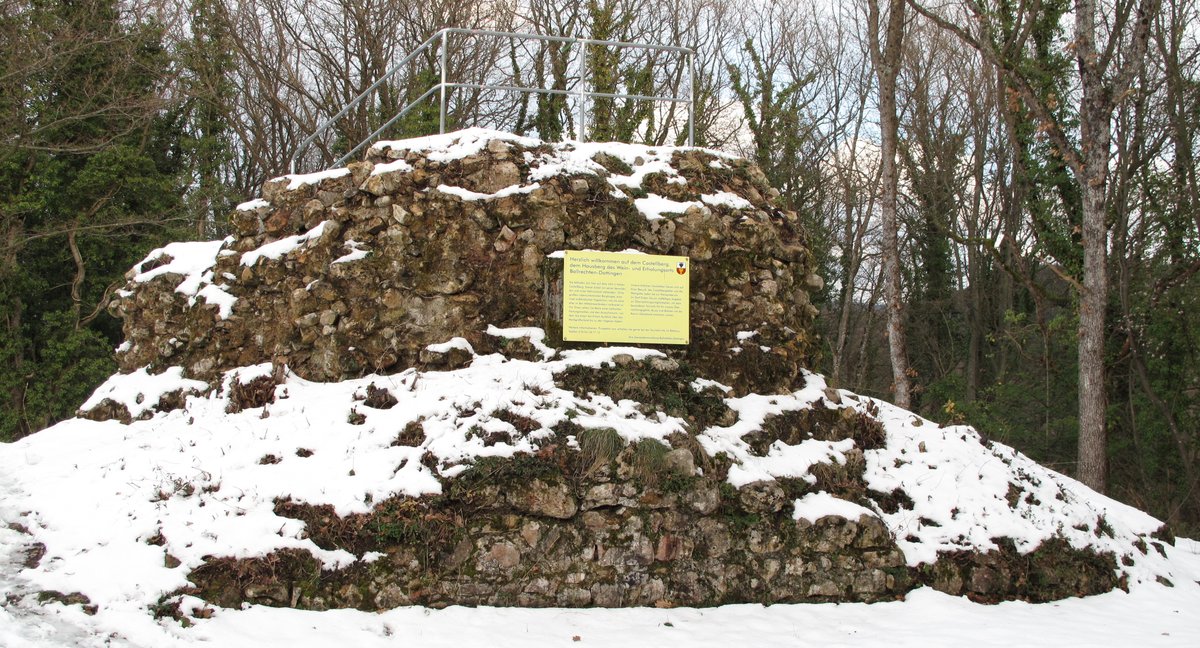
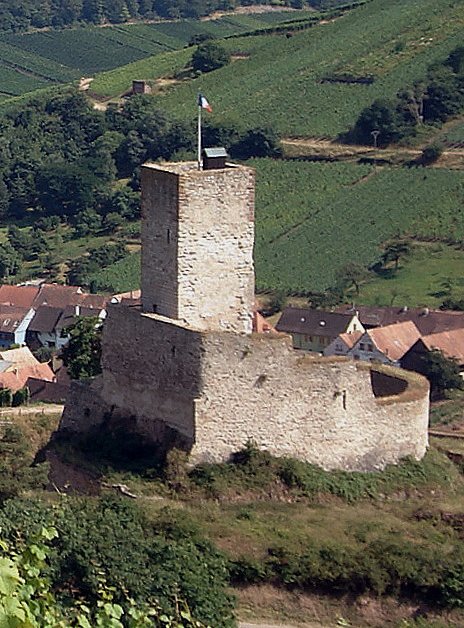
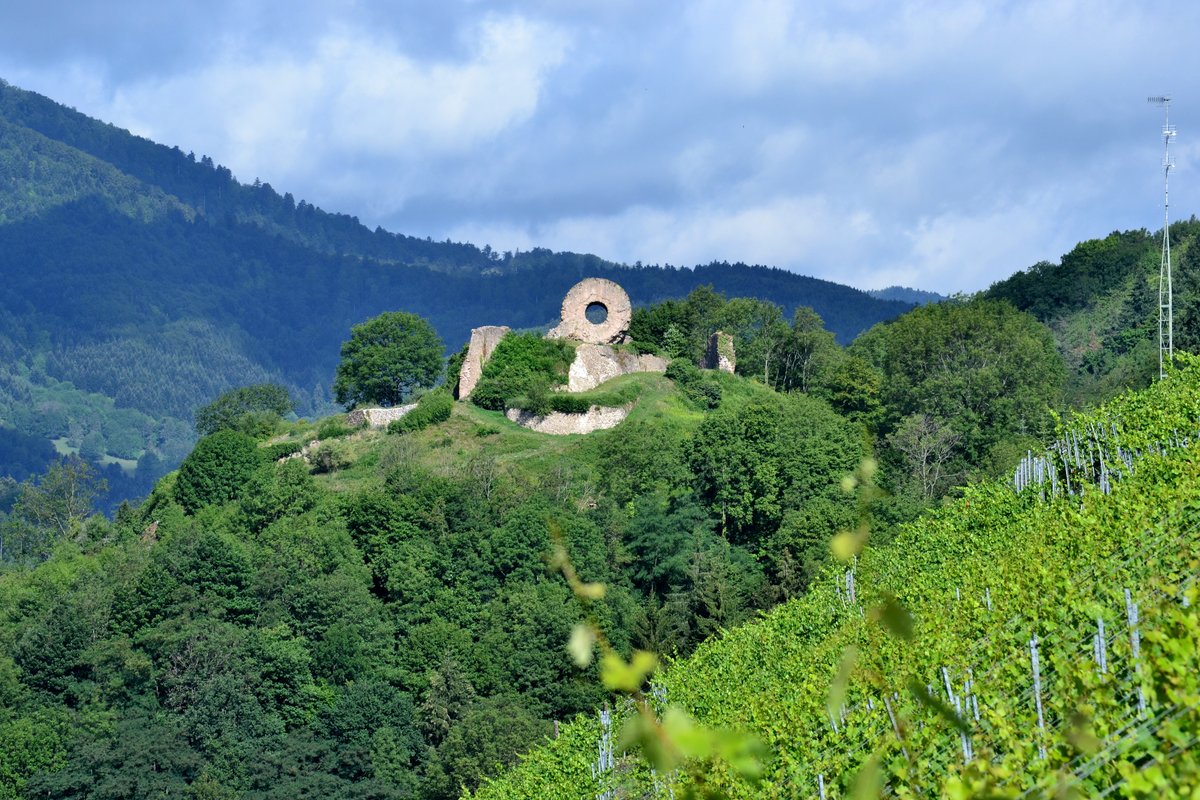
A stump of a tower remains on the gentle summit of the Castellberg, its masonry 3.6 metres thick. This is the ruin of a hilltop castle built in the 12th century, perhaps by the Lords of Üsenberg. It sits on a rectangular plateau of about 36 by 16 metres, cradled by a dry moat that drops seven metres into the earth. Inside the northern part of the ruin, the interior shows lining made of regular limestone blocks up to 0.5 m large, standing as a heavy record of medieval masonry.
Long before the medieval lords arrived, the mountain served as a place of shelter. Pottery shards found in the soil prove that people lived here during the Bronze Age, the Urnfield culture, and the Hallstatt period. The entire mountain was fortified with a wall system in prehistoric times, marking it as a site of long-standing significance. There is a section wall with a preceding ditch nearby, a remnant of a prehistoric settlement that might have functioned as a Celtic Fliehburg, or refuge castle. While other internet claims suggest a Roman settlement on the mountain, this has not been confirmed.
The mountain's southern and western slopes have been sculpted by human hands for over a millennium. Vineyards have occupied these sunny reaches for more than 1,000 years, with the layout remaining largely unchanged since 1784. Steep stone stairs and dry stone walls climb the slopes, providing access to the sandy, calcareous loam where Gutedel, Müller-Thurgau, and Gewürztraminer grapes grow. These terraces are more than just agriculture; they are a preserved landscape where the work of the 18th-century Margrave Karl-Friedrich still dictates the curve of the land.
Nature holds its own territory in the uncultivated pockets of the reserve. Rare woodland and semi-dry grassland communities host the Flaumeichen and Dürrwurz, while several orchid species, including the Nestwurz and Pyramidenorchis, bloom in the quiet places. The Grasshopper Warbler and the Woodchataczek are frequent visitors to these heights. Just 500 metres northeast of the castle stands the Gerichtseiche, a court oak over 400 years old, which remains a landmark of the local landscape.
Today, a steel observation tower stands near the ruins, its structure inaugurated in 1962 by the local group of the Schwarzwaldverein. From here, the view stretches across the Rhine plain and the Markgräflerland. The castle ruins and the tower are open to everyone, offering a path that follows the ridge for 2.5 kilometres. It is a place where the medieval keep, the prehistoric walls, and the ancient vineyards meet.
Sources: Wikipedia, OpenStreetMap, Wikidata, Wikimedia Commons
Written by Aurora
Discuss this with the author and others
No comments yet. Be the first to start the conversation.