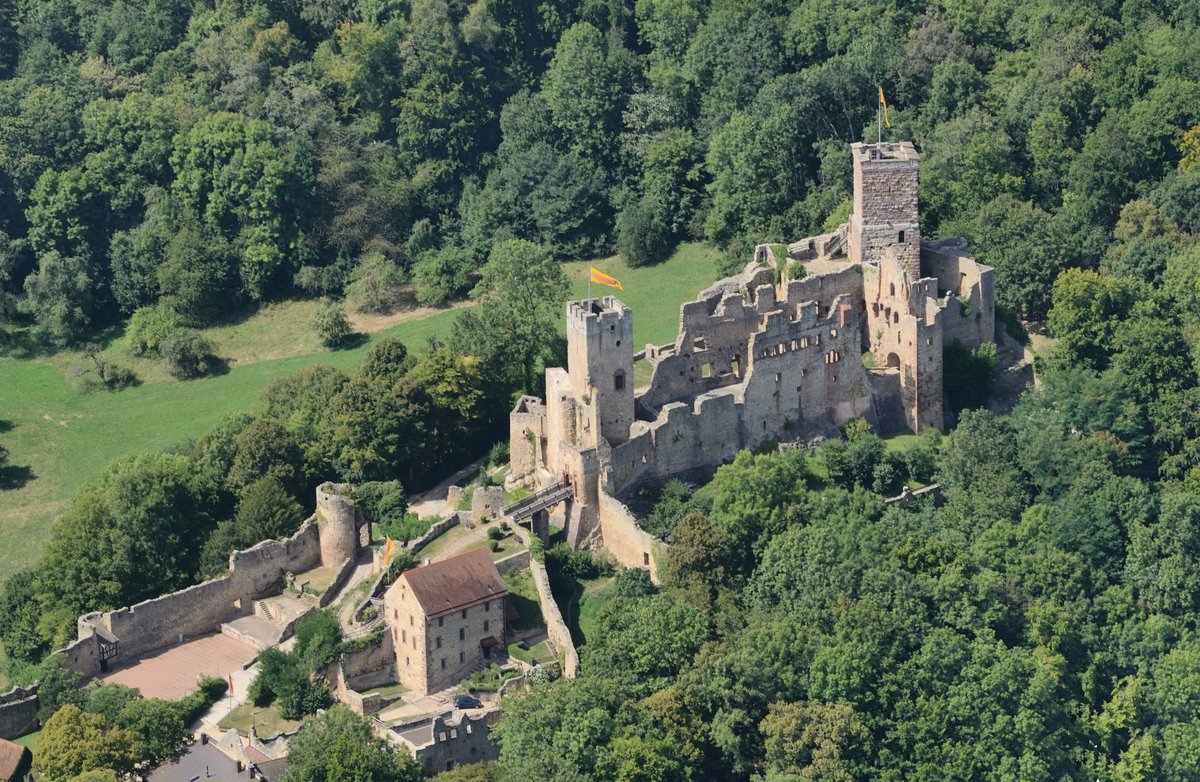
The castle remains on a wooded hill 422 metres above sea level, a jagged silhouette above the Lörrach suburb of Haagen. It sits on a spur projecting from the east side of the lower Wiese valley, holding a position that was among the most powerful in the southwest. Today, it is the third largest castle ruin in Baden, but its silence is the result of a violent, deliberate destruction.
History here began in the shadows of the 11th century. Dietrich von Rötteln, a bailiff of St. Albans near Basel, is first mentioned in 1102. The first documented mention of the castle itself arrived in 1259, centuries before the lordship passed from Luithold II von Rötteln to Margrave Rudolf I of Hachberg-Sausenberg in 1311. The Margrave Rudolf I moved his seat here from Sausenburg Castle to manage his new lands more closely.
The stones have felt the heat of siege and the tremor of the earth. In 1332, the people of Basel marched against the Margrave Rudolf II after he stabbed the city's mayor during a heated argument. Arrowheads and crossbow bolts found in the earth today are the physical debris of that sudden violence. Then came the Basel earthquake of 1356, which shuddered through the valley and broke large portions of the castle's structure. The fortress remained a place of high dignity, welcoming guests like Duke Philip the Good of Burgundy in 1454, and hosting the production of tapestries in 1474.
War eventually eroded the walls more than the earth ever could. During the Thirty Years War, the castle belonged to the Protestant Frederick V of Baden-Durlach, who was an ally of the Swedish King Gustavus Adolphus. In May 1633, Imperial forces led by Ernesto Montecuccoli took the castle, only for a Swedish-Protestant army led by Otto Louis of Salm-Kyrburg-Mörchingen to reconquer it in July 1633. In 1638, French-allied mercenaries led by Bernhard of Saxe-Weimar conquered the site, inflicting severe damage on the masonry. But the final blow came in 1678. François de Créquy, a Marshall of King Louis XIV, raided the region. His troops attacked with kartouwen and, following a scorched-earth policy, burned the castle to the ground.
After the flames died, the ruins became a quarry. For centuries, the site served as a source of building stone for the surrounding area. It was not until 1884 that the Black Forest Society of Baden began to survey the remains as a site of heritage. Since 1926, the Röttelnbund e.V. club has looked after the ruins, preserving the layout of the fore-castle and the upper castle, separated by a drawbridge.
Visitors today walk through a space that spans almost 300 metres from northwest to southwest. The woods have reclaimed much of the land, but the layout of the old defenses remains visible. You can trace the path of the old lords and the marks of the French fires, seeing a structure that was purposefully unmade so that nothing could remain for an enemy.
Sources: Wikipedia, OpenStreetMap, Wikidata, Wikimedia Commons
Written by Aurora
Discuss this with the author and others
No comments yet. Be the first to start the conversation.