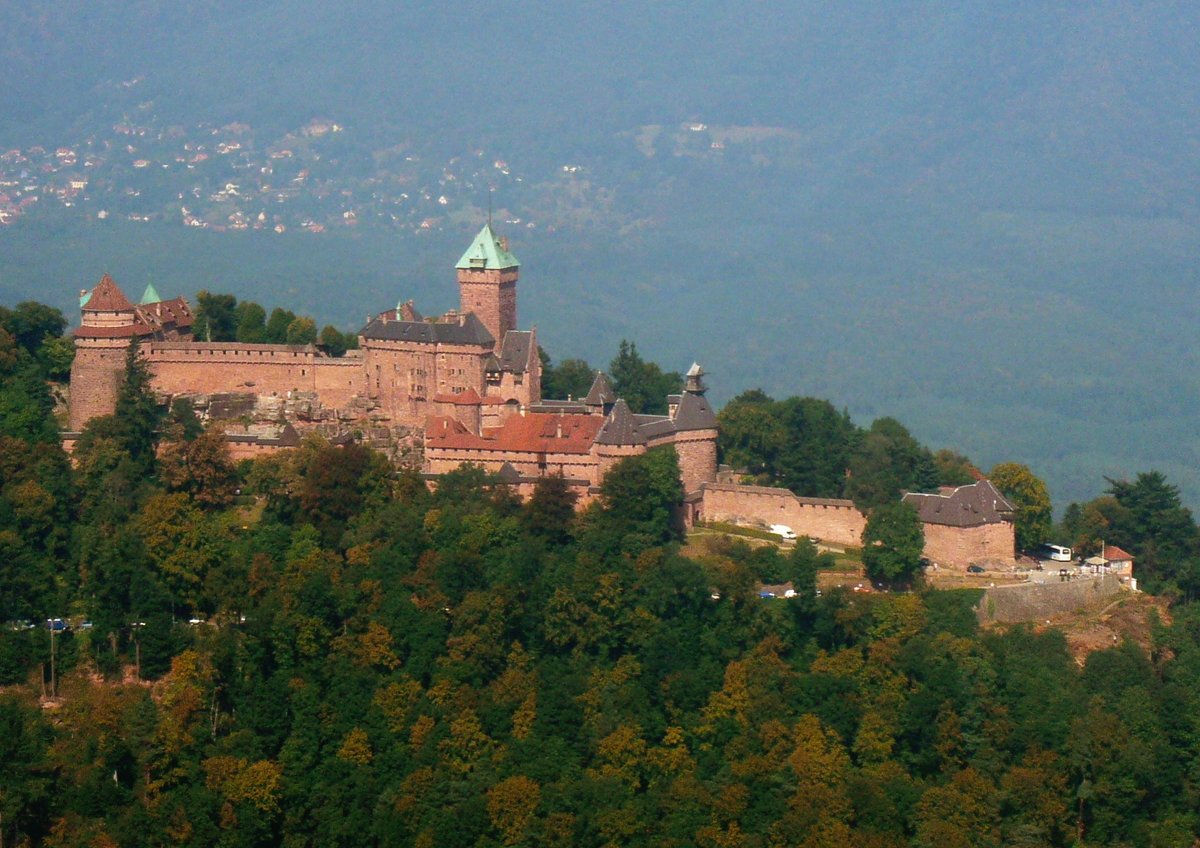

The Château du Haut-Koenigsbourg, perched on a rocky spur over the Upper Rhine Plain, is no stranger to destruction. First recorded in 774 AD, it was a monastery under the French Basilica of St Denis until 1147, when the Hohenstaufen Duke Frederick II of Swabia built a castle here, named Kinzburg. A century later, it changed hands to the Dukes of Lorraine, but by 1454, the Fortress was occupied by Elector Palatine Frederick I. A religious fire in 1462 damaged the castle significantly, but it was not abandoned until the Thirty Years' War in 1633.
In 1479, the castle was given as a fief to the Counts of Thierstein, who rebuilt it with a new defensive system, only for the last Thierstein to die in 1517, leaving the castle to the Habsburg emperor Maximilian I. The castle changed hands a few times during the 16th century, eventually returning to the Habsburgs, who finally let it fall into ruin once more. Three hundred years of decay passed before Wilhelm II, the German kaiser, decided to revive the castle in the 20th century, turning it into a symbol of a romanticized German civilization.
Sources: Wikipedia, OpenStreetMap, Wikidata, Wikimedia Commons
Written by Nicolo Ciampini
Discuss this with the author and others
No comments yet. Be the first to start the conversation.