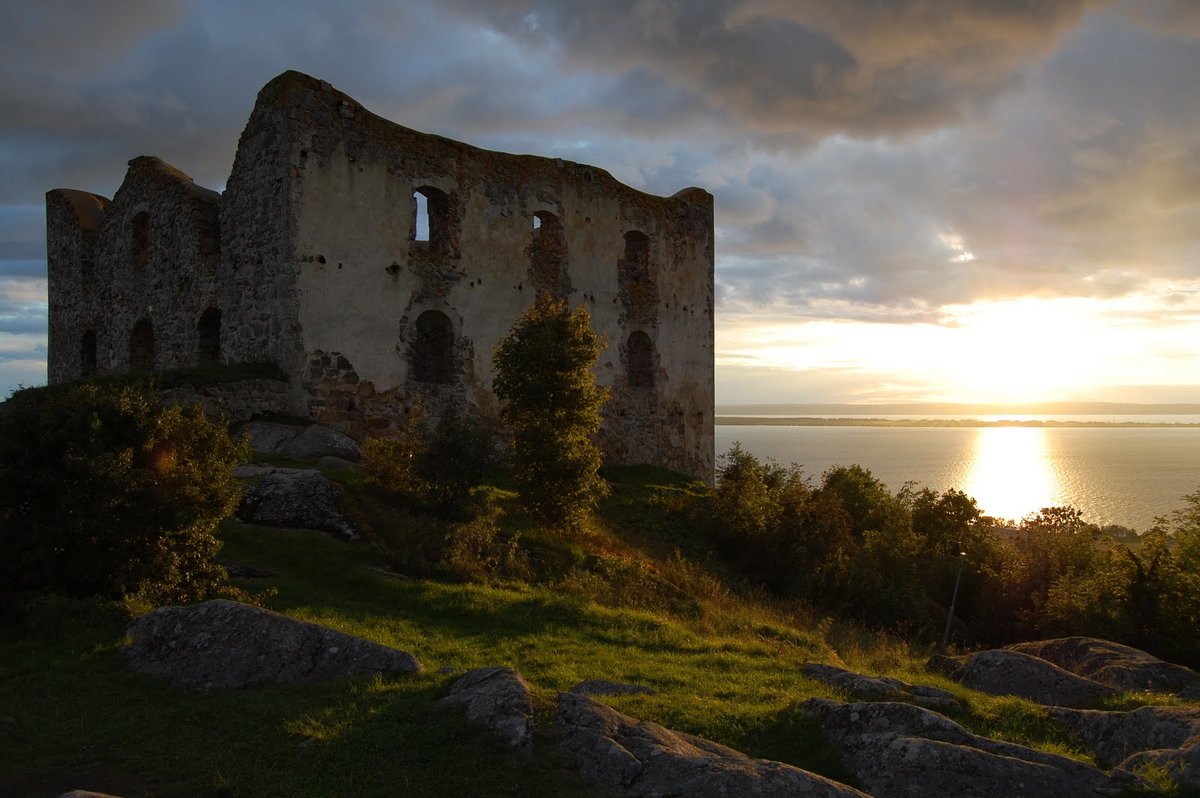

The ruins of Brahehus Castle, boldly colored and Renaissance-inspired, are located 3 km (2 mi) outside of Gränna in Jönköping County in the province of Småland, Sweden. Built for and named after Count Per Brahe the Younger in the 1640s, Brahehus initially served as a dower house for Countess Kristina Katarina Stenbock. Upon her death in 1650, the castle was repurposed as an entertainment venue for guests. The castle’s location harmonizes visually with two of Brahe’s other castles – Västanå Manor and Visingsborg Castle.
The castle consists of a square main building with two spired side towers. The northern tower housed twelve guards, weapons storage, and possibly a prison cell. The southern tower housed a well and likely also a kitchen. The main building was divided into two storeys and a cellar. The kitchen was on the lower floor, and halls and bedrooms were on the upper floor. Roof lanterns, surrounded by a balcony, were placed on the roof. The castle’s decorative features included brightly-coloured themes from the mythology of the Roman poet Ovid.
Brahehus was finished in 1651. Gränna was founded by Per Brahe the Younger in 1651 with its streets oriented towards the castle. Brahehus was confiscated to the crown in the Great Reduction of Charles XI in the late 1680s. A fire destroyed Brahehus in 1708. Today, Brahehus is a tourist destination, and the E4 motorway is located 50 meters from the ruins. The castle has been restored five times, the latest in 2011–2012. Interest in the castle ruins grew in the 19th century.
First plans for a restoration of the ruins were drawn up by the Royal Academy of Letters in 1891. The actual restoration was performed between 1911 and 1913.
Sources: Wikipedia, OpenStreetMap, Wikidata, Wikimedia Commons
Written by Nik Frost
Discuss this with the author and others
No comments yet. Be the first to start the conversation.