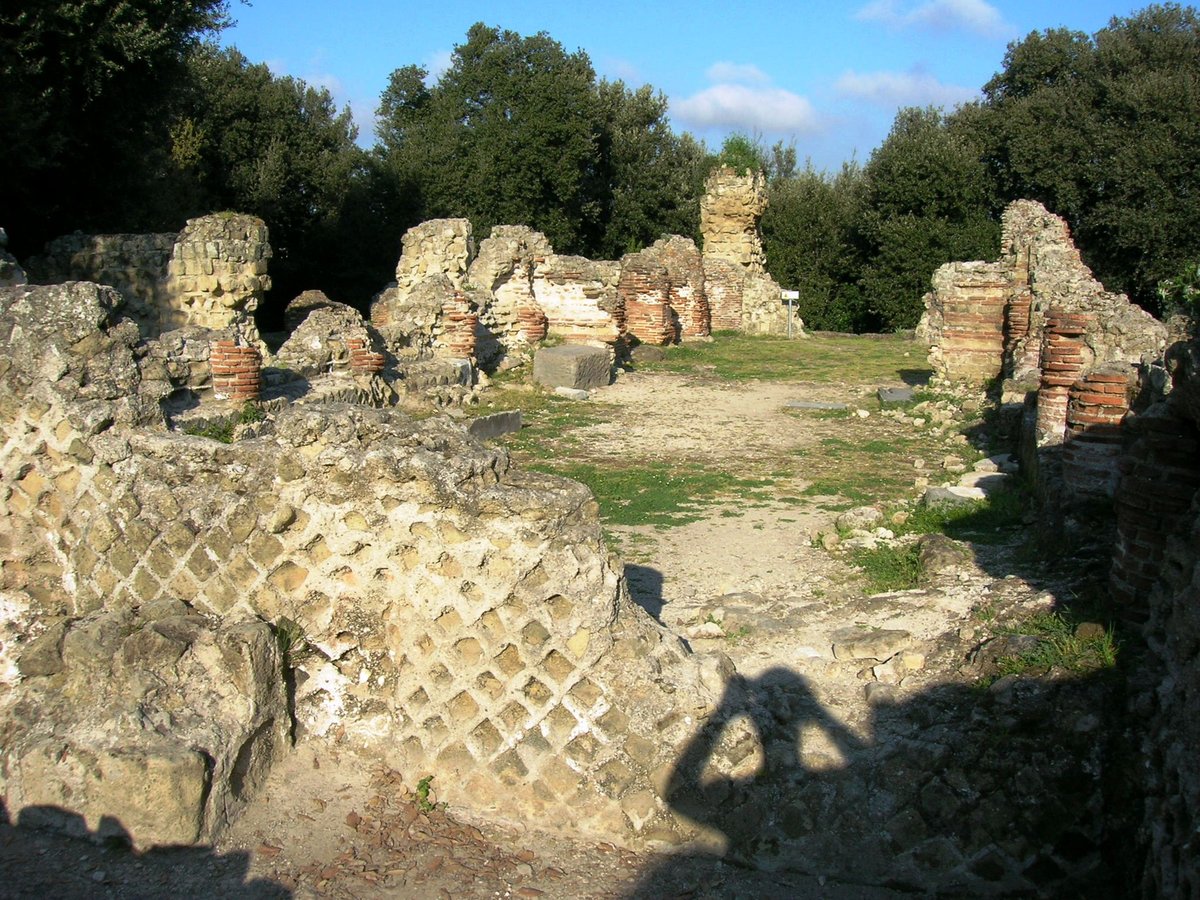

Upon Cuma's lofty crest, we find the Temple of Jupiter, a structure that's racked up more lives than most. Originated as a homage to Demetra by the Cumans in the 6th or 5th century BC, it met an odd twist in destiny when it was transformed into a temple for Giove at the end of the 1st century AD. Yet, the Temple of Jupiter refused to hang its hat, morphing into a Christian basilica christened San Massimo Martire in the Roman era. It served as Cuma's cathedral until the 13th century, only fragments of the original Greek temple remaining. With a pseudo-periptero boasting a length of 39m and a width of 24m, its orientation shifted from south to north during the Roman period. What was once a grand structure with three openings and five naves, partitioned and adorned with semicolumns, niches, altars, and fountains, now stands as a silent sentinel, a riddle yet unsolved.
Sources: Wikipedia, OpenStreetMap, Wikidata, Wikimedia Commons
Written by Nicolo Ciampini
Discuss this with the author and others
No comments yet. Be the first to start the conversation.