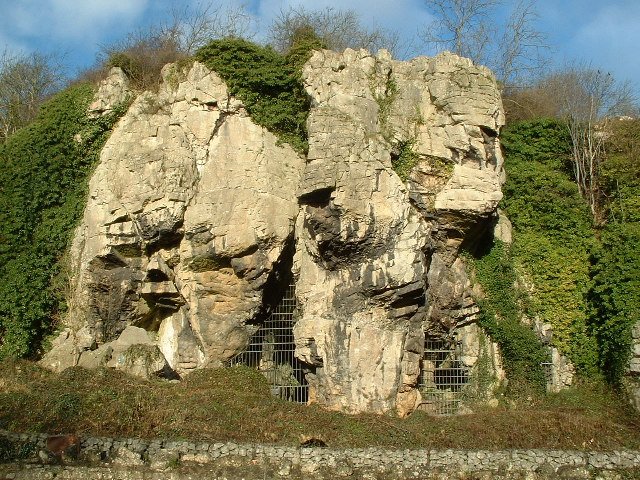

Creswell Crags is an enclosed limestone gorge on the border between Derbyshire and Nottinghamshire, England, near the villages of Creswell and Whitwell. The cliffs in the ravine contain several caves that were occupied by Neanderthals and modern humans during the Last Glacial Period, between around 60,000 and 10,000 years ago. The caves contain Upper Palaeolithic cave art, the northernmost cave art in Europe, with other Palaeolithic art objects having also been found in the caverns.
The caves contain occupation layers with evidence of flint tools including those of the Neanderthal-made Mousterian, and the modern human-made Lincombian-Ranisian-Jerzmanowician, Gravettian, and the eponymous Creswellian cultures. Mother Grundy's Parlour has produced numerous flint tools and split bones and was occupied until Mesolithic times, while Robin Hood Cave is the location of a bone engraved with a horse's head. Church Hole has more than 80 engravings on its walls and was occupied intermittently until Roman times.
The engravings were discovered in April 2003 and include representations of animals including bison and several different bird species, though some workers consider that the bird figures are more likely to be female anthropomorphs. The engravings are most likely contemporary with evidence for occupation during the late glacial interstadial around 13,000-15,000 years ago. The engravers seem to have made use of the naturally uneven cave surface and likely relied on early-morning sunlight entering the caves to illuminate the art.
Sources: Wikipedia, OpenStreetMap, Wikidata, Wikimedia Commons
Written by Nicolo Ciampini
Discuss this with the author and others
No comments yet. Be the first to start the conversation.