

Gegsky Waterfall (also known as the Circassian Waterfall) is a waterfall in Abkhazia about 70 meters high (according to other sources, 50–55 m). It is located in the northern spurs of the Gagra Range at an altitude of 530 meters above sea level, on the side of the Gega River valley, six kilometers from the confluence with the Yupshara River.
The Gega River, 25 km long (the largest right tributary of the Bzyb River), flows through a narrow and very picturesque gorge, forming numerous rapids and waterfalls along its course. In one section, part of the river disappears into a karst fissure (this cave-fissure is called the Circassian Waterfall) and, after traveling a long way through underground corridors and grottos, plunges down as a waterfall.
From the point where the water emerges to the surface into the mountain, there extends a cave with a total length of 315 m, with an elevation difference from the entrance to the highest point of 100 meters. The cave was explored by Siberian speleologists in 1984.
The water in the waterfall is icy cold, and at the foot of the mountain from which the water mass falls, snow usually lies until the end of summer. To the left of the waterfall, there is a grotto formed by water emerging from side fissures. The water from these fissures is renowned for its purity, and it is from here that drinking water is taken. The height of the grotto’s opening is about 15 meters, and its width is 35 meters.
During the filming of the movie "The Adventures of Sherlock Holmes and Dr. Watson," the scene of Holmes’ fight with Professor Moriarty was shot against the backdrop of this waterfall (not the Reichenbach Falls).

How it happened.
Once in a Lenfilm café, stuntman and stunt coordinator Nikolai Vashchilin met with director Igor Maslennikov. Over a cup of coffee, he was invited by Maslennikov to join their conversation with artist Mark Kaplan about the new Sherlock Holmes film. They started with an informative question – what is baritsu wrestling? As a USSR master of sports in sambo and judo, Vashchilin was expected to know.
Nikolai Nikolaevich honestly admitted he had never heard of such wrestling. He had only read Conan Doyle’s "The Hound of the Baskervilles." But he dared to suggest that the ending "-tsu" in "baritsu" might indicate Japanese origin. Well-known Japanese fighting styles judo and jujutsu, familiar in Russia, supported this idea.
Operator Yura Veksler, who joined them, confirmed his guesses and promised to find the story where he had definitely read about baritsu’s Japanese roots. The story was called "The Empty House." There was no doubt about this, as at the end of the 19th century, Japanese martial arts were very fashionable in Europe.
Requests at the Public Library yielded nothing. Professor Ivan Edmundovich Kokh of the stage movement department at LGITMiK and Professor Konstantin Trofimovich Bulochko of the Lesgaft Institute’s martial arts department regretted that the great French boxer and fencer Ernesto Lustallo was no longer among them, as he would surely have given a precise answer. Nobody knew about baritsu wrestling.
Another important problem for the filmmakers was the final fight scene on the edge of a cliff, where Professor Moriarty, missing his step, falls into the abyss. The professor was to be played by Innokenty Smoktunovsky, so only his stunt double could perform the fall. But before discussing the double’s identity, Vashchilin reminded Igor Fyodorovich of a similar cliff-fall episode of Konstantin Raikin’s character in Nikita Mikhalkov’s film "At Home Among Strangers, a Stranger Among His Own."
Despite his participation in Mikhalkov’s film, they agreed that the same stunt would look uninteresting. Moreover, the seasoned criminal Moriarty should know a few cunning killing moves. At this pause of doubts, they decided to discuss everything on location. A few days later, they were already heatedly arguing on the plane heading to the mountain peaks of Abkhazia.
After winding through the gorge by bus, the group arrived at the waterfall, still not awakened from winter hibernation. By then, Vashchilin began leaning toward staging the fight with English boxing techniques.
His prototype was the fight scene in the ring of Lord Byron from the 1972 English film "Lady Caroline Lamb," brutal and realistic. Maslennikov liked the idea but wanted the viewer to watch the fight with a certain irony—not the humor typical of Charlie Chaplin’s fights, but the subtle irony of people understanding the futility of what’s happening. As Rabindranath Tagore wrote:
"Yesterday here raged a battle,
The sand soaked with blood.
But who won in the end—
The morning breeze."
Vashchilin’s personal life experience of fighting evil, nurtured by sambo coach Alexander Massarsky, led him to believe that evil should destroy itself, run into an obstacle. This obstacle just needs to be timely presented. Reflecting and trying out the fight scheme, in which Igor Maslennikov and Mark Kaplan played the fighters, it became clear that such an exhausting fight on the cliff edge should bring the opponents to complete exhaustion. And the figure of Colonel Moran, finishing off the murderer of Professor Moriarty—Holmes—kept coming to mind.
Thus, the stuntman conceived the final phase of the deadly fight and the opponents’ demise. In his opinion, they should end the fight, locked together on the ground with their last strength, relentlessly rolling toward the cliff edge.
Here, Her Majesty Fate, siding with noble Holmes, would allow him, once below, to cling to the cliff stones, while Moriarty, seemingly successful, would straddle him from above. At least so that, locked together, they would drown in the abyss.
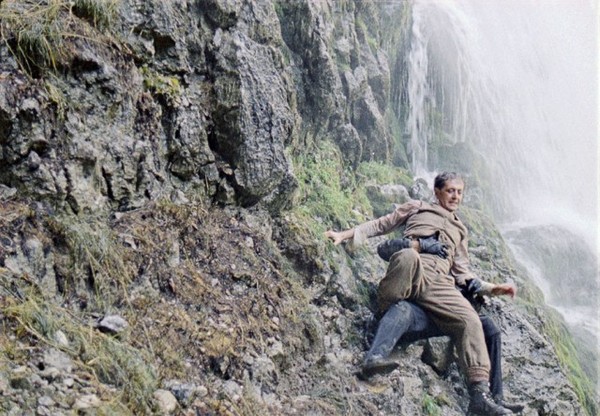
But Holmes’ clothing was an unreliable grip; it tore, and Moriarty slipped into the abyss alone, leaving the lucky Holmes on the rock ledges. Now he only had to outwit the tiger hunter by faking his death after the marksman’s accurate shots at the detective’s hands.
The finale was received with great enthusiasm. And that is the main thing in any endeavor. The end crowns the work. Now that it was clear how the fight would end, they could think about how it would proceed. First, how long. Second, at what pace. And third, with what techniques, revealing the characters of the opponents.
Now it was necessary to study the opponents’ characters, observe their natural plasticity, invent attack and defense techniques for the entire fight, and then train them to automatic execution. Essentially, to choreograph a dance, a pas de deux, in which they would demonstrate their characters, intrigue the audience, and reach a finale that would elicit a cry of joy for the beloved hero. Vashchilin’s assistants Igor Maslennikov and Mark Kaplan, unfortunately, could not help him in these cliff-edge searches, and everyone returned to Leningrad. Vashchilin took with him only a precise idea of the quality of the ground underfoot, the many slippery stones on it, and its outline up to the safe zones.
Back in Leningrad, Vashchilin gathered stuntmen from the Theater Institute, where he had the honor to serve as an associate professor, and began rehearsals.
The fight’s rhythm was divided into two parts. In the first, attacks were lightning-fast and decisive, full of the desire for a quick and crushing victory. Moriarty attacked first, suddenly and treacherously, and was surprised that he could not quickly achieve his goal and win.
This disarmed him. Holmes, like a wall from which hostile bullets ricochet, deflected attacks without delivering decisive counterblows.
In the second half of the fight, interrupted by a distracting maneuver by Moriarty to divert Dr. Watson, the opponents, quite exhausted and in torn clothes, engaged in a positional, drawn-out struggle for a more advantageous position relative to the cliff edge that inevitably awaited them.
Having estimated the approximate time and selected a number of suitable techniques, Vashchilin began rough rehearsals.
At the same time, he involved his old acquaintances, climbers Volodya and Yura, who had worked with him on Andron Konchalovsky’s "Sibiriada," and assigned them to practice the stuntmen’s and actors’ safety techniques in the Moriarty cliff-fall scene. In the preparation workshop, according to his drawings, they began making a doll of Professor Moriarty with jointed connections in the arms and legs, roughly human weight.
Such a doll, thrown by climbers from the top of the waterfall and falling in the water streams, was intended to perfectly imitate Moriarty’s body hitting the rocks. Performing such a stunt by a stuntman seemed absolutely pointless to him.
Igor Maslennikov visited rehearsals. At rehearsals, he saw Viktor Evgrafov, who had acted for him in "Yaroslavna, Queen of France" as a monk and had not impressed him much. The images embodied by the stuntmen in the fight increasingly pleased Igor Fyodorovich.
When Vasily Livanov appeared at rehearsals in the Theater Institute hall, paired with Vitya Evgrafov, they looked very expressive. Maslennikov first approved Evgrafov as a double, then for the role of Professor Moriarty.
As a result of rehearsals and searches, by September a complete fight scheme was formed. By the end of rehearsals, it was decided to abandon boxing punches, as they required a prepared site and quick distance changes.
Lightning-fast throws for deadly grabs, grappling for a favorable position relative to the cliff edge, freeing from grabs with strikes to pain points, and headbutts—this was the arsenal of the duel between two implacable enemies representing two schools: the attacking, aggressive school of the English criminal world and the school of Eastern wisdom and cunning intellect, quite fitting for the hieroglyph of Conan Doyle’s language "baritsu."
In October, the entire film crew of "The Adventures of Sherlock Holmes and Dr. Watson" arrived in Pitsunda. They settled in a boarding house by the sea. Almost without disturbing the shooting of other episodes involving Vasily Livanov, they rehearsed daily.
In the morning—a one-hour physical conditioning workout, using running on sand and swimming in the sea. And a mandatory threefold repetition of the entire fight scheme at a slow, or rather comfortable, pace.
In the evening, after the shooting day—a one-hour training of fight techniques by individual moves, and at the end—a full fight scheme at maximum speed and load. Then, when darkness fell, a relaxing swim in the warm sea. Water wears down stones, time heals and teaches.
After a month of training, the actors began to suggest introducing new, more complex techniques. Vashchilin forbade these innovations at a certain stage, causing their dissatisfaction and irritation. Especially restless Viktor Evgrafov. Vashchilin’s task was to develop such automatism and speed in them that professionalism would be visible in their moves. The filming method of this scene and its significance, as indicated by the director, did not allow using professional athletes as doubles. Stuntmen only demonstrated exemplary execution of techniques and insured the actors.
Sometimes director Grigory Prusovsky gave them a bus, costume designers, makeup artists, and everyone went to rehearse on the shooting location in the gorge, at the "Reichenbach Waterfall." Vashchilin filmed the most interesting fight phases and angles on his "Salut" camera to later show the operator and director. When the stunt coordinator felt the actors’ patience was at its limit, he ended the rehearsal.
Once the group arrived after heavy rains and were stunned by the spectacle. The waterfall poured down like Niagara. The site was wet from water. It was impossible to step on the rock ledge where the actors hung. Costumes soaked through in a minute. Makeup ran and streamed down cheeks.
But it was magnificent. It created such an atmosphere that could not be acted out by anything. Neither Stanislavski nor Nemirovich-Danchenko. Vashchilin insisted on shooting.
The knife appeared the day before. According to the shooting plan, it was a day to familiarize with the site. But Igor Fyodorovich decided not to waste the moment and filmed several shots of the opponents preparing for the duel.
Holmes wrote a note to Watson, warmed up his shoulders and wrists for intricate finger jabs to pain points in baritsu style.
Moriarty generously parted with his non-felt hat, hinting to Holmes and the viewers how deep the abyss was.
And here Maslennikov decided to emphasize the professor’s treacherous character by having Holmes, like a clairvoyant, guess that Moriarty had a knife. The idea struck with its simplicity. Let him cut and stab Holmes with the knife, and Holmes uses baritsu fighting techniques against the knife.
But Vashchilin rebelled. It was hard to imagine how such improvisation could end! They decided that Moriarty would twirl the knife and magnanimously throw it into the abyss. Like an honest man!
Only his swift flight was not captured by the operator.
The next morning, October 29, the group arrived at the hotel, and Vashchilin went to Livanov’s room. Vasily Borisovich was in bed, suffering from a fever. His nose was running like a bucket. Maslennikov came and decided to cancel the shoot. Vashchilin got down on his knees. It worked.
He understood that such a coincidence of circumstances might not happen again soon. And, as always in cinema, they would have to make do with what was available. And everyone went to the deadly fight. To the fight with rain, with water streams, with melting makeup, wet costumes, splashes into the camera, with wet slippery rocks.

The driver cursed the director, winding along the wet serpentine. Maslennikov waited—what would happen. After all, it’s never too late to cancel shooting. In those glorious times, scenes were finished even a year later. State money was not very economized.
A fine drizzle fell. The group sat in the bus. Everyone began rehearsing in tracksuits.
Most of all, the director was worried about the phase of Evgrafov’s imitation of losing balance and recovering into a fighting stance for attack. At such a tense moment, Evgrafov declared he would not do it, that he didn’t like it, and generally...
Generally meant that Vashchilin was a fool and he was the boss here. Nikolai Nikolaevich hissed a threat. Livanov supported him. Together they broke him down. An hour later, he came around.
Motor! Camera! Action!
They filmed the scene where Moriarty throws the knife. Then throws the hat. And here is Moriarty’s first deadly throw with a throat grab. Bad. Weak. Unexpressive. No swiftness, no power. And most importantly—the treacherous suddenness of the criminal world’s professor. Five takes—into the bin.
The director told him he was not Moriarty but Little Red Riding Hood. He had it on his head with an "Adidas" emblem. It worked flawlessly. Evgrafov lunged like a panther, almost knocking Livanov out of the frame. Livanov freed himself from the grab with jabbing strikes to the subclavian area. This was a pure symbol. But bright, clearly readable on screen.

Another throw—a tense struggle in a block, Moriarty’s headbutt to Holmes’ face. This is a greeting from the London criminal world. A typical hit from gangsters worldwide, especially English boxers.
Lapshov filmed everything close-up. The actors’ faces were clearly visible, and the hint that they stood on the cliff edge where Moriarty’s hat had just flown off was created by the waterfall’s streams in the background. Again a throat grab, and again a release by twisting the hand behind the back. Here a wide shot and loss of balance on the cliff edge. But Moriarty held on and was ready to fight again.

Here Evgrafov takes revenge on Vashchilin and exaggerates a stance resembling karate style. Better to stand in a boxing stance. Moriarty and the East—these themes are incompatible. He should create the image of the London criminal underworld. Moriarty’s stance should hide his plans and make the attack sudden. As it was done in the first shot. Or did he and Holmes attend the same baritsu wrestling class?
A little rest, hot tea, nose drops for Holmes, and, of course, a cigarette in the mouth. The costume designer dropped her knitting and ran over with her assistants. They fixed makeup, changed costumes.
Vashchilin dressed in Holmes’ costume, preparing to double Vasily Borisovich in wide shots of ground fighting, flipping and throwing Moriarty. They set the internal montage of the subsequent cliff-fall scene.
While the actors rested, they filmed the doll’s fall.

Under pressure from Maslennikov and Sergeev, Lapshov set up two cameras. An unheard-of luxury for that time. After all, an operator should be behind the camera.
But where to find one? Lapshov trusted assistants. One camera filmed almost frontally, the other slightly from the side. Administrator Zhora Mautkin went up the mountain with climbers, carrying a flare gun.
Shouting was useless, even by radio, which, moreover, they did not have.
Motor! Camera! Instead of "Action!"—a flare.
The doll flew in the water streams, hit the rocks, bounced, flipped. Just like Moriarty. Now it remained only to pray that the film of this single take was not defective.
But they would only find out two weeks later when the film was developed at the Lenfilm factory. The place where the actors rested and filmed the doll would be inserted with a hotel conversation scene with the deceived Watson.
They began filming the continuation of the fight.
Holmes’ rear grab and push to the cliff edge. The scene was filmed near a rock, implying it was the cliff edge. For this, they filmed the cliff edge and the raging waterfall streams flying into the abyss. In editing, this would create a sense of danger for viewers.
Holmes, pushed from behind by the professor to the cliff edge, threw Moriarty by twisting and he dramatically slid on the pebbles. Moriarty, with manic persistence, lunged at Holmes pinned to the rock. Holmes put out his leg, stopping the attack, and headbutted Moriarty against the rock.
Throat grab, release by twisting the arm behind the back. If speaking of Eastern martial arts, these are aikido techniques. Although in aikido they came from the earlier Chinese fighting art—kempo.
They moved on to filming the fall from the cliff.
With God’s help, they filmed movement along a narrow ledge over the abyss. The stones were slippery. Safety was difficult. Nervousness grew. The director guessed the actors were afraid. He put on a climber’s harness and hung over the abyss himself.
The height was about ten meters. Enough not to return home. Climbers Volodya and Yura hung on safety ropes and performed a demonstration "fall." Nervous and coaxed, they prepared for shooting.
Safety ropes were passed under the costume and allowed free movement. But this freedom created the feeling of no safety, and falling into the abyss with this feeling was not for the faint-hearted. The waterfall lashed icy streams on the actors’ faces and backs. The noise was incredible. Not a word was heard. All communication was by gestures. Attention calls were made with a two-meter bamboo stick. Everyone forgot about makeup; it was all washed away.
The actors began to shiver from the cold. Allowed? Allowed. Now only hoping the film of this single take was not defective. But this too would only be known two weeks later when developed at the studio.
Motor! Camera! Action!
Livanov was the first to roll over the cliff edge into the abyss. Evgrafov lay on him, clutching him with his arms. Slowly, very cautiously, the actors rolled over the rock ledge and fell into the abyss. The safety ropes jerked. They hung.
Livanov’s hands grabbed sharp stones. Moriarty began to slide down. Holmes’ and Moriarty’s shirts tore, and Moriarty, falling off him, flew down in a pendulum arc, falling out of the frame. The safety held the actors over the abyss.
Stop! Cut!
P.S.: Time passed, a quarter of a century.
Famous fencing master Sergey Mishenyov, who revived baritsu wrestling in Russia, told Nikolai Vashchilin that at the end of the 19th century, this wrestling was quite popular in England. The then-new (once) martial art baritsu, created by Barton Wright at the very end of the 19th century, lasted only a few years. The baritsu academy closed already in 1903.
But it was in this year that Wright’s creation was destined to take a step into immortality. In Arthur Conan Doyle’s story "The Empty House," baritsu (according to Sergey Mishenyov, slightly misspelled as "baritsu") is mentioned as a mysterious Japanese wrestling style mastered by Sherlock Holmes himself…
Sergey told Nikolai Vashchilin that his English colleague, one of the world leaders of modern baritsu Tony Wolf, had seen their Holmes film and spoke very highly of the duel at the Reichenbach Falls, reflecting the unique style of baritsu fighting techniques.
Scenes from the films "Rikki-Tikki-Tavi," "Sportloto-82," as well as several scenes from the Georgian TV series "Berga" (based on Chabua Amiredjibi’s novel "Data Tutashkhia") were also shot here.
Sources:
https://ru.wikipedia.org/wiki/Гегский_водопад
https://dubikvit.livejournal.com/18414.html


Written by Jermaine
Discuss this with the author and others
No comments yet. Be the first to start the conversation.