Bolshoy Okhtinsky Bridge - Emperor Peter the Great Bridge

Bolsheokhtinsky Bridge, Bolsheokhtinsky Bridge, Saint Petersburg, Russia, 195112

The Bolshoy Okhtinsky Bridge over the Neva connects the Central District of Saint Petersburg with Krasnogvardeysky (Bolshaya Okhta). The ceremonial laying of the bridge took place on (June 26) July 9, 1909, a day before the celebration of the 200th anniversary of the Battle of Poltava. Therefore, the bridge was named in honor of Emperor Peter the Great.

The Bolsheokhtinsky Bridge across the Neva connects the Central District of Saint Petersburg with the Krasnogvardeysky District (Bolshaya Okhta). It is a three-span structure of a bascule system made of riveted metal constructions with a double-leaf drawbridge span in the middle. The side spans are covered with metal arch trusses with the roadway underneath. The drawbridge span is double-leaf with a fixed axis of rotation. The size of the side spans is 136 meters each, and the drawbridge span is 48 meters.

The total weight of the metal structures is 8,920 tons, including the counterweights of the drawbridge span weighing 1,065 tons. The bridge has two towers 36 meters high from the water level. Large mirrored lanterns were located on the upper platforms of the towers. Inside the towers are the mechanisms of the drawbridge span, and on the outside, memorial plaques with the names of the builders are installed. The bridge supports and the descent to the water are faced with granite.

The bridge lighting consists of 1,300 lamps.

In 1829, when the city’s master plan was being developed, Emperor Nicholas I approved the construction of a crossing near the place where the Okhta flows into the Neva. However, the plan was not implemented, and only a boat ferry was used.

The need to build a crossing began to be discussed as early as the 1820s, but due to lack of funds, the problem was postponed. The discussion about building a bridge, as well as the administrative annexation of Okhta to Petersburg, resumed only in the 1860s. There was a dispute about the location of the future crossing—each industrialist wanted the bridge to be built near his enterprise. The ferry and boat owners were categorically against its appearance—they did not want to lose their jobs.

A joking folk song even appeared:

"From under Smolny to Okhta
The ferry is very expensive.
Oh, how I carried my dear one
In my arms."

Thus, only in June 1884 did the City Council resolve the issue of building a bridge from Smolny Cathedral to the Creighton shipyard: “To recognize the Okhta suburb as subject to annexation to the city of Saint Petersburg.”

In 1860, Okhta was decided to be made an administrative district of the city. At the same time, the “Society of the Okhta Bridge across the Neva” was established. However, there was no consensus on where the bridge should be built: each industrialist argued that the bridge was needed near his enterprise, while the ferry operators, on the contrary, did not want to lose their jobs and obstructed the start of construction.

On June 5, 1887, the City Duma decided to build a bridge from the Smolny Monastery to the Creighton shipyard. But the final decision to build a permanent crossing was made only on January 22, 1900.

In September 1901, the City Duma announced an international competition for the design of the new bridge. Sixteen entries were submitted by engineers from Russia, France, Germany, the USA, the Netherlands, and Austria-Hungary. All projects were rejected for various reasons.

Eventually, a non-competitive project under the motto “Freedom for navigation” was accepted. It was developed by Professor Grigory Krivoshein of the Nikolaev Engineering Academy and military engineer Vladimir Apyshkov. The authors proposed to arrange a drawbridge span in the middle of the Neva channel, with the roadway suspended from the lower part of the bridge arches.

Thus, only in June 1884 did the City Council resolve the issue of building a bridge from Smolny Cathedral to the Creighton shipyard: “To recognize the Okhta suburb as subject to annexation to the city of Saint Petersburg.” Actual construction work began on June 26, 1909, on the eve of the 200th anniversary of the Battle of Poltava. This date easily explains the name of the future bridge—the Peter the Great Bridge—named after the emperor who emerged victorious from this famous battle. The ceremonial opening of the crossing took place on October 26, 1911. When talking about the construction of the bridge, it is important to mention one tragic event that significantly accelerated the process of the crossing’s appearance. On April 7, 1907, a disaster occurred: at the mouth of the Okhta into the Neva, the steamer "Arkhangelsk" sank after colliding with a small ice floe—at least 39 people died.


This tragedy caused a great public outcry, and on May 13, 1907, Nicholas II issued a resolution: “Do not delay the construction of the bridge.” And in September of the same year, the project was approved with minor modifications.

The city signed a contract with the Warsaw factory “Rudzki and Co.” to build the bridge in three years. The construction was supervised by Grigory Krivoshein. The drawbridge mechanism was manufactured by the Petersburg Metal Plant. To transport the spans weighing 3,660 tons each, the hulls of old battleships were used, converted into huge pontoons with water ballasting.

The ceremonial laying of the bridge took place on (June 26) July 9, 1909, a day before the celebration of the 200th anniversary of the Battle of Poltava. Therefore, the bridge was named after Emperor Peter the Great.

The crossing was ceremoniously opened on October 26, 1911, in the presence of the Minister of Internal Affairs of the Russian Empire, Alexander Alexandrovich Makarov. However, some construction work continued until 1913.

There is an interesting urban legend associated with the Bolsheokhtinsky Bridge. It is said that one of its million rivets is golden. The builders placed it for good luck, having previously covered it with a metal film, so to speak, for safety reasons. This myth has neither been confirmed nor, by the way, refuted during the entire existence of the bridge, so you can choose for yourself whether to believe it or not.

Strangely enough, the Bolsheokhtinsky Bridge has much in common with the Eiffel Tower. Both structures are made of metal constructions, with small fragments connected by rivets. Contemporaries criticized the bridge no less than Parisians once criticized the tower. The crossing seemed too bulky and even ugly to them—now the Bolsheokhtinsky Bridge is one of the most beautiful in Petersburg, and the Eiffel Tower has become the main symbol of the French capital.

In the outlines of industrial Petersburg, an inexperienced traveler could easily see London.
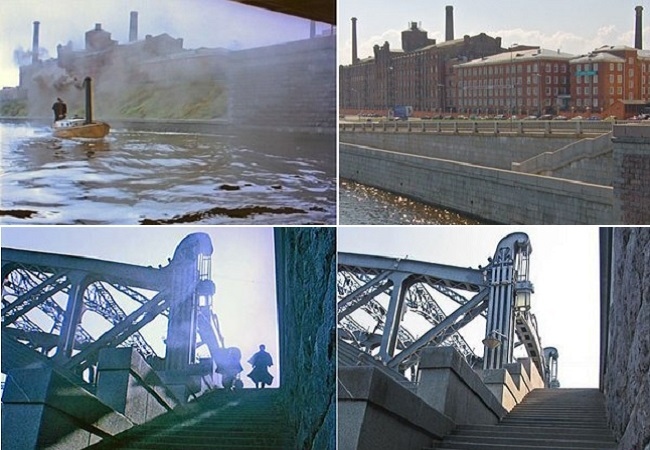

The Neva was seen as the Thames, and the Bolsheokhtinsky Bridge as the Tower Bridge. This similarity was used by the director of the film "The Adventures of Sherlock Holmes and Dr. Watson," episode "The Treasures of Agra." Key scenes of the film were shot during the White Nights, minimizing the risk of unwanted people and Soviet cars appearing in the frame. Although one local resident turned out to be quite helpful—he rented out his boat. To make it look appropriate, a metal pipe was attached to it, in which straw and diesel fuel were burned, simulating the smoke of a steam engine.

The Peter the Great Bridge became the first bridge on the Neva to provide the greatest convenience for navigation—a three-span structure with a double-leaf drawbridge span in the middle and two spans near the banks. At the time of the bridge’s opening, the side spans were the longest in the city. The bridge is decorated with granite lighthouse towers that illuminate the approaches to the bridge for ships at night.

After the 1917 revolution, the Peter the Great Bridge was renamed Bolsheokhtinsky, and in 1956, according to new spelling rules, it became Bolsheokhtinsky.

Since the bridge’s construction, mainly maintenance work has been carried out. The first repair was done only in 1971. Then, in the early 1980s, when a transport interchange was created on the embankments, the drawbridge span of the bridge was also extensively repaired.

From 1993 to 1997, a large-scale reconstruction of the drawbridge span and mechanisms took place. At the same time, the appearance, architecture, and dimensions of the Bolsheokhtinsky Bridge were fully preserved. At that time, the inscription “Bridge of Emperor Peter the Great” was restored on the bridge.

In 2000, the ceremonial opening of the artistic lighting took place.

In 2005, tram traffic on the bridge was discontinued. Five years later, the tram rails were removed.

In 2011, the Bolsheokhtinsky Bridge celebrated its centenary. In October-November of the anniversary year, the left-bank tower of the bridge was opened to visitors for the first time for two weeks.

Sources:

https://mostotrest-spb.ru/bridges/bolsheohtinskij-most

https://petersburglike.ru/2016-12-19/bolsheoxtinskij-most-fakty-i-legendy/

Follow us on social media

More stories from Following in the footsteps of: "Sherlock Holmes and Dr. Watson," a film walk through Latvia, Estonia, Abkhazia, and St. Petersburg

Glen Castle (Hohenhaupt Castle) - Baskerville Hall 1

Vana-Mustamäe 48, 11611 Tallinn, Estonia

Glen Castle (Hohenhaupt Castle) is a two-story limestone building without plaster on the slope of Mustamäe in the Tallinn district of Nõmme. It is located in the Glehni Park Forest in the southwestern part of the Nõmme-Mustamäe landscape reserve on the territory of Tallinn University of Technology at 48 Vana-Mustamäe Street.

Maarjamäe Castle (Orlov-Davydov Residence) - Baskerville Hall 2

Pirita Road 56, 12011 Tallinn, Estonia

Maarjamäe Castle (Estonian Maarjamäe loss) or Orlov Castle — the former summer residence (mõis) of the family of Count Anatoly Vladimirovich Orlov-Davydov in the suburb of Reval (Tallinn).

Gegsky (Circassian) Waterfall, also known as the Reichenbach Falls from Sherlock Holmes

8HM2CCPV+79

The Gegsky Waterfall (also known as the Circassian Waterfall) is a waterfall in Abkhazia with a height of about 70 meters (according to other sources, 50–55 m). The Reichenbach Falls and the fight between Holmes and Moriarty were filmed here.

Resort Auadhara, hotel in Meiringen from "Deadly Grip"

8HM2GJ9R+89

Auadhara is a balneological resort in the northwest of Abkhazia, in the Gudauta district, 18 kilometers from Lake Ritsa. The film "Sherlock Holmes and Dr. Watson," episode "Deadly Duel," was shot here, where it "played the role" of a hotel in Meiringen (exterior shots).

The dacha of Grand Duke Boris Vladimirovich

Moskovskoye Highway, 23, Saint Petersburg, Russia, 196601

The summer residence of Grand Duke Boris Vladimirovich — an Art Nouveau estate of Grand Duke Boris Vladimirovich, built in 1896–1897 by the London firm "Maple" under the direction of architects Sherborne and Scott. The estate "played" the role of Ronald Adair's house in the film *The Adventures of Sherlock Holmes and Dr. Watson* in the episode "The Tiger Hunt," and its interior was used as a hotel in Meiringen in the episode "Deadly Fight."

Saltykova's Dacha

TD "Burda Moden, Akademika Krylova St., 4, Saint Petersburg, Russia, 197183

The history of this place begins in 1743. It was then that Baron Sergey Stroganov became the owner of the plot near the Chyornaya Rechka metro station. The construction of the building was undertaken by Petr Sadovnikov, a former serf of the Golitsyn family and an architect, while the decoration of the facades and interiors was supervised by Harald Bosse. The construction was completed in 1843. The building's facade faced Stroganovskaya Street (now Akademika Krylova Street). The mansion was surrounded by a landscaped park, part of which has been preserved as Stroganov Garden. The main entrance is marked by gates consisting of two pseudo-Tudor towers with battlements and loopholes. These have also survived to this day. One of the most famous Sherlock Holmes episodes, "The Bloody Inscription," was filmed here.

The mansion of V.N. Yakovenko, "Professor's House"

Petrogradskaya Embankment, building 34, lit. B, room 1-N, office 514, Saint Petersburg, Russia, 197376

A two-story building designed in the style of French Gothic and Renaissance. The professor's house is connected by a passage to the building of the Saint Petersburg Marine Fisheries College.

Kshesinskaya's Mansion: How the Ballerina Fought the Bolsheviks

Kronverksky Ave, 1, Saint Petersburg, Russia, 197046

The Matilda Kshesinskaya Mansion is one of the legends of St. Petersburg. This historic building, erected at the beginning of the 20th century on Troitskaya Square in the northern capital, has remained almost unchanged to this day. The mansion belonged to the famous St. Petersburg ballerina and socialite Matilda Kshesinskaya, who was favored by Emperor Nicholas II himself. After the October events of 1917, the ballerina’s mansion came under the control of the Petrograd Soviet. Later, it housed the "Ilyich Corner," the Society of Old Bolsheviks, and the Museum of the Great October Socialist Revolution. After the collapse of the USSR, the building became home to the State Museum of the Political History of Russia. Everyone knows there is a museum on Gorkovskaya, but few remember that such a vivid and genuine history is connected to this beautiful house. The story of one of the most beautiful women of the era of the fall of the Russian Empire.

Sellgren Estate on Lodochny Island

MM7J+CP Sokolinskoye, Leningrad Oblast, Russia

The Russian island of Lodochny was owned by the commercial advisor E.V. Sellgren. In 1913, according to the project of architect Uno Ullberg, he built a beautiful villa made of red brick. The Sellgren estate was used for the filming of the Sherlock Holmes movie directed by Maslennikov, "The 20th Century Begins"; it served as the lair of the German spy von Bork.

Reinforced Concrete Canopy of the "Iron-Concrete" Partnership

Bolshaya Alley, 24, Saint Petersburg, Russia, 197183

On the northern shore of Kamenniy Island stands a reinforced concrete canopy. Although it looks quite weathered by time, it still attracts attention with the elegance of its forms. This is one of the artifacts left from the International Construction and Art Exhibition of 1908, which played an important role in the history of Russian architecture.

Stock-Moron Estate in Jurmala

XG27+W4, Jūrmala, LV-2012, Latvia

In the film *The Adventures of Sherlock Holmes and Dr. Watson*, episode *The Acquaintance*, a plot from Conan Doyle's story "The Speckled Band" is used, describing events taking place in the sinister estate of Dr. Roylott at Stoke Moran. The building that served as the estate in the film is located in the resort town of Kemeri, Jurmala.

Cottage Palace

VWHW+95 Petrodvortsovy District, Saint Petersburg, Russia

The Cottage Palace (English: cottage) is the central architectural structure of the palace and park ensemble of Alexandria, built using elements of the Neo-Gothic style in 1826–1829 for the family of Emperor Nicholas Pavlovich according to the design by architect Menelas, with an extension by Shtakenshteider. In the film *The Adventures of Sherlock Holmes and Dr. Watson*, the Cottage "played" the role of Milverton's mansion.

Follenweider Mansion

Bolshaya Alley, 13, Saint Petersburg, Russia, 197376

At the beginning of the 20th century, Eduard Follenweider, a tailor and supplier to the Imperial Court, turned to Roman Meltzer — an architect who was building a house for himself nearby in this settlement — with a request to design a house for him. The building is the first and most striking example of Northern Art Nouveau. This style was actively developing at the time in St. Petersburg under the influence of Scandinavian architecture. In Follenweider’s house project, the architect used a complex combination of shapes and volumes, as well as finishing materials unusual for the region. Among the locals, due to the particularly prominent large tiled roof in the overall composition, the house quickly earned the nickname "Sugar Head."

The Mansion of Countess Kleinmichel

nab. Krestovka River, 10, Saint Petersburg, Russia, 197110

The mansion of Countess Kleinmichel, a remarkable architectural monument, is located in the northwestern part of Kamenny Island, on the bank of the Krestovka River, a tributary of the Malaya Nevka, which separates Kamenny and Krestovsky Islands.

House of P. I. Goze (Sherman the Scarecrow's House)

Side Alley, 11, Saint Petersburg, Russia, 197376

On Kamenny Island, there are few historical houses left that have remained untouched since the 1990s. The house of Petr Goze, later rebuilt into the summer residence of Mrs. Orlova, is one of the vivid examples of the Art Nouveau era, when buildings were still constructed from wood.

Krimulda Church and the Road to the Stok Moron Estate

Kubesele Nature and History Trail, 57.16365, 24.76881, Krimulda Parish, Sigulda Municipality, LV-2144, Latvia

The Krimulda Church was built in 1205; it was one of the first churches in Livonia and the very first stone church in this region, and despite many changes, it has been preserved to this day.

Cozy courtyards of old Riga - Jana seta

Jāņa sēta 5, Central District, Riga, LV-1050, Latvia

Yana Seta is a small courtyard located in the very heart of the old town of Riga, behind St. Peter's Cathedral, between Skarnu and Kaleju streets. The courtyard is an architectural monument and one of the main attractions of the old town of Riga. In the film *The Adventures of Sherlock Holmes and Dr. Watson*, in the episode "The Bloody Inscription," this courtyard featured a hotel where Stangerson was killed.

Lidval. Tolstoy House

Fontanka River Embankment, 54, Saint Petersburg, Russia, 191002

One of the legendary landmarks of St. Petersburg is the income house of Count Tolstoy, popularly known as the Tolstoy House. This huge six-story building was skillfully fitted by the builders onto a small plot by the Fontanka Embankment. The house, designed in the Northern Art Nouveau style, is distinguished by its unique facade architecture and stunning interior layout.

Milverton Fence 1 - Petersburg

Angliyskiy Ave., 2B, Saint Petersburg, Russia, 190121

In the film *The Adventures of Sherlock Holmes and Dr. Watson*, in the episode "The King of Blackmail," we are mostly shown the fence of Milverton's estate.

Milverton Fence 2 - Pitsunda

The fence of Milverton's mansion, which Holmes and Watson storm, looks completely different in the evening than it does in daylight. No longer made of red brick, it is constructed from cut limestone and is not in Petersburg, nor even in Peterhof, but in Pitsunda, where the film crew went to shoot Swiss landscapes.

The pavement on Baker Street: Saint Petersburg, Zamkovaya Street

Sadovaya St., 2, Saint Petersburg, Russia, 191023

At different times, a marker, Miss Morsten, and Holmes himself in a sailor's outfit walked along this cobblestone. This place holds the record for inconspicuousness. After all, from Holmes's windows, we are shown only a piece of the pavement and nothing more. Without the director Igor Maslennikov's hint, it would have been almost impossible to find it.

Peter the Great Botanical Garden

Professora Popova St., 2, Saint Petersburg, Russia, 197022

Tsar Peter, when transferring the capital from Moscow to Petersburg, ordered the establishment of a "much-needed institution for medical practice" in the form of the Apothecary Garden "for sowing medicinal herbs and flowers." In the film *The Adventures of Sherlock Holmes and Dr. Watson*, in the episode "The King of Blackmail," the Milverton greenhouse was portrayed by the greenhouse of the Botanical Garden.

Tauride Palace Orangery - Exhibition Hall "Flowers".

Potemkinskaya St., 2, Saint Petersburg, Russia, 191123

The Orangery of the Tauride Palace - Exhibition Hall "Flowers" is an orangery located in the Central District of Saint Petersburg, at the corner of Shpalernaya and Potemkinskaya Streets, adjacent to the Tauride Garden. In the film *The Adventures of Sherlock Holmes and Dr. Watson*, episode "The Deadly Fight," the orangery played the role of the Lowersky Passage.

Sagadi Manor: Grimpen in The Hound of the Baskervilles

The Sagadi Manor was built over 500 years ago. It is first mentioned in chronicles in 1469. At that time, the estate belonged to the Risbiters family. Subsequently, the manor changed owners multiple times. The manor was featured in the film "The Adventures of Sherlock Holmes and Dr. Watson" in the episode "The Hound of the Baskervilles" as Grimpen.

House-Museum of the Estonian Artist Ants Laikmaa: Merripit House from The Hound of the Baskervilles

Marja, Kadarpiku, 90804 Lääne County, Estonia

Ants Laikmaa (1866–1942) was one of the most prominent figures in Estonian art. The artist's house-museum was built according to the artist's own designs, and the surroundings of the house are adorned with a beautiful natural park. He gained fame both as a portraitist and as a landscape painter. In the film *The Adventures of Sherlock Holmes and Dr. Watson*, in the episode *The Hound of the Baskervilles*, the Ants Laikmaa house-museum played the role of Stapleton's Merripit House.

Pastoral Villa Juuliku: Lefter Hall (Frankland House).

The Juuliku Shepherd's Villa was built in 1927–29 based on the design of the Estonian architect Robert Natus. The manor was featured in the movie *The Adventures of Sherlock Holmes and Dr. Watson* in the episode "The Hound of the Baskervilles" as Lefter Hall (Frankland's house).

Holmes's dwelling on the moor in *The Hound of the Baskervilles*

The building in which Holmes lived in the film *"The Adventures of Sherlock Holmes and Dr. Watson,"* episode *"The Hound of the Baskervilles,"* is nothing more than the ruins of a Dutch-style mill.

The History of the Stieglitz Academy - the Famous Fly

Solyanoy Lane, 13, Saint Petersburg, Russia, 191187

The Baron Stieglitz Academy is known not only in Russia but also abroad as a forge for outstanding artists. Its history began in 1876 and is inextricably linked with the name of Alexander Ludwigovich Stieglitz.

Church of Saint John: Church of St. Monica from "The Treasure of Agra"

Vabaduse väljak 1, 10146 Tallinn, Estonia

The Church of Saint John (in Estonian: Jaani Kirik) is a large Lutheran parish church in Tallinn, Estonia. It is dedicated to Saint John the Theologian, a disciple of Jesus Christ and the author of the fourth Christian Gospel. Construction began in 1862, and the church was opened in 1867.