

In 1853, the courtyard plot, under the old number 53 in the Admiralty district, belonging to Major General Karl Ivanovich Albrecht, was divided by him into 10 separate plots. By 1869, all the plots were registered under the common number 4 on English Avenue and remained vacant. From 1872, the sale of these plots was undertaken by the major general's son, retired rotmistr Petr Karlovich Albrecht. In 1872, the plot numbered 4 according to Albrecht's division plan was acquired by the "Hessian nobleman" Vladimir Christianovich von Welling. The owner of plot number 3 was the court councilor Petlin. The neighboring plot number 5 remained with P. K. Albrecht and was mortgaged by him to the City Credit Society.
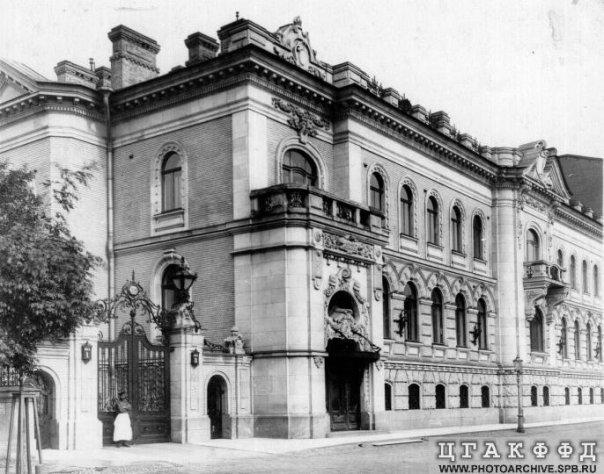
On September 7, 1872, the construction department permitted the building on von Welling's plot of a two-story stone house on cellars, with two adjoining side outbuildings, as well as one-story service buildings according to the project by architect Mizhuyev. On the courtyard plan, the neighboring plot to the right is marked as "neighbor." On July 24, 1873, a new project by the same architect was approved instead of the previous one. According to the new project, the front house was planned to be two stories, partly three stories on the yard side. One outbuilding was designed next to it, with one-story laundries nearby. The plot was 12 sazhen wide, with space left to the left of the front house for a driveway into the yard. On the courtyard plan, the plot on the right is marked as "vacant land" belonging to the same owner. It is evident that von Welling bought the plot from Albrecht, along with his debt to the Credit Society, which is confirmed by the archive file title. According to the 1875 House Register, von Welling owned two adjacent plots - numbers 10 and 12 on English Prospect. The owner of the neighboring plot number 8 was Petlin.
In 1883, house number 10 and plot number 12 became the property of second guild merchant Herman-Wilhelm Büchtger.
The 1883 Merchant Register reports that second guild merchant Büchtger Herman-Wilhelm, aged 64, of Lutheran faith, was educated at a school in Mitau; he has been a merchant since 1880, paying guild dues since 1860 and from 1873 in the first guild. He resided in the Admiralty district, 1st section, house number 7Y on the Moika. He ran a furniture store in the same house. His wife Amalia and sons Harald-Alexander, Robert-Wilhelm, and Herman-Edward lived with him. The following year, the merchant Büchtger's residence was listed as house number 10 on English Prospect, where the furniture store was also located.
In 1889, after renumbering, Büchtger's house and plot were registered as numbers 8 and 10 on English Prospect.
After Büchtger's death in 1896, the property at English Prospect 8–10 was inherited by his widow, Amalia Andreevna Büchtger. The furniture and wallpaper business was continued by the eldest son, Harald-Alexander Büchtger. The furniture workshops were located in a two-story outbuilding adjoining the front house on the yard side. The house also housed a furniture and wallpaper store. The 1898 Merchant Register states that Harald-Alexander Hermanovich Büchtger was a class III artist.
On June 23, 1899, the City Administration granted permission to enlarge openings in the internal walls of the basement floor and to install new stone staircases in the two-story outbuilding on Amalia Andreevna Büchtger's plot. The project was signed by architect Harald Büchtger
On May 29, 1901, the Technical Department of the St. Petersburg City Administration permitted the construction of a three-story stone front house with attics facing the street and a four-story one facing the yard. The courtyard plan of Dutch subject Hendrik Hendrikovich van Gilse van der Pals was signed by architect Iogansen
The mansion was built in 1901–1902 by architect William Yulievich Iogansen for the family of his sister Lucia Matilda Teresa, who was the wife of Heinrich Heinrichovich van Gilse van der Pals. Lucia Yulievna Gilse van der Pals died on April 9, 1903, and is buried at the Novodevichy Cemetery. The chapel over her sister's grave was made in 1904 by architect Iogansen.
On July 23, 1910, the City Administration issued permission for a major reconstruction of the one-story stone outbuilding, which housed a stable. The courtyard plan of Dutch subject Hendrik Hendrikovich van Gilse van der Pals at English Prospect 8 and 10 was signed by architect Iogansen.
Until 1901, this address was listed as the house and furniture factory of Büchtger. By 1903, this factory was already listed at Aptekarsky Prospect 2.
After the death of his father Büchtger in 1896, Harald Hermanovich Büchtger, an architect and class artist, continued the production of fine and artistic furniture; he also fulfilled orders related to carpentry-decorative and wallpaper-decorative finishes of apartments and mansions, carriages, yachts, etc. Regarding the quality of work produced by the Büchtger house, it is sufficient to mention the exhibits awarded the highest honors at exhibitions, and the fact that these exhibits were not specially prepared for exhibitions but were sold from the permanent stock in the Büchtger store, now on English Prospect.
Herman Wilhelm Fedorovich Büchtger, the father of the current owner of the firm, opened his own artistic furniture, wallpaper, and carpentry workshop in St. Petersburg on December 4, 1851. In 1851, he was awarded the title of Carpenter Master of the Court of His Imperial Highness Grand Duke Mikhail Nikolaevich, and in the following years, he repeatedly received awards from Their Majesties: Emperor Alexander II, Emperor Alexander III, and members of the Imperial Family. Carpentry and furniture-wallpaper works for the imperial yachts "Livadia" and "Derzhava" were carried out by him, as well as the iconostasis for the Orthodox Church of Her Imperial Highness Grand Duchess Maria Alexandrovna in London and furniture for the main dining room in the Kremlin Palace in Moscow. In addition, numerous finishes were carried out by the firm of V. Büchtger in the imperial train carriages. Harald Hermanovich Büchtger took over the management of the factory while his father was still alive in 1883. In 2021, the city military commissariat was located here. Two windows on the basement floor with double sashes are filled with solid etched glass with Art Nouveau ornamentation.
Inside the vestibule door of the main entrance is a three-leaf door with a shaped transom glazed with a faceted stained glass on a brass profile. The design depicts stylized tulip flowers. Above the door is a transom window with faceted stained glass on a brass profile. The design represents half a flower with petals, framed in a bean-shaped frame.
In the main hall on the first floor, there are at least two doors. One is double-leafed, the other is a four-leaf folding door. Both doors are glazed with faceted glass in rectangular muntins of the panels. The transom above the four-leaf door has a fan-shaped muntin, also with faceted glass.
Five semi-circular windows in the main hall have shaped applied false muntins in the inner transoms. These false frames are large rocaille elements enclosed in a circle with symmetrical curls extending from them. They are superimposed on solid textured glass.
The door from the landing of the second-floor main staircase leading to the interior rooms is three-leafed, with a shaped transom filled with faceted stained glass in the shape of half a flower. The sashes are glass, filled with faceted stained glass of geometric design on a lead profile.
In the "Moorish Room" there is a window with shaped muntins in a horseshoe-shaped opening, glazed with colorless glass. The adjoining "Green Living Room" ("Herb Room") is a vivid example of Art Nouveau style. The room is a passage room, with identical double-leaf doors with glazed shaped panels leading into it from both sides. In the technique of deep multilayer etching, images of flowers and leaves are applied to the glass. In this same room, there is a large three-part window with a shaped transom part. The center of the window is filled with solid glass, with faceted stained glass frames of simple geometric design on a brass profile on the sides and top.
In one of the offices in the 1990s, there was a polychrome stained glass window depicting flowers in the Art Nouveau style. It is known from a photograph by K. K. Sevastyanov from the 1990s and is mentioned by Ivanov. There is no information about its preservation.
On the second floor of the building, a glazed three-sided veranda with a semicircular projection remains, glazed with colored glass. The glass is unevenly colored on the surface from the inside, probably a result of renovations during the Soviet era. The muntin pattern is geometric, composed of rectangular and diamond-shaped elements.
In one of the windows, known from a photo from the KGIOP archive, there were solid glasses with etched images of climbing grape leaves. There is no information about the preservation of this window.
Sources:
https://www.citywalls.ru/house639.html


Written by Jermaine
Discuss this with the author and others
No comments yet. Be the first to start the conversation.