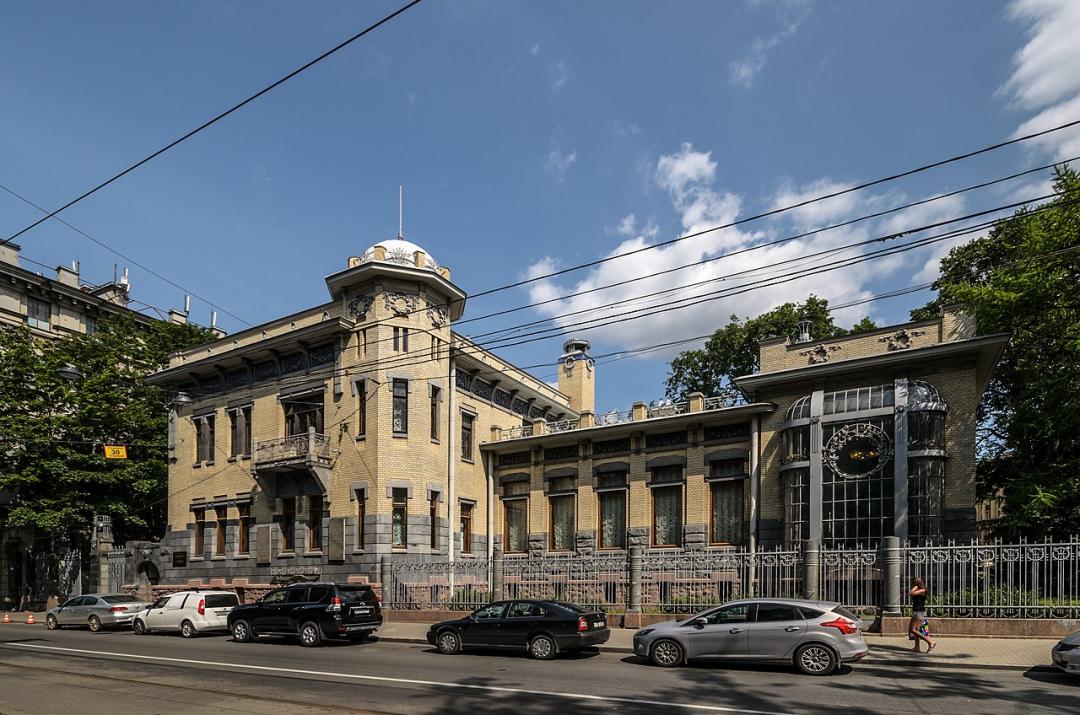
Kshesinskaya's Mansion: How the Ballerina Fought the Bolsheviks

Kronverksky Ave, 1, Saint Petersburg, Russia, 197046

The Matilda Kshesinskaya Mansion is one of the legends of St. Petersburg. This historic building, erected at the beginning of the 20th century on Troitskaya Square in the northern capital, has remained almost unchanged to this day. The mansion belonged to the famous St. Petersburg ballerina and socialite Matilda Kshesinskaya, who was favored by Emperor Nicholas II himself. After the October events of 1917, the ballerina’s mansion came under the control of the Petrograd Soviet. Later, it housed the "Ilyich Corner," the Society of Old Bolsheviks, and the Museum of the Great October Socialist Revolution. After the collapse of the USSR, the building became home to the State Museum of the Political History of Russia. Everyone knows there is a museum on Gorkovskaya, but few remember that such a vivid and genuine history is connected to this beautiful house. The story of one of the most beautiful women of the era of the fall of the Russian Empire.
In 1904, plots 1/2 and 3 on Kronverksky Prospekt were acquired by Matilda Kshesinskaya. The purchase (for 88 thousand rubles) was made by the nobleman Kollin in his own name, as a trustee. However, the sales record stated that the place was bought with Kshesinskaya’s money. Official documents in her name were issued on September 10, 1905 (old style). Before that, the ballerina lived on English Avenue.
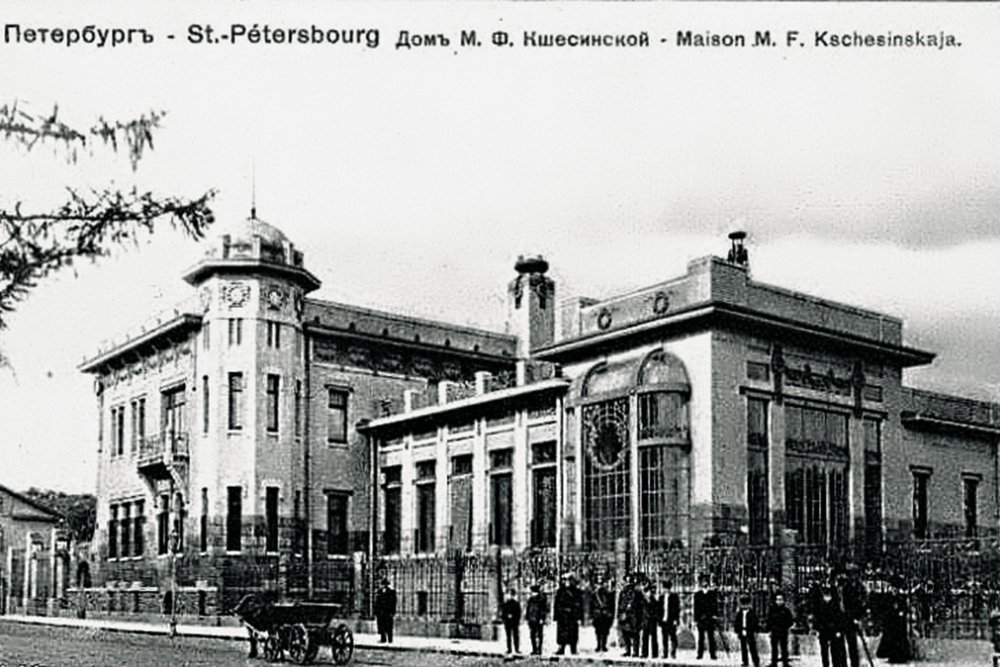
Kshesinskaya commissioned the project and construction of the mansion to the academician of architecture von Hogen. The interiors were created with the participation of the young architect Alexander Dmitriev. The realized project is the result of close collaboration between the architect and the client. Von Hogen developed the mansion project in 1904. The drawings he submitted to the City Administration are dated July 26. The project differs little from the constructed building. The final project was published in the journal "Zodchiy" in 1905.
By autumn 1905, the building was constructed in rough form. In the ballerina’s memoirs, it is said that she moved into the new house around Christmas 1907. Kshesinskaya was involved in the details of the interior arrangement and decoration, deciding on the design of some rooms. According to von Hogen, the interior decoration was conceived without excessive luxury. More than 70 interior drawings were made by von Hogen and his student Dmitriev. Architect Dubinsky also worked on the mansion’s interiors, but it is unknown whether his proposals were implemented. Von Hogen’s assistant during the mansion’s construction was Samoylov, a student of the Institute of Civil Engineers.
What Kshesinskaya wrote about this in her memoirs: "I commissioned the plan from the very famous architect Alexander Ivanovich von Hogen in Petersburg and entrusted him with the construction as well. Before drawing up the plan, we discussed together the arrangement of rooms according to my wishes and the conditions of my life. I outlined the interior decoration of the rooms myself. The hall was to be done in the style of Russian Empire, the small corner salon in the style of Louis XVI, and I left the rest of the rooms to the architect’s taste, choosing what I liked best. I ordered the bedroom and the toilet in the English style, with white furniture and cretonne on the walls. Some rooms, like the dining room and the adjacent salon, were in Art Nouveau style. All the stylish furniture and that intended for my personal rooms and my son’s rooms I ordered from Meltzer" - 
Kshesinskaya’s mansion became a classic example of Petersburg Art Nouveau. In 1907, at the competition for the best facades of new buildings, the City Administration awarded it a silver medal.
Except for a small facade part on Kronverksky Prospekt, the entire building is located in a garden. The living quarters face the sunny side. Only the staircase, vestibule, and toilet face north. The front garden, a delicate fence on the south side, and a gazebo-pergola on the corner decorate the building.
The building’s architecture in Art Nouveau style attracts attention with its free asymmetrical composition, elegance, and variety of forms. The different heights of its parts and window sizes reflect the features of the interior layout. The front garden, fence, and gazebo complete the building’s appearance. The exterior has survived almost unchanged. Since the revolutionary events, the original interiors and furniture of the mansion have almost completely disappeared. Only the vestibule, antechamber, and staircase (with losses) remain from the interior decoration. The interior layout combines free volumes with ceremonial enfilades. The one-story wing contains two parallel enfilades. The internal organization of rooms is visible behind the external volumes of the building.
The building’s plinth is laid with Valaam red granite of rocky texture. Above it runs a belt of gray Serdobol granite. The walls are faced with light Zigersdorf brick. Against their background stand out dark blue ceramic friezes, metal structures, and wrought elements. The courtyard facades are simply decorated.
On the northern side of the plot, a small wing with living quarters and a common dining room was allocated for the servants. In the backyard were a laundry, cowshed, carriage and automobile shed. The owner’s pride were the dressing rooms (upstairs and downstairs), kitchen, and wine cellar with a buffet, where dinners were often held. Also in the semi-basement were a pantry, icehouse, and boiler room. The furnishing of the utility part and servants’ rooms was done by the furniture firm Platonov.
The main entrance to the building was located from the small northern courtyard. From the vestibule opened the main enfilade. The enfilade includes the vestibule, antechamber, large hall, and winter garden.
Matilda Felixovna Kshesinskaya was born into a Polish aristocratic family on August 19, 1872, in Ligovo near Petersburg. Her father, Felix Ivanovich, graduated from the Warsaw Ballet School and danced at the Warsaw Grand Theatre. In 1853, he moved to Petersburg, joined the Mariinsky Theatre troupe, and was considered the first "mazurka dancer" in Russia. Her mother, Yulia Kshesinskaya, was a ballet artist of the Mariinsky Theatre who left the stage for the family. In 1890, Matilda graduated with honors from the theatrical school. At the graduation evening, she met the Tsarevich Nikolai Alexandrovich. Soon she became the first Russian prima ballerina on the Mariinsky Theatre stage, displacing Italian ballerinas. In February 1900, the ballerina met Grand Duke Andrei Vladimirovich. In 1902, they had a son, Volodya.
In her mansion, Kshesinskaya held receptions. Frequent guests were actors from the Alexandrinsky Theatre. Italian singer Lina Cavalieri, Sobinov, and Shalyapin sang here. Jeweler Karl Fabergé and dancer Isadora Duncan visited. The ballerina received her colleagues Anna Pavlova, Tamara Karsavina, Vaslav Nijinsky, and Sergei Diaghilev here. The receptions were attended by Grand Dukes Andrei Vladimirovich (the ballerina’s future husband), Boris Vladimirovich, and Kirill Vladimirovich. The emperor’s cousin, Grand Duke Sergei Mikhailovich, managed the ballerina’s affairs and bought her a dacha in Strelna. At the mansion and dacha, home performances, improvised concerts, and "kapustniks" were held. In the 1900s, Kshesinskaya brilliantly performed both in Marius Petipa’s classical ballets and in new ballets by Fokine, successfully touring Europe and Russia. The mansion’s owner was a loving, caring mother and exemplary hostess. The ballerina’s French chef Denis, who accompanied her on all trips, was famous throughout Petersburg.


On February 22, 1917, Kshesinskaya gave her last dinner in the mansion. On February 27, the ballerina, her son, and tutor left the mansion after receiving threats. The empty building was soon looted by a large crowd of marauders, and a few days later was occupied by soldiers of the workshops of the reserve armored division, who were mainly housed on the lower floor. One of the agitators reported this to the Petersburg Bolshevik Committee, which, after the party came out of hiding, was cramped in two small rooms in the attic of the Petrograd Labor Exchange (Kronverksky Prospekt, 49) and desperately needed premises for work. Member of the PC Petr Dashkevich was sent to negotiate with the "armored men" (as the soldiers of the armored division were called). He quickly found common ground with them, and on March 11, the PC RSDLP (b), its Military Organization, and then the Central Committee of the Bolshevik party moved into Kshesinskaya’s mansion, which, as the Petrograd newspapers wrote, became the "main headquarters of the Leninists."

Now fierce meeting passions constantly boiled around the mansion. The wife of the famous historian academician S. F. Platonov, living with her family on Kamennoostrovsky Prospekt, wrote in her diary: "There is always a crowd around it and someone is speaking — it is no longer Lenin himself who speaks the most..., but someone from the 'Leninists,' fierce disputes occur between the 'Leninists' and their opponents, and those who disagree with Lenin are sometimes arrested, and sometimes, they say, the Leninist speaker has to hastily escape into the yard or house to avoid being beaten." Meanwhile, its true owner, having somewhat recovered from the experienced turmoil, decided to try to return home. But it turned out that the uninvited guests had no intention of leaving the cozy mansion, which also had a very advantageous strategic location: nearby was the Peter and Paul Fortress, not far in the People’s House after the February Revolution soldiers of the 1st Machine Gun Regiment — one of the most revolutionary units of the garrison — were stationed, and the working outskirts of the Vyborg side were within arm’s reach. On the other hand, the city center — Nevsky, or as it was called in ’17, the "Milyukov" Prospekt — could be reached in fifteen minutes. 
The ballerina quickly grew bold and decided to reclaim her house. She tried to talk with the Bolsheviks. They spoke politely but refused to vacate the premises and openly mocked the "poor" ballerina. Kshesinskaya went to various authorities. The only help from the "revolutionary democracy" was a resolution from the executive committee of the Petrograd Soviet of Workers’ and Soldiers’ Deputies. The document stated that the seizure of private property was unacceptable. The Petrograd Soviet called on the "armored men" to vacate the building. However, the resolution did not help, nor did the prosecutor’s demand to return the building to the owner. In revolutionary Petrograd, only decisions backed by concrete military and political power had force. Minister of Justice Alexander Kerensky told the ballerina that the house could not be taken back by force, as it would end in bloodshed and further complicate matters.
Moreover, public opinion was clearly not on Kshesinskaya’s side. She was the object of rumors and ridicule. 
In the drawing titled "Victim of the New Order," a ballerina lies on a bed. The caption reads: "Matilda Kshesinskaya: 'My close ties to the old government were easy for me: it consisted of only one person. But what will I do now, when the new government — the Soviet of Workers’ and Soldiers’ Deputies — consists of 2,000 people?!'"
Even among the liberal intelligentsia, the opinion was popular that the ballerina’s house should become public property. However, a couple of months later, "terrible Lenin and the Leninists" appeared to the public as much more dangerous than the "tsar’s favorite," historians write.
Having exhausted almost all possibilities, Kshesinskaya sued the Bolsheviks and their leader Lenin. On the morning of May 5, 1917, at house No. 9 on Bolshaya Zelenina Street, where the magistrate’s chamber of the 58th district was located, there was unusual excitement. The courtroom was packed to capacity. Some of the curious asked, "Are they really trying the Leninists here?" To avoid possible incidents, heightened security measures were taken. An enhanced detachment of rifle-armed militiamen guarded the entrance. Everyone wishing to attend the session was asked about the purpose of their visit, and numerous representatives of the Petrograd press were required to show editorial credentials. Everyone eagerly awaited noon, when the trial was to begin. But to better understand the sensational trial’s background, one should go back a little over two months...
The party in this trial was defended by Lithuanian revolutionary and lawyer Mechislav Kozlovsky. At the May 5 trial, he stated that the Bolsheviks almost saved the building from destruction.
"[Revolutionary organizations] occupied it when it was empty, when the raging masses were destroying Kshesinskaya’s palace, considering it a nest of counterrevolution, where all the threads connecting Kshesinskaya to the tsar’s family converged, who, according to the masses’ understanding, was if not a member of the tsar’s family, then at least the favorite of the overthrown tsar," Kozlovsky reasoned at the trial.
The defendants listed at the trial by the plaintiff were: "1. Petrograd Committee of the Social-Democratic Workers’ Party; 2. Central Committee of the same party; 3. Central Bureau of Trade Unions; 4. Petrograd District Committee of the Socialist-Revolutionary Party; 5. Club of Military Organizations; 6. Candidate of Law V. I. Ulyanov (pseudonym — Lenin); 7. Assistant Attorney S. Ya. Bagdatyev; 8. Student G. O. Agababov." The plaintiff’s lawyer Vladimir Khesin insisted that even during the revolution there is law. In response to Kozlovsky’s words about the angry crowd and the tsar’s favorite, the lawyer said the court is no place for "rumors and street talk."
"Does the crowd say anything? — he said. — The crowd talks about traveling in a sealed train through Germany and about German gold brought to my client’s house. But I did not repeat any of this in court."
The court ultimately ruled in favor of Kshesinskaya. The Bolsheviks had a month to vacate the premises. As expected, the enforcement of the court decision was delayed. The Bolsheviks and their supporters actively resisted eviction, threatening to use weapons. They simply had nowhere to go, and the headquarters in the city center was very convenient. The issue of the mansion had to be resolved in the context of the general political situation, which was increasingly approaching civil war.
By early July, the confrontation between left-wing radicals and other revolutionaries and the Provisional Government almost escalated into open armed conflict. Armed demonstrators with Bolshevik slogans roamed Petrograd, demanding the transfer of power to the Soviets. The Socialist-Revolutionaries and Mensheviks considered these demonstrations counterrevolutionary.
On the evening of July 5, reliable units summoned from the front, supporting the official authorities, arrived in Petrograd. Reports about Lenin’s connections with Germany, which influenced public opinion and the mood of most military units, were also published. The situation shifted in favor of the Provisional Government.
Significant military forces were allocated to evict the Bolsheviks from Kshesinskaya’s mansion: eight armored cars, soldiers, a machine gun team, and two artillery pieces. On the morning of July 6, RSDLP(b) party members hurriedly left the building, which was immediately occupied by a combined detachment of Provisional Government troops.
"The soldiers who stormed the building wreaked complete havoc in the premises of the Bolshevik organizations," write the authors of the book "Around the Winter Palace." The looters had not only ideological motives — many soldiers believed rumors that Germany generously financed the Bolsheviks and hoped to find "German millions" in the mansion.

Destruction of Kshesinskaya’s mansion by Provisional Government troops. July 6, 1917

The book "Around the Winter Palace" contains the memoirs of Staff Captain Ivan Mishchenko — head of the machine gun team of the 1st Motorcycle Battalion of the 1st Cavalry Corps of the Northern Front. The manuscript of his memoirs was found in the State Archive. Mishchenko participated in the building’s occupation and was its commandant for some time afterward. Apparently, the house was already abandoned by the Bolsheviks when the staff captain and soldiers entered.
"There was complete chaos in the house," he wrote. Cigarette butts, food remains, empty cognac bottles were scattered everywhere; furniture upholstery and curtains were torn; armchairs and sofas were broken. On the lower floor, beds, mattresses, books, tables, broken figurines, and clothes were piled up in heaps.
"In the winter garden, apparently, someone practiced saber cuts, so only the stems remained of the expensive tropical plants. Madame Kshesinskaya’s wonderful bathroom was turned into a cesspool; various items, from cigarette butts to human excrement, lay at the bottom of the pool," Mishchenko wrote in his memoirs.
The next day, in the presence of a commission from the Provisional Government, two rooms were broken into in the mansion, the keys to which the Bolsheviks had taken with them. Correspondence of the RSDLP(b) was found there.
"When the commission interrogated the janitor... he, giving testimony and seeing a hat, said it was Comrade Lenin’s hat. The commission sat for several days," recalled the staff captain. "Once, one volunteer member of the commission said to me: 'Yes, it’s a pity we took so long to deal with the Bolsheviks. Look. They have already taken all of Russia into their hands; from Lenin’s correspondence, it is clear that everything is already done in this direction.'"
After the Bolsheviks’ eviction, Matilda Kshesinskaya could not return to her home because this time it was occupied by soldiers of the 1st Motorcycle Battalion, who had liberated the building. No one was in a hurry to evict them.
Lawyer Khesin continued to file lawsuits, but the ballerina realized waiting was pointless. On July 13, 1917, she left Petrograd and went to Kislovodsk, where Grand Duke Andrei Vladimirovich awaited her. In February 1920, she left Russia forever.

Kshesinskaya died in 1971 in Paris, just a few months short of her 100th birthday.
After the October events of 1917, the ballerina’s mansion came under the control of the Petrograd Soviet. Later, it housed the "Ilyich Corner," the Society of Old Bolsheviks, and the Museum of the Great October Socialist Revolution. After the USSR’s collapse, the State Museum of Political History of Russia was opened in the house. Everyone knows there is a museum on Gorkovskaya, but few remember that such a vivid and real history is connected with this beautiful house. The story of one of the most beautiful women of the time of the Russian Empire’s demise.

Filming of the movie "The Adventures of Sherlock Holmes and Dr. Watson" took place in and around this mansion in the episode "Deadly Fight," where the "Bagatelle" club was located. Lenin and his comrades once used this club’s entrance.


Through this archway passed the carriage carrying Holmes to his meeting with Moriarty, and in the next episode, Watson, disguised as a priest, will pass here in a cab drawn by old lady Meadows.


Sources: 
https://kudago.com/spb/place/osobnyak-kshesinskoj/
https://www.bbc.com/russian/features-40417656
https://family-history.ru/material/history/place/place_4.html
Yulia Demidenko, Vladlen Izmozik, Yulia Kantor et al.: 1917. Around the Winter Palace
https://www.citywalls.ru/house3962.html
Bobrov V.D., Kirikov B.M.: Kshesinskaya Mansion


Follow us on social media

More stories from Petersburg: Masterpieces of Art Nouveau

Egyptian house

Zakharyevskaya St., 23, Saint Petersburg, Russia, 191123

Almost every resident of St. Petersburg, when mentioning house No. 23 on Zakharyevskaya Street in St. Petersburg, will immediately say that it is the "Egyptian House." And not without reason—just a quick glance, and you are instantly immersed in the world of pharaohs, pyramids, sphinxes, and the legends of ancient Egypt.

Singer House or House of Books

Nevsky Ave., 28, Saint Petersburg, Russia, 191186

Not only today's entrepreneurs strive to immortalize their ambitions in the height of their office buildings. And the passions regarding the appearance and height regulations were intense.

Trading House of the Eliseevs

Nevsky Ave., 56, Saint Petersburg, Russia, 191023

The building for the Eliseyev Trading House store was constructed at the corner of Nevsky Prospect (No. 56) and Malaya Sadovaya Street in 1902-1903, based on the design by architect Baranovsky.

Eliseevsky Trading House

Nevsky Ave., 56, Saint Petersburg, Russia, 191023

The building for the Eliseyev Trading House store was constructed at the corner of Nevsky Prospect (No. 56) and Malaya Sadovaya Street in 1902-1903, based on the design by architect Baranovsky.

Cathedral Mosque

Kronverksky Ave, 7, Saint Petersburg, Russia, 197046

Already in the early years of the existence of Saint Petersburg, a Tatar settlement appeared near the Peter and Paul Fortress. In 1798, more than five hundred Muslim servicemen submitted a petition requesting the granting of a prayer house and the allocation of land for a cemetery.

The building of the "Au Pont Rouge" department store – the first department store in Russia

Moika River Embankment, 73, Saint Petersburg, Russia, 190000

This building, with a history of more than a century, once overshadowed the Admiralty; famous St. Petersburg dandies used to dress here, and today the entrance to the department store is open to everyone.

Lidval. Tolstoy House

Fontanka River Embankment, 54, Saint Petersburg, Russia, 191002

One of the legendary landmarks of St. Petersburg is the income house of Count Tolstoy, popularly known as the Tolstoy House. This huge six-story building was skillfully fitted by the builders onto a small plot by the Fontanka Embankment. The house, designed in the Northern Art Nouveau style, is distinguished by its unique facade architecture and stunning interior layout.

Lidval. Income House, the Beginning of Northern Art Nouveau in Petersburg

Kamennoostrovsky Ave., 1-3, Saint Petersburg, Russia, 197046

The works of Fyodor Lidval began to play a significant role in the architecture of Saint Petersburg in the 1900s. In the first stage of his creativity (1897–1907), he was a prominent representative of the "Northern Modern" style; his explorations during these years were close to the aspirations of Scandinavian and Finnish architects. At the same time, Lidval's buildings did not contradict the historically established appearance of the city. The Lidval tenement house, one of the architect's early works, is usually cited as an example of a residential building in this style. The Ida Amalia Lidval tenement house — the first independent work of this outstanding architect — was commissioned by his mother.

Dacha Gauswald, the first Art Nouveau house in Russia

Bolshaya Alley, 14, Saint Petersburg, Russia, 197376

The Hauswald Dacha is one of the first buildings in the Art Nouveau style on Kamenniy Island, designed by the then-popular young architects Vladimir Chagin and Vasily Shene. It gained recognition across the Soviet Union and even abroad after the release of the film *The Adventures of Sherlock Holmes and Dr. Watson*, as this building "played" the role of Irene Adler's house. Additionally, it appeared in the films *Don Cesar de Bazan*, *The Bat*, *Without Family*, and *Maritza*.

The House of Buck - Escher's Engraving Realized in Architecture

Kirochnaya St., 24, Saint Petersburg, Russia, 191123

The income house at 24 Kirochnaya Street has become one of the symbols of Petersburg: before the revolution, famous figures lived there; during the Soviet era, creative people moved into the communal apartments; and nowadays, photo shoots take place there, and homeless people live in it. This building, with its unique architectural features, is one of the city's informal landmarks – it amazes with its airy galleries. Once luxurious, the house is currently going through its not-so-great times.

Novitsky Plant Office — a magical castle

Sadovaya St., 21a, Saint Petersburg, Russia, 191023

The Art Nouveau building on the corner of Sadovaya Street and Bankovsky Lane draws attention with its unusual architectural appearance, reminiscent of the grand European trading houses of the early 20th century. In fact, it housed the office of Eduard Novitsky's rubber and metal stamping factory.

Income House of Sh. Z. Ioffe

Zagorodny Prospekt, 11, Saint Petersburg, Russia, 191002

A tall tower with five dormer windows dominates the Five Corners, serving as a landmark in the urban space. The facade of the building facing Rubinstein Street is symmetrical. The first and second floors were built to house retail spaces, so their exterior decoration is the most modest: large windows are divided by granite piers, and it is evident that slabs of gray granite decorate the brickwork of the building. The third, fourth, and fifth floors seem like a separate structure. The Venetian windows on the third floor have semicircular transoms that open inward. Caryatids standing on the sides of the window openings support the false balconies of the windows on the next floor. On the fourth floor, the pediments are in the form of triangular gables resting on brackets; in the recesses of the pediments, there is something resembling an image of a bird. In the pediments above the bay windows are Hermes' caducei entwined with snakes — the symbol of the god of trade, travel, and deception. The cornices of the third floor and the roof of the building are supported by massive modillions. Everything is massive, solid, and at the same time — light and airy.

Income House of the Agricultural Partnership "Landowner"

7th Krasnoarmeyskaya St., 32, Saint Petersburg, Russia, 190005

The income house of the agricultural partnership "Pomeshchik" is a historic building in the style of Northern Modern with elements of Neo-Gothic, located in Saint Petersburg at 7th Krasnoarmeyskaya Street, 28-30 / Izmailovsky Prospect, 16. It is one of the first examples of sectional houses in Petersburg. The building was constructed in 1911–1912 for the company "Pomeshchik," which was engaged in the sale of milk and dairy products. The project’s author is architect Yakov Bluvshtein. The building’s expressive appearance and the turret with a dome decorating the corner make it an architectural dominant of the avenue.

Lidval. Building of the Azov-Don Bank

Bolshaya Morskaya St., 3-5, 6th floor, office 3, Saint Petersburg, Russia, 191186

This remarkable building is located in the very center of the city, next to the Arch of the General Staff. In fact, it is two houses that were built at different, though close, times, which is also reflected in their address - Bolshaya Morskaya St., 3-5. This building was constructed for the Azov-Don Commercial Bank.

The dacha of Grand Duke Boris Vladimirovich

Moskovskoye Highway, 23, Saint Petersburg, Russia, 196601

The summer residence of Grand Duke Boris Vladimirovich — an Art Nouveau estate of Grand Duke Boris Vladimirovich, built in 1896–1897 by the London firm "Maple" under the direction of architects Sherborne and Scott. The estate "played" the role of Ronald Adair's house in the film *The Adventures of Sherlock Holmes and Dr. Watson* in the episode "The Tiger Hunt," and its interior was used as a hotel in Meiringen in the episode "Deadly Fight."

Baltic Fleet Machine School

Petrovskaya St., 9, Saint Petersburg, Russia, 197762

Anyone who has ever walked along Petrovskaya Street in Kronstadt has seen the building with a huge stained-glass window in the Art Nouveau style. This is the former machine school of the Baltic Fleet; it housed the stokers' school, and inside the building there was a working model of a military ship's stoker room, a machine school, and a marine technical college.

Follenweider Mansion

Bolshaya Alley, 13, Saint Petersburg, Russia, 197376

At the beginning of the 20th century, Eduard Follenweider, a tailor and supplier to the Imperial Court, turned to Roman Meltzer — an architect who was building a house for himself nearby in this settlement — with a request to design a house for him. The building is the first and most striking example of Northern Art Nouveau. This style was actively developing at the time in St. Petersburg under the influence of Scandinavian architecture. In Follenweider’s house project, the architect used a complex combination of shapes and volumes, as well as finishing materials unusual for the region. Among the locals, due to the particularly prominent large tiled roof in the overall composition, the house quickly earned the nickname "Sugar Head."

Melzer Estate ("Baba Yaga's House," "Fairy Tale House") and the Dispute Associated with It

Polevaya Alley, 8, Saint Petersburg, Russia, 197376

At the beginning of the 20th century, the master of St. Petersburg Art Nouveau, Roman Fyodorovich Meltzer, decided to build his own house on Kamenny Island. From 1901, the architect's project underwent multiple changes, and in 1904 it was finalized. The Meltzer mansion, which can be seen from the Krestovka embankment, is one of the key monuments of northern Art Nouveau in St. Petersburg. When constructing the mansion, Meltzer used motifs of ancient Russian architecture and Russian national architecture. Undoubtedly, elements of Finnish national romanticism played a significant role in the appearance of the house. The walls made of roughly hewn stone, massive logs, and the high-rising pyramidal roof give the house a picturesque quality. The most attention is drawn to the gable roof, which becomes the defining part of the silhouette and soars upward.

Mansion of V. I. Shöne

Teatralnaya Alley, 3, Saint Petersburg, Russia, 197376

Schöne worked on the design of his own house from 1900 to 1903. Initially, his mansion was supposed to represent a complex compositional group united by the symbolic theme of the "temple of labor." The idea was inspired by the work of architect J.-M. Olbrich for the Darmstadt Artists' Colony (1901). However, Schöne's original concept was not realized, possibly due to its high cost. One of the buildings in the complex planned by Schöne was a small wing, which the architect redesigned into a mansion. The city council issued a permit for the construction of this house on May 30, 1903.

E. I. Lumberg's Dacha (wooden) - Einar Kunttu's Dacha

Primorskoe Highway, 570L, Saint Petersburg, Russia, 197720

A truly fabulous example of Art Nouveau, a dacha on the edge of the forest with a facade facing a sandy beach. This neglected architectural masterpiece stands near St. Petersburg, in Zelenogorsk on Primorsky Highway, 570. This is the Lumberg dacha.

Annex of the Goze House

Bolshaya Alley, 12, Saint Petersburg, Russia, 197376

Wooden tongs, roof overhangs on wooden brackets projecting over the stone volume, windows of various shapes — a distinctive interpretation of the architectural traditions of Western Europe.

Income House of Charles de Ritz-à-Port

Malaya Posadskaya St., 15, Saint Petersburg, Russia, 197046

The income house of Charles de Ritz-à-Port on Malaya Posadskaya Street, house 15A, Built in 1910 based on the design of architect Fyodor Ivanovich Lidval.

Building of the Merchant Hotel of M. A. Alexandrov

Apraksin Lane, 6, Saint Petersburg, Russia, 191023

On April 28, 1902, Lidval signed the completed project. It was approved by the City Council on May 3. The City Council's resolution specifically noted the conditions under which the building's height could not exceed the width of Apraksin Lane, the courtyard area could not be less than 30 square sazhen (a fire safety requirement due to the need for turning horse-drawn fire engines), and the steps of the first and basement floors could not extend beyond the building line by more than 8 vershoks (35.5 cm). The latter requirement arose because the project provided for entrances to the commercial premises of the first and basement floors via steps starting from the sidewalk. To avoid obstructing pedestrians, their size had to be limited.

Income House of A. K. Lemmerich

Malaya Posadskaya St., 19, Saint Petersburg, Russia, 197046

One of the buildings of a large residential complex designed by Fyodor Lidval. The five-story building was constructed in 1904. Its owner was the engineer-technologist Adolf Kazimirovich Lemmerich.

Income House of the Swedish Church

Malaya Konyushennaya St., 3, Saint Petersburg, Russia, 191186

This remarkably elegant house (Malaya Konyushennaya, house 3) catches the eye even from the Griboedov Canal embankment.

Residential building of the Evangelical Swedish Church of St. Catherine

Malaya Konyushennaya St., 1-3, Saint Petersburg, Russia, 191186

The residential building of the Evangelical Swedish Church of St. Catherine is located in the city of Saint Petersburg, on Malaya Konyushennaya Street. The building with a concert hall was constructed between 1823 and 1862, based on a design by architect Karl Karlovich Anderson. From 1904 to 1905, the building was rebuilt by architect Friedrich Johannovich Lidval.

The House of Yu. P. Kollan

Bolshoy Prospekt of Vasilievsky Island, 92, Saint Petersburg, Russia, 197136

The house of Yu. P. Kollan is one of the many buildings by architect Fyodor Lidval in St. Petersburg, executed in the style of Northern Modern.

Building of the Second Mutual Credit Society

Sadovaya St., 34, Saint Petersburg, Russia, 194361

This building is one of the best examples of "Northern Modernism": a strict style that favors gray color, muted tones of other paints, massive columns, an equally massive—monolithic, like a Roman palace—facade, and small windows.

E. L. Nobel Mansion - M. L. Oleynikova Mansion

Lesnoy Ave., 21-1, Saint Petersburg, Russia, 194044

The mansion was built between 1902 and 1904 by architect Melzer Robert-Friedrich (Roman Fyodorovich) and military engineer Melzer Ernest Fyodorovich, and was rebuilt in 1910 by architect Lidval Fyodor Ivanovich.

Income House of Emmanuel Ludwigovich Nobel

Bolshoy Sampsoniyevsky Ave., 27, Saint Petersburg, Russia, 194044

The Income House of Emmanuel Ludwigovich Nobel is an architectural monument and is part of the Residential Complex for employees of Ludwig Emmanuelovich Nobel's factory. The house was built in 1910–1911. The large gray house in Art Nouveau style closes off the Residential Complex of the "Ludwig Nobel" factory from the side of Lesnoy Avenue.

The People's House of Emmanuel Nobel

Lesnoy Ave, 19, Saint Petersburg, Russia, 196642

The People's House or the Hall for Public Readings of Emmanuel Ludwigovich Nobel – a community center of the production-residential complex of the mechanical plant "Ludwig Nobel." This cultural and educational institution for all laborers and intellectual employees of the plant was established on the initiative and with the funds of the industrialist Emmanuel Nobel.

Hotel "Astoria"

Bolshaya Morskaya St., 39, Saint Petersburg, Russia, 190000

"Astoria" (since March 1916 — "Petrograd Military Hotel"; since September 1918 — "First House of the Petrograd Soviet"; since 1924 — "First House of the Leningrad Soviet"; since February 1991 — "Astoria") is a five-star hotel in Saint Petersburg, located in the city center on St. Isaac's Square next to St. Isaac's Cathedral.

Income House of S. M. Lipavsky

Bolshoy Prospekt P.S., 39, apt. 8, Saint Petersburg, Russia, 197198

The house was built for professors of the Medical Institute. It was equipped with an elevator (starting from the level of the 2nd floor (residential)), plumbing, electric lighting, and a coal boiler room with a very efficient steam heating system.

The Mansion of S. N. Chaev

9 Rentgen Street, Saint Petersburg, Russia, 197101

The mansion, featuring the characteristic variety of textures typical of Art Nouveau, relief friezes inspired by antiquity, elegant decor in the style of the Vienna Secession, and an extraordinary spatial design with a winter garden rotunda, ranks among the finest works of St. Petersburg Art Nouveau.

Building of the Russian Bank for Foreign Trade

Professora Popova St., 41/5, Saint Petersburg, Russia, 197376

In 1915–1916, at the address Bolshaya Morskaya Street, No. 18 (No. 5-7 Kirpichny Lane, No. 63 on the Moika River Embankment), construction of a building for the bank was started (but not completed due to the revolution) based on a design by architects Fyodor Lidval and Leonty Benois. However, currently, this building, completed in 1929–1931, houses the State University of Technology and Design.

House of Urban Institutions (City House)

Sadovaya St., 55-57, Saint Petersburg, Russia, 190068

The House of City Institutions (also known as the "City House") is an architectural monument and administrative building located in the center of Saint Petersburg at Sadovaya Street, 55–57, and Voznesensky Prospect, 40–42. The building has a double number because it was constructed on the land of two separate plots. The architect was Alexander Lvovich Lishnevsky, and the stucco decoration was executed in the workshops of Zhilkin and Egorov. It was built between 1904 and 1906 to house several city institutions. Throughout its existence, neither the volumetric-spatial structure nor the original facade decoration has undergone any significant changes. The building is designed in a mixed style, with certain facade elements attributed to Art Nouveau, pseudo-Gothic, and other stylistic directions. Currently, the building houses offices of various organizations and city institutions, including the State Multifunctional Center for the Provision of Public Services.

Palace of Grand Duke Mikhail Alexandrovich (House of A. S. Menshikov)

English Embankment, 54, Saint Petersburg, Russia, 199034

One of the grand ducal palaces of Saint Petersburg, located on the English Embankment of the Neva River. The development of this area began in the 18th century; later, the building underwent several major reconstructions and changed its appearance. At the beginning of the 20th century, the palace was renovated to meet the needs of Grand Duke Michael Alexandrovich.

Mansion of G. G. Gilze van der Pals

Angliyskiy Ave., 8/10, Saint Petersburg, Russia, 190121

This mansion was built for the entrepreneur Heinrich Heinrichovich van Gilse van der Pals, a Dutch citizen. The project was entrusted to the academic architect William Yulievich Iogansen, who was married to one of his sisters, Lucia. Soon, a luxurious three-story stone mansion with service buildings was erected – a stable, cowshed, icehouse, wood shed, and two carriage sheds, above which were located the laundry and coachmen's apartments. More than half of the plot was occupied by the courtyard and garden, making the mansion a rather rare example of estate construction in the center of Petersburg. The courtyard and garden were accessed through gates with an ornate wrought-iron grille.

Income House of A. I. Tsekhova

Kamennoostrovsky Ave., 8, Saint Petersburg, Russia, 197101

The stone house in Art Nouveau style was built in 1903 by architect Zeidler for Tsekhovaya, who purchased this plot. Previously, there were three vacant buildings and a wooden residential house on this site. The facade of the house features small balconies and numerous windows with varied designs; on the fourth floor, the cornice is supported by six herms. The facade, in pastel tones, is richly decorated with white stucco floral ornamentation, which reveals fairy-tale motifs.

Income House of A. F. Zimmerman

Kamennoostrovsky Ave., 61, Saint Petersburg, Russia, 197022

The house belonged to the hereditary honorary citizen, engineer Arthur Fedorovich Zimmerman.

Kavos Income House

Kamennoostrovsky Ave., 24, Saint Petersburg, Russia, 197101

The Kavos Income House at the intersection of Kamennoostrovsky Prospect and Bolshaya Monetnaya Street is one of the first residential buildings in St. Petersburg constructed in the Art Nouveau style. However, it is notable not just for this. The building is closely connected with two names without which the history of architecture in the Northern capital is inconceivable: Kavos and Benois. This 1897 building became the "flagship" of St. Petersburg Art Nouveau.

Income House of E. K. von Lipgart - Workshop of E. K. von Lipgart

Kamennoostrovsky Ave, 16, Saint Petersburg, Russia, 197101

The income house of E.K. von Lipgart was built in 1904-1905 by the St. Petersburg architect of German origin V. Shaub. The style is late eclecticism with elements of Art Nouveau. In the courtyard of the house is the wing-workshop of E.K. von Lipgart, built in 1898-1899 according to the project of architect E.F. Virrich.

Income House of K. H. Keldal

Kamennoostrovsky Ave., 13/2, Saint Petersburg, Russia, 197101

Architect - Vasily (Wilhelm) Shaub - a St. Petersburg German, an active architect-builder of that era. Year of construction: 1902-1903. Style: Art Nouveau. It stands out for its rhythmic variety, play of textures and curved lines, and the introduction of plant ornamentation.

Income House of E. K. Barsova

Kronverksky Ave., 23, Saint Petersburg, Russia, 197101

The income house purchased by Elena Konstantinovna Barsova was built in 1911–1912 according to the design of civil engineer Evgeny Lvovich Morozov. From 1914 to 1924, until his departure to Italy, Maxim Gorky lived in the income house with his common-law wife Maria Fyodorovna Andreyeva. They occupied two apartments located on the 6th floor.

Income House of T. N. Putilova or the House with Owls

Bolshoy Prospekt P.S., 44, Saint Petersburg, Russia, 197198

The Income House of Tatyana Nikolaevna Putilova, or the "House with Owls," is a building on Bolshoy Prospekt of the Petrograd Side in Saint Petersburg, designed in the style of Northern Modern. It was built in 1906–1907 commissioned by the merchant widow Tatyana Nikolaevna Putilova. It is one of the main works of the architect Pretro. In 1912, it was awarded a silver medal at the city competition for the best facades.

House of V. V. Korelin

Apraksin Lane, 4, Saint Petersburg, Russia, 191023

The large gray building, whose corner is adorned with a clock tower, is a former revenue house built in 1912–1913 by A. L. Lishnevsky for the merchant Vasily Korelin. The large gray building, whose corner is adorned with a clock tower.

Income House of P. T. Badaev

19 Vosstaniya Street, Saint Petersburg, Russia, 191036

In the early 1900s, an income house was built on a plot owned by hereditary honorary citizen and owner of several houses, Panteleimon Trifonovich Badaev. Badaev was the elder of the house church and an honorary steward for economic affairs at the St. Petersburg Theological Seminary, located on the Obvodny Canal. The architect of the building was Vasily Antonovich Kosyakov, a graduate of the Institute of Civil Engineers in 1885, an artist, and a teacher at the Institute since 1888. Kosyakov began the construction of the house with Kornilov. Then the architect involved his younger brother, who, together with architect Podberesky, created sketches for the decorative design of the house.

Imperial Pavilion at Vitebsky Railway Station

Vvedensky Canal, 7-414, Saint Petersburg, Russia, 190013

Next to the main building of the Vitebsky railway station is the elegant building of the former Tsar’s Pavilion (built in 1900-1901 by architect S.A. Brzhozovsky). It was intended for the travels of the royal family and was connected by the so-called private Imperial branch of the Tsarskoye Selo Railway.

Income House on Zhukovsky Street – Owls and Others

Zhukovskogo St., 47, Saint Petersburg, Russia, 191014

Among the Art Nouveau houses in St. Petersburg, the building located at 47 Zhukovsky Street has one of the most comical decorations. The building is adorned with amusing mascarons. But the funniest element is the pair of crocodile-dragons at the top of the right risalit. The decor also features several owls decorating the windows in a floral pattern and the gate portal.

Vitebsky Railway Station

Zagorodny Prospekt, 52, Saint Petersburg, Russia, 190013

The oldest railway terminal in Saint Petersburg and the first railway station in Russia. The railway connecting Tsarskoye Selo and Saint Petersburg in 1837 became the first public railway in the country.

Income House of L. L. Koenig - the house of the "Sugar King"

Kronverksky Ave., 77, Saint Petersburg, Russia, 197198

In 1911–1912, a house in the Art Nouveau style was built according to the design of Karl Karlovich Schmidt, a representative of the "brick style" architect. The client was the wealthy sugar factory owner Leopold Egorovich Koenig. In fact, at different times, the Koenigs owned quite a few "real estate properties" in the capital. The house turned out to be rather heavy-looking, with a round tower on the roof featuring windows that faced all around.

Income House of S. V. Muyaki

18-a Vosstaniya St., Saint Petersburg, Russia, 191014

In Saint Petersburg, at the corner of Vosstaniya Street and Kovensky Lane, stands an amazing building. It is a vivid example of early Petersburg Art Nouveau. The house features multicolored brick cladding, flowing lush stucco reminiscent of Rococo motifs, and lace-like metal decorations.

Income House of A. N. Shtalman / Musinykh-Pushkins

Zagorodny Prospekt, 45A, Saint Petersburg, Russia, 191180

The Musiny-Pushkin Revenue House is located at the corner of Zagorodny Prospect and Bolshoy Kazachy Lane in Saint Petersburg. The building was constructed in the Northern Modern style by architect and civil engineer Moshinsky in 1907, commissioned by the widow of Lieutenant General Anna Nikolaevna Shtalman. The building is adorned with bay windows featuring balconies and wrought iron grilles, arched shapes of windows and doorways, richly decorated with natural stone and wrought iron. The Northern Modern style of the house is primarily characterized by the graphic lines of the facade and decorative details. The Art Nouveau style is also evident in the diverse window frames and the unusually designed corner portal.

Income House of I. V. von Besser - Commercial and Hotel Complex "Vladimirsky Passage"

Vladimirsky Ave., 19, Saint Petersburg, Russia, 191002

The income house of Ivan Viktorovich von Besser, today the shopping complex "Vladimirsky Passage," occupies a unique place in the architectural history of Saint Petersburg. Its true authorship remains a mystery, and the style—the northern modern style—is unique and significantly different from other buildings of this style in the city. In essence, it is a one-of-a-kind building in Petersburg.

Income House of E. P. Mikhailova on Vvedenskaya

Vvedenskaya St., 7, Saint Petersburg, Russia, 197198

A large five-story residential building, constructed in the early 1900s by civil engineer Vladimir Nikolaevich Smirnov. The facade of the building is clad in natural stone (red gneiss granite and gray granite). At the height of the second to fourth floors, the facade is decorated with seven pilasters. At the top, the pilasters are crowned with waist-high half-sculptures of atlantes.

Income House of K. I. Volkenstein

Lenina St., 33, Saint Petersburg, Russia, 194362

On the Petrograd Side, there is another tenement house built by architect Sima Isaakovich Minash in the style of Northern Modern. This is the tenement house of K. I. Volkenstein.

Income House of A. M. Vasilyev

Gatchinskaya St., 11, Saint Petersburg, Russia, 197136

The four-story income house No. 11, owned by the brothers Vasily, Andrey, and Pavel Andreevich Vasilyev, began construction in 1901 based on the design by civil engineer Vasily Vasilievich Korvin-Krukovsky. The project was revised and the construction completed by architect Vasily Vasilievich Shaub in 1902.

House of the Partnership for the Arrangement of Housing of the Petrovsky Commercial School

Maly pr. P.S., 32, Saint Petersburg, Russia, 197198

House of the Partnership for Housing Arrangement, established by the Society for the Assistance of Former Pupils of the Imperial St. Petersburg Commercial School and their Families. The house No. 32 on Malyy Prospect P.S. was built in 1907-1908 according to the design of architect Alexander Ignatievich Vladovsky to provide assistance in housing former pupils, indigent families, and elderly pupils of the St. Petersburg Commercial School.

Income House of M. D. Kornilov

Maly Prospekt P.S., 26-28, Saint Petersburg, Russia, 197198

Доходный дом Корнилова был построен в 1910 году по проекту архитектора и художника Александра Барановского. Это солидное здание с гранитным цоколем, верхним рядом шестиугольных окон и фронтонами над тремя треугольными эркерами, которые ритмично организуют протяженный фасад. Два цилиндрических эркера на углах, переходящие в граненые башенки, служат акцентами в уличных перспективах.

Income House of K. K. Schmidt

Khersonskaya St., 13, Saint Petersburg, Russia, 191024

The massive yet compact volume of the residential building resembles a castle. Its walls seem designed to serve as a fortress, protecting the residents' family peace from the hustle and bustle of the city.

Income house of G.G. Zollikofer - owls of the fourth floor

12th Krasnoarmeyskaya St., 1, Saint Petersburg, Russia, 190005

Above the fourth floor, among the fir trees and pine cones, owls have nestled.

Income House of V. P. Kanchielov - Athena and the Owl

8 Malaya Podyacheskaya St., Saint Petersburg, Russia, 190068

The medallions with Athena and the owl are located between the third and fourth floors, but they can be seen.

A. F. Bubyr's Private Income House

Stremyannaya St., 11, Saint Petersburg, Russia, 191025

On Stremyannaya Street, there is a house of original architecture that attracts the gaze of passersby and is known to all connoisseurs of architecture. This house is recognized as the best example of Northern Art Nouveau.

Church of Our Lady of Lourdes

Kovensky Lane, 7, Saint Petersburg, Russia, 191014

Catholic church in the Liteyny District of Saint Petersburg. Built between 1903 and 1909 to serve the needs of the French Catholic community, designed by architects L. N. Benois and M. M. Peretyatkovich. Consecrated on December 5 (November 22 old style), 1909 by Bishop Ioann Tsepliak. From 1938 to 1992, the church remained the only functioning Catholic church in Leningrad.

Duderhof. Station building.

Dudergof (formerly Mozhayskaya), Saint Petersburg, Russia, 198325

The Dudergof station building was constructed in 1899 based on the design of architect Semyon Nikolaevich Lazorev-Stanishev. It is immediately worth noting the unusual shape of the structure, its asymmetry – three volumes of different sizes joined together. This asymmetry of the building clearly demonstrates its connection to the Northern Modern style.