
Modern residents of St. Petersburg associate Dekabristov Street exclusively with the Mariinsky Theatre. Numerous disputes and regrets remain in history about the demolished Palace of Culture of the Five-Year Plan, and even earlier, the building of the decoration workshops destroyed by fire, which has now been rebuilt into a Concert Hall. It was on this site, marked on the city’s posters as Mariinsky-3, that the best theatrical venues and the most amazing park in the city once stood.
In the 19th century, Dekabristov Street was called Officers’ Street, where at numbers 35–39 was located the Demidov Garden (1830–1918), in which various theaters operated over the years: Nemetti (1893–1897), Farce (1905–1911), Komissarzhevskaya (1906–1909), the Merry Theatre for Elderly Children (1909–1910), as well as the city’s first Luna Park (1912–1918).
At the end of the 18th century, this place was home to the “Naryshkin Garden,” the first entertainment venue where citizens could participate in celebrations, masquerades, and dances on Wednesdays and Sundays. The open-air theater served as a stage for pantomimes and fireworks. Over time, the owners changed—from Catherine II’s Ober-Hofmeister L. Naryshkin, in the 1830s it passed to Demidov, a philanthropist and industrialist, who in 1864 leased part of the land to Egarev. The entrepreneur on part of the plot at Officers’ Street, 39, organized the “Russian Family Garden,” which the townspeople nicknamed “Demidov.”
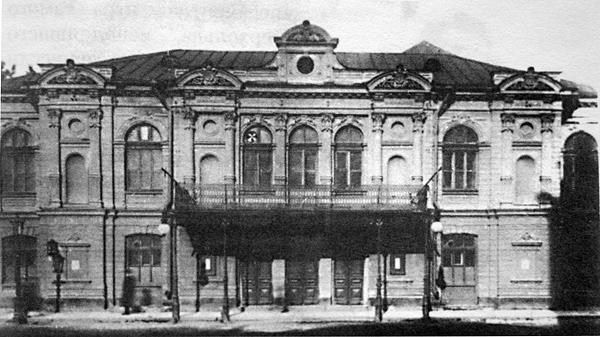
The first performance in the “Demidov Garden” took place on May 1, 1878, and in December the Winter Café-Chanteen “Folie-Berger” opened. A few years later, in 1882, the Winter Theatre was opened nearby (Officers’ Street, 35). The landowner Egarev, due to financial decline in the mid-1880s, sold the garden at auction to former operetta actress Linskaya-Nemetti. The new owner demolished the old building and built two new ones: the Summer and Winter “Nemetti Theatres.” St. Petersburg residents could enjoy performances by artists of various genres here; in summer, open-air variety shows were held, with main acts by singers and reciters; in the warm stone Winter Theatre, operettas and dramas were staged.
The Winter Theatre suffered a fire (1882) but was immediately restored and continued to operate. Later it was rented by Amphitheatrov’s “Russian Dramatic Theatre” (1898). Then it was bought by Shabelskaya (1900) to organize the main stage for her troupe.
In 1906, Vera Fyodorovna Komissarzhevskaya opened her theater here, in the building of the old Nemetti Theatre. The interior was redesigned: the hall now resembled an ancient temple—white, round, with marble columns. Artist Lev Bakst created the curtain “Elysium” — bright souls of the otherworldly realm amid paradisiacal groves. At Komissarzhevskaya’s theater, a synthesis of the arts was born, bringing together the creative destinies of artists, poets, musicians, and actors. The director invited was Vsevolod Meyerhold. On December 21, 1906, Meyerhold staged the play “The Booth” by Blok on the theater’s stage. This performance became not only an event in the theater’s life and in the history of St. Petersburg culture but also a symbol of the culture of the entire Silver Age for future generations. Blok himself wrote about the play: “I owe the ideal staging of the little fairy tale ‘The Booth’ to Meyerhold, his troupe, Kuzmin, and Sapunov.”
The actors played marionette puppets, which in turn enacted the tragedy. Everyone who attended this first performance of “The Booth” remembered the passionate excitement that gripped the auditorium, the turmoil that began in the stalls when the last sounds of Kuzmin’s sharp, spicy, anxious, and sweet music faded and the curtain separated the audience from the mysterious and magical world in which the poet Pierrot lived and suffered. This role was played by Meyerhold himself.
Georgy Chulkov wrote: “I have never before or since witnessed such irreconcilable opposition and such enthusiasm from admirers in the theater auditorium. The furious whistles of the enemies and the thunder of friendly applause mingled…”
In 1909, Komissarzhevskaya, together with N. Evreinov, organized the “Merry Theatre for Elderly Children” here. Despite the great success of this theater’s performances and good attendance, it had to be closed. The reason was prosaic—the lease ended, and from the new season it was transferred to another troupe. Shortly thereafter, V. Komissarzhevskaya died (February 12, 1910); until the revolution, the troupe of K. Nezlobin performed on the stage of the theater she created.
In May 1912, entrepreneur Yalyshev opened Luna Park on the territory of Demidov Garden. The entrance was decorated with wide gates, and various pavilions were built everywhere, designed by architect Waitens. A restaurant was built in the park, and stages for theatrical performances were equipped (on one of which, in December 1913, the premiere of a futurist play by Mayakovsky took place), but what mainly attracted audiences of all ages was the attractions in the center of the garden.
The first Luna Park in Russia was built by an English company with money from a Russian millionaire and was modeled after the one recently opened in London. It housed “roller coasters,” a “Ferris wheel,” “Love Mill,” “Drunken Ladder,” “Humorous Kitchen,” and many other previously unseen attractions.
Luna Park survived World War I, during which it continued to operate (except for autumn 1915–spring 1916, when a military automobile company was stationed there), but some pavilions had already been demolished. In November 1915, the summer restaurant burned down, and a year later a stone winter theater and concert hall were built in its place. In June 1917, the premiere of I. Kalman’s operetta “Silva” took place on its stage. The Luna Park territory housed a music hall, variety shows, and two cinemas (“Dona Gloria” and “Gloria”).
In April 1918, Luna Park was requisitioned and transferred to the Kolomna Council of Workers’ and Soldiers’ Deputies. That same year, Meyerhold organized the Workers’ Theatre of the 2nd Kolomna District and staged plays as director, but due to extremely poor attendance, it had to be closed.
Soon after, it was completely destroyed, and a stadium was built on its site, which now belongs to the Lesgaft Institute of Physical Culture, as well as the Concert Hall of the Mariinsky Theatre.
Sources:
https://alcurium.com/2016/01/19/id_2014/
https://www.citywalls.ru/house10969.html


Written by Jermaine
Discuss this with the author and others
No comments yet. Be the first to start the conversation.