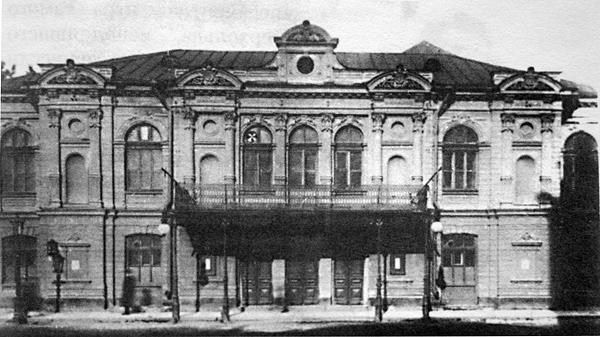
Gymnasium Period

Bolshoy Prospekt P.S., 37, Saint Petersburg, Russia, 197198

My mother took me to the gymnasium; for the first time in my life, from a cozy and quiet family, I found myself among a crowd of neatly cut and loudly shouting boys; I was unbearably scared of something, I would have gladly run away or hidden somewhere; but at the classroom door, though open, I felt an impassable boundary. They seated me at the front desk, right in front of the teacher’s podium, which was pushed up close to it and on which the Latin teacher was about to step any minute. I felt like a rooster whose beak had been chalked to the floor, and it remained bent and motionless, not daring to raise its head… *Confession of a Pagan.* A. Blok

The gymnasium period of Blok’s life has not attracted special attention from researchers. It is generally believed that the gymnasium did not play a significant role in the poet’s creative biography; he himself noted that it had a much smaller influence on him than his home environment — “an old noble atmosphere with literary tastes,” in which his childhood and adolescence passed.

Today, few remember that the building of the modern hotel complex once housed a boys’ gymnasium, and even earlier, a two-story merchant’s house stood on this site. This early 19th-century building was rebuilt many times throughout its history, changed owners and purposes, but from 1891 to 1898, it was here that Alexander Blok studied.

Blok himself, in 1918, in the unfinished story “Confession of a Pagan,” recalled his gymnasium years: “The times were those of Delyanov; the Tolstoy classical teaching system was degenerating and dying (the name of the Minister of Education from 1866-80, Tolstoy, is associated with the introduction of conservative curricula that focused primarily on the study of Latin and Greek), but as it degenerated, as always happens, it raged especially fiercely: they taught almost exclusively grammar, without inspiring it in any way, taught fiercely and relentlessly, year after year, spending endless hours on it. Moreover, the gymnasium was very provincial, the boys mostly came from non-intellectual families, and in many fresh hearts, if desired and skilled, one could write and draw anything. However, none of the teachers even thought of trying to teach the boys anything other than what was written in the textbooks in “large” print (the “small” print was usually allowed to be skipped).”

The Vvedenskaya Gymnasium, where Blok spent seven years, had, as one of its students recalled, “a special reputation among other educational institutions in Petersburg.” It was located on the Bolshoy Prospekt of the Petersburg side, in an area that was distant by the standards of the time from the central parts of the city and inhabited mainly by minor officials, petty bourgeoisie, and military personnel. Moreover, the tuition fee was the lowest among all classical gymnasiums in the capital, and all this largely determined both the composition of the students and the atmosphere of the gymnasium. The poet himself described it as “very provincial” and “terribly plebeian.” “I observe there types of merchants, brutes, drunkards, and so on,” writes eighth-grader Blok to his mother. “And there are many such types, I think more and more diverse than in any other place (in another gymnasium).”


Alexander Blok (standing in the 4th row, 1st from the right) among teachers and students of the Vvedenskaya Gymnasium. St. Petersburg, 1895

By the way, he was never an excellent student but remained among the average pupils. On April 16, 1898, Blok was admitted to the maturity certificate exams, having an “average score from compulsory subjects” of 3.7/11 and the following “successes in gymnasium course subjects”: religious studies — 4, Russian language with Church Slavonic and literature — 4, logic — 4, Latin — 3, Greek — 3, mathematical geography — 5, mathematics — 4, physics — 3, history — 4, geography — 3, French — 4, German — 3. The exams took place from April 28 to May 29. Blok passed them “barely,” receiving a two in oral mathematics and threes in written translations from Latin and Greek, history, and German; he passed the other subjects with fours.

Another famous graduate of the gymnasium was film director Sergey Vasilyev, who, together with his brother, made the film “Chapaev.”


Source:

https://kudago.com/spb/list/peterburg-bloka/

https://www.citywalls.ru/house1786.html

http://www.nasledie-rus.ru/podshivka/11524.php

Report by K. A. Kumpan and A. M. Konechny: ALEXANDER BLOK IN THE VVEDENSKAYA GYMNASIUM

Follow us on social media

More stories from St. Petersburg of Alexander Blok

The poet's early childhood

Universitetskaya Embankment, 9, Saint Petersburg, Russia, 199034

In infancy, Blok lived and was raised in the family of his grandfather Andrey Beketov, a botanist and rector of St. Petersburg University.

Grenadier Regiment Barracks - Youth

Petrogradskaya Embankment, 44, Saint Petersburg, Russia, 197101

The poet Alexander Blok's mother divorces her husband and later marries the military officer Franz Kublicki-Piottukh. The family moves to the barracks of the Grenadier Regiment. From 1889 to 1906, Blok lives with his mother and stepfather in an apartment in the officers' barracks of the Life Guards Grenadier Regiment.

Universities of the Bloc

Universitetskaya Embankment, 11, Saint Petersburg, Russia, 199034

The famous poet Alexander Blok graduated from Saint Petersburg University at the beginning of the 20th century. He started in the Faculty of Law but finished university as a student of Philology. In his letters, he sometimes mentioned the time he spent within the university walls. Like today's students who move from school to university, Alexander Blok was amazed by the freedom that higher education grants after the tedious rote learning in school. “At university, of course, it is much more interesting, and besides, there is a very strong feeling of freedom, which I, however, do not misuse and attend lectures diligently” (Letter to his father, 18.10.1898).

The Marriage of Blok

Lakhtinskaya St., 3, lit. A, Saint Petersburg, Russia, 197136

Alexander Blok and Lyubov Mendeleeva, the daughter of chemist Dmitri Mendeleev, had known each other since childhood. But it was in the summer of 1898, when they worked together on an amateur home production of *Hamlet*, that they grew closer. Their estates near Moscow, Shakhmatovo and Boblovo, were neighbors, and their parents had always been friends. She perfectly fit the image of a professor’s daughter: a strict and reserved gymnasium student. At that time, Blok was not yet “the” Blok — he was only destined to become a famous poet. He asked for Mendeleeva’s hand and heart much later and married his beloved only in 1903, at the age of 23. Lyubov Dmitrievna became the poet’s muse and influenced the creation of his first book of poems, *Verses About the Beautiful Lady*. Their relationship, with interruptions, lasted until the poet’s final years.

Nemetti Theater

39 Dekabristov St., Saint Petersburg, Russia, 190121

Modern residents of St. Petersburg associate Dekabristov Street exclusively with the Mariinsky Theatre. Numerous disputes and regrets remain in history about the demolished Palace of Culture of the Fifth Five-Year Plan, and even earlier, the building of the decoration workshops destroyed by fire, which has now been rebuilt into a Concert Hall. It was precisely on this site, listed on the city’s posters as Mariinsky-3, that the best theatrical venues and the most amazing park in the city once stood.

Blokovskaya "Stranger" - Ozerki Station

Ozerki, Saint Petersburg, Russia, 197375

“In the evenings above the restaurants, the hot air is wild and deaf…” Who isn’t familiar with these lines from the famous Blok poem *The Stranger*? Under the poem, there is a note: “April 24, 1906, Ozerki.” It is commonly believed that the poet wrote it in the station restaurant in Ozerki. But where exactly? In this popular summer suburb, there were two stations: one on the Finland railway line, the other on the Ozerki branch of the Primorskaya (Sestroretskaya) railway…

Poem Retribution

Malaya Monetnaya St., 12, Saint Petersburg, Russia, 197101

From 1910 to 1912, Alexander Blok lived here together with Lyubov Mendeleeva. Their four-room apartment No. 27 was located on the sixth, attic floor. The poet's study had a balcony, which has been preserved to this day.

The Last Address of Blok

57 Dekabristov St., Saint Petersburg, Russia, 190121

Died "from lack of air." A contemporary recalled: "They had just removed the plaster mask from his face. It was quiet and solemnly desolate... nearby, by the wall, stood Anna Akhmatova quietly weeping; by six o'clock the room was filled with those gathered for the memorial service. Anna Akhmatova lay dressed in the shroud of the deceased, with a gaunt, yellowish-pale face... In death, he lost the appearance of greatness and took on the visage of suffering and decay."

Two graves of Blok - the first is Smolensk Cemetery

Kamskaya St., 24, Saint Petersburg, Russia, 199178

Surprisingly, there are two graves of Alexander Blok in Saint Petersburg. Fans of the poet visit both of them, as no one is still certain where his remains are actually buried. Initially, Blok was buried at the Smolensky Orthodox Cemetery, alongside other family members. According to his will, the tombstone was made in the form of a simple wooden cross. In 1944, it was decided to move the grave to the Volkovo Cemetery, to the prestigious Literatorskie Mostki (Writers' Footsteps). Blok’s biographers never saw the point in this action, considering it unnecessary. The new burial site caused many discrepancies regarding where admirers of Blok’s work should make their pilgrimage. Historians claim that only the skull was moved to the Volkovo Cemetery, while the rest of the remains stayed in place. This version was confirmed by the art historian, academician Dmitry Likhachyov. Today, at the Literatorskie Mostki, one can see a beautiful memorial in the form of a black stele with the poet’s name and years of life. Fans love this place and willingly come to honor the memory of the outstanding Russian symbolist.

Two graves of Blok - the second is Volkovo Cemetery

Rasstannaya St., 30, Saint Petersburg, Russia, 192007

In 1944, it was decided to move the grave to the Volkovo Cemetery, to the prestigious Literatorskie Bridges. Block's biographers never saw the point in this action, considering it unnecessary. The new burial gave rise to many discrepancies regarding where fans of Block's work should make their pilgrimage. Historians claim that only the skull was moved to the Volkovo Cemetery, while the rest of the ashes remained in place. This version was confirmed by the art historian, academician Dmitry Likhachyov. Today, at the Literatorskie Bridges, one can see a beautiful memorial in the form of a black stele with the poet's name and years of life. Admirers love this place and willingly come to it to honor the memory of the outstanding Russian symbolist.

The Suicide Pharmacy of Blok

Chkalovskaya metro station, Admiral Lazarev Embankment, 24, BC "Trinity", Saint Petersburg, Russia, 197110

Night, street, lamp, pharmacy, Meaningless and dim light. Live for another quarter of a century — Everything will be the same. There is no way out.

Controversial monument to Blok

60 Dekabristov St., Saint Petersburg, Russia, 190121

In Saint Petersburg, on Dekabristov Street, a monument to Alexander Blok was unveiled. The bronze sculpture, 3.6 meters tall, was placed in the square near the house where the poet lived for nine years from 1912 to 1921. The authors of the sculpture are Evgeny Rotanov and architect Ivan Kozhin.