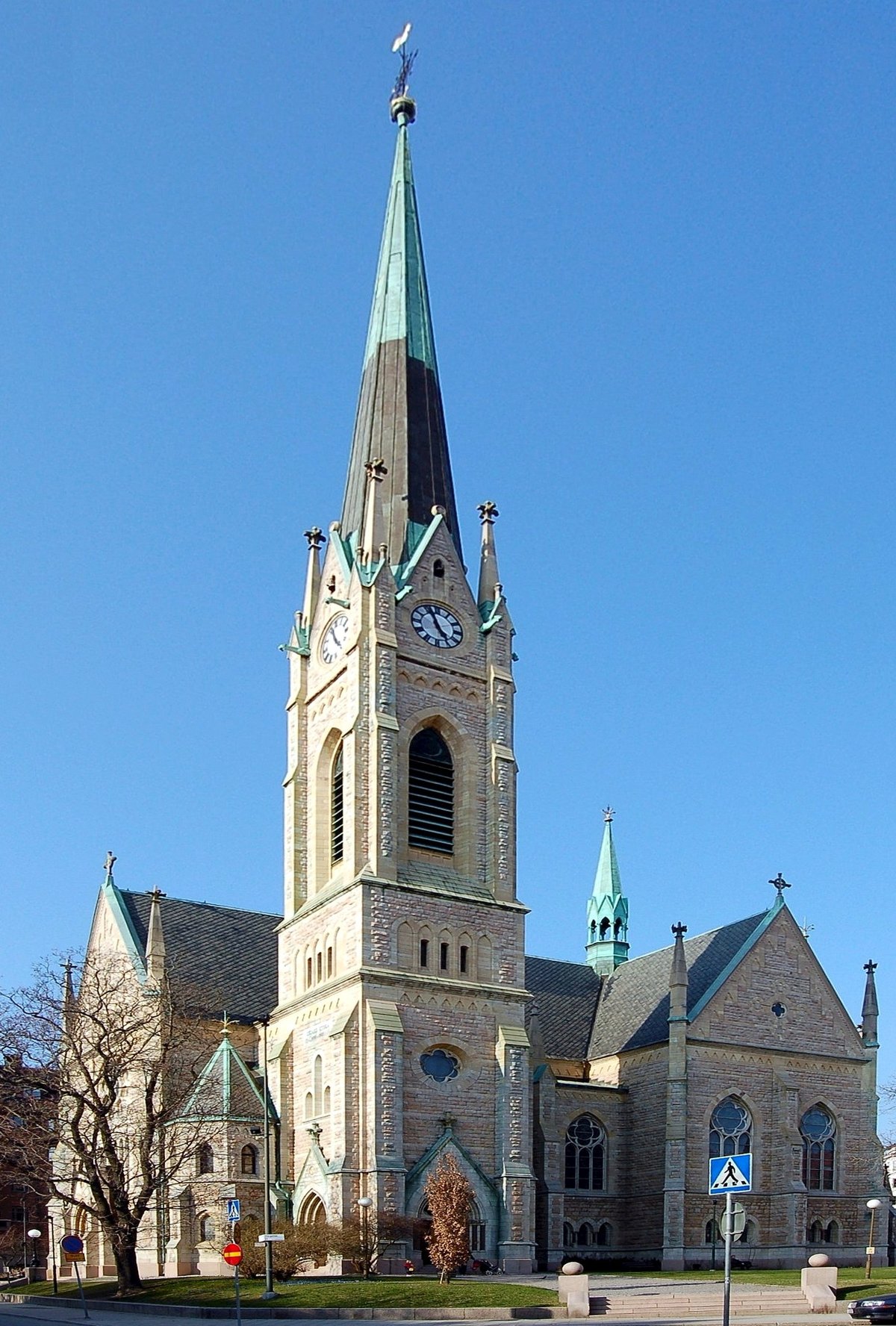

Oscar's Church, standing tall overlooking Narvavägen and the grand boulevard stretch of Strandvägen, is an anomaly in an otherwise historically preserved city. Its 80-meter high tower, meticulously clad in the same white stone as a passport, was envisioned to make it a national spectacle, yet its Neo-Gothic Revival style has been met with controversy. The church was built in 1903 under the direction of architect Gustaf Hermansson, who also designed the Sofia Church.
Initially conceived as part brick and part stone, the church's façade was eventually changed to uniformly white, clad in limestone and marble. The construction work was plagued with delays because of difficulty with the foundation, non-delivery issues, and labor strikes, resulting in its consecration being delayed until 1903.
Throughout the 1900s, the church underwent several renovations. Significant alterations to the interior were made in 1921–1923, including new stained glass windows designed by Emanuel Vigeland, all under the direction of architect Lars Israel Wahlman. Later, in 1954–1956, more changes were made to the interior, leading to modifications in the altarpiece and the removal of certain ornamental ceiling decorations.
The church's main organ, considered one of the country's most notable, was built in 1949 by the Danish firm Marcussen & Søn at the request of Alf Linder, the church organist from 1943 until his death in 1983. The organ features four manuals and a pedal, with a total of 78 voices and more than 5,200 pipes, making it one of the largest in Sweden.
Sources: Wikipedia, OpenStreetMap, Wikidata, Wikimedia Commons
Written by Nik Frost
Discuss this with the author and others
No comments yet. Be the first to start the conversation.