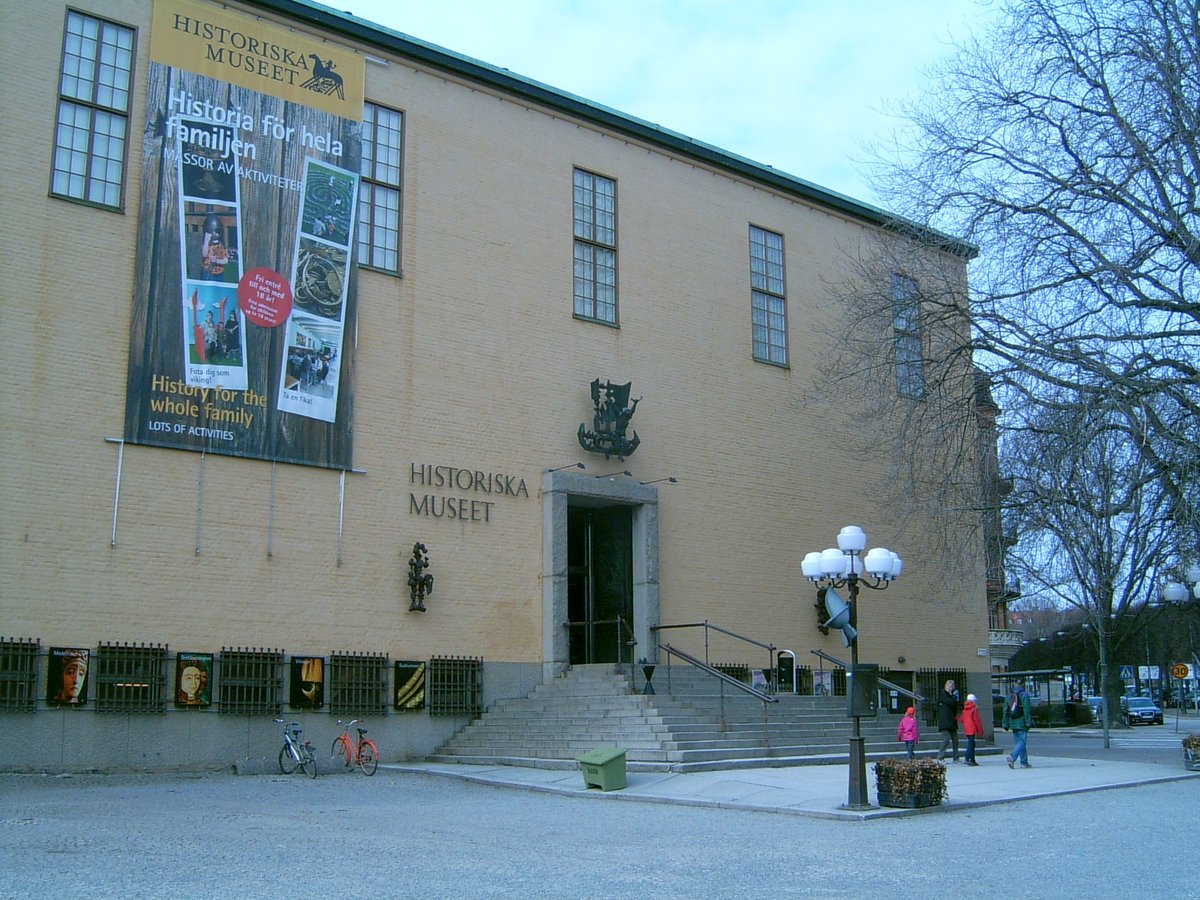

The Swedish History Museum (Historiska museet or Statens historiska museum) in Stockholm, Sweden, is a government agency tasked with preserving Swedish historical items and making knowledge about history available to the public. The origin of the museum lies in the collections of art and historical objects that Swedish monarchs have gathered since the 16th century. As the Swedish Empire expanded, the collections grew through acquisitions, gifts, and spoils of war. Some of the collections were lost during the fire in Tre Kronor castle.
In the later part of the 18th century, art and antiquities were bought by Swedish ambassadors and members of the royal family, and the collections were turned over to the Swedish government after King Gustaf III's death in 1792. The Royal Museum (Kongl. Museum) opened in Stockholm Palace that same year, one of the first public museums in the world.
The Swedish History Museum was established in the Ridderstolpe House in 1847, according to historical records, but it wasn't until 1866 that Bror Emil Hildebrand founded the present-day museum. The collections were previously exhibited on the ground floor of Nationalmuseum, but they found the premises too small, and the debate about housing for the museum continued for decades.
In 1923, Sigurd Curman, Custodian of Ancient Monuments, moved the issue to a more concrete solution, and the Swedish government suggested the use of a former military barracks and stables at Storgatan in 1929. An architectural competition for the conversion of the block into suitable accommodation for the museum was held in 1930. The museum was built in 1934-1939 using funds granted by the Swedish government during the depression. The plans for the museum were not finalized until 1936, and the museum was designed by Romare and Scherman.
The museum's exterior reflects an ambivalence between modern and neoclassicist styles. The main building takes a step backwards from the street and consists of four two- and three-story buildings surrounding an inner courtyard. The façade is decorated with sculptures made by Bror Marklund and reliefs by Robert Nilsson. A piece called Näcken in the courtyard was scultped by Carl Frisendahl. The main entrance to the museum was designed by Bror Marklund, who also created the entrance doors called the Gates of History, which took 13 years to make and were cast at the Herman Bergman foundry. Each door is 4.5 meters high and weighs about 1 ton. Marklund carved a 1950s pilsner bottle on the far right side as a deviation from the historical theme. The bottle has been touched by many people and is now polished to a shine.
The museum's interior is spacious for both permanent and special exhibitions. Permanent displays are arranged in chronological order in rooms facing the inner courtyard. The entrance hall was refurbished in 1994 to give a modern impression of a medieval knight's hall. The floor of the entrance hall was laid with stone and the exposed beams in the ceiling were made of concrete.
Sources: Wikipedia, OpenStreetMap, Wikidata, Wikimedia Commons
Written by Nik Frost
Discuss this with the author and others
No comments yet. Be the first to start the conversation.