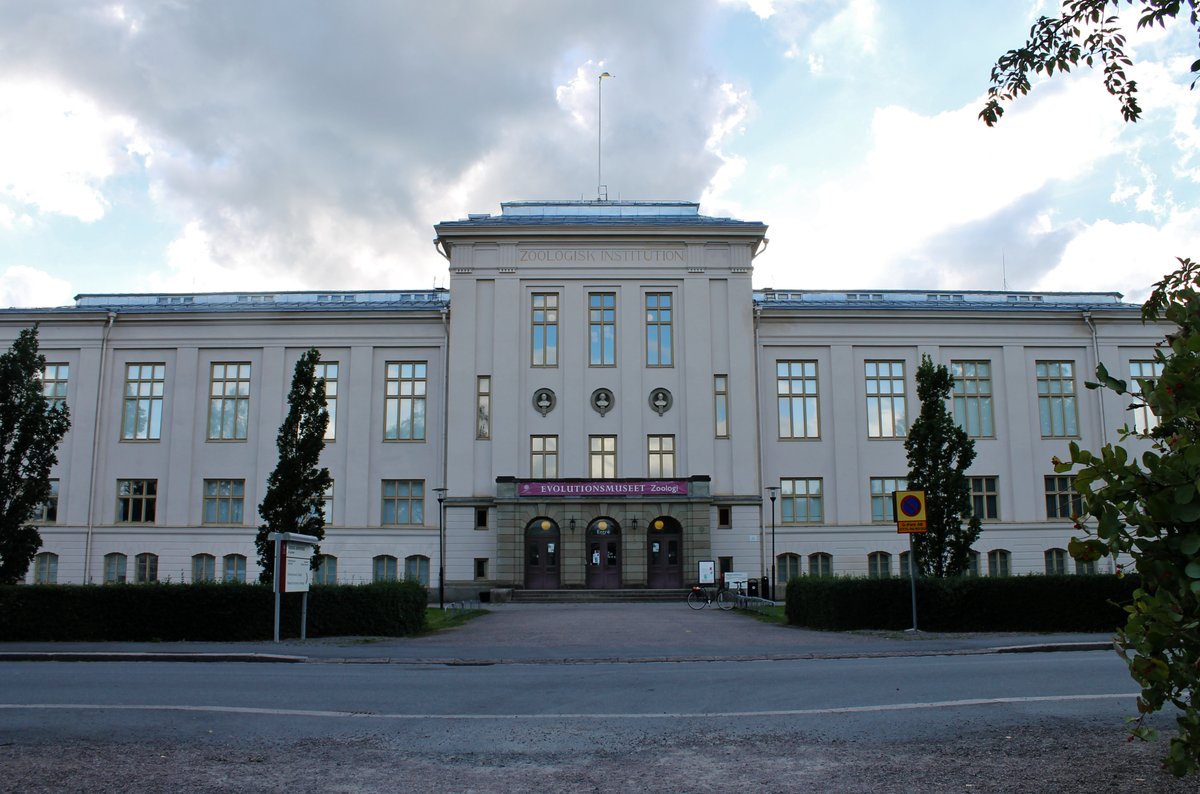

The Museum of Evolution of Uppsala University (Swedish: Evolutionsmuseet) is a natural history museum in Sweden, and holds Scandinavia's largest fossil collection of dinosaurs. The number of items in today's collection, which spans zoological, paleontological and mineralogical specimens, is approximately 5 million unique pieces, of which only a fraction are exhibited. Expeditions to China in the 20th century unearthed numerous unique paleontological treasures.
Despite being formally founded in 1999, the museum traces its history back to the 17th century. During this time upstanding university members like Carl Linnaeus, Olof Celsius and Jonas Alströmer donated collections of material to the museum. In the 20th century, notable paleontologists Otto Zdansky and professor Carl Wiman contributed to the growth of the collections. Several expeditions to China yielded many unique vertebrate fossils.
From 1917 and onwards the zoological collections of the museum were stored and displayed in a building designed by the architects Ture Stenberg and Victor Holmgren.
Before the 1930s, the paleontological collections of the museum were disorganized and spread out in a number of buildings across the city. Wiman, who was the first professor of paleontology at Uppsala University, had powerful connections and managed to bring about the construction of a single large building in which all the paleontological and mineralogical specimens could be stored. The architect was Axel Anderberg and the building was given a vaguely Chinese style in recognition of the Chinese origins of many of the museum's dinosaur specimens. Construction was completed in 1931 and since then the building has served both as a museum and as a classroom for paleontology students.
Over 620,000 plant specimens are digitized and available online in the botanical section's herbarium. Only a fraction of the museum's 5 million unique pieces are exhibited.
The Museum of Evolution holds many mesozoic fossils of marine reptiles including Ophthalmosaurus and Platecarpus. It has several original fossils of pterosaurs and dinosaurs including a unique specimen of Euhelopus zdanskyi and a cast of Archaeopteryx lithographica. The museum contains a ceratopsid dinosaur Pentaceratops sternbergi and a skull of Parasaurolophus tubicen.
Wiman named both Pentaceratops and Parasaurolophus. The museum also has mounted skeletons of contemporary cetaceans and a fossilized mandible of an Eocene mysticete. The museum has numerous fossils of invertebrates including trilobites, cephalopods, bivalve molluscs and corals. The mineral room contains a collection of zircon and malachite.
In 1921, Otto Zdansky discovered three teeth of the Peking Man during an expedition to Zhoukoudian in China. Today, those teeth are displayed in the Museum of Evolution, where the museum's collection is an important establishment in the field of biological systematics, and it maintains an active exchange with other scientific institutions worldwide.
Sources: Wikipedia, OpenStreetMap, Wikidata, Wikimedia Commons
Written by Nik Frost
Discuss this with the author and others
No comments yet. Be the first to start the conversation.