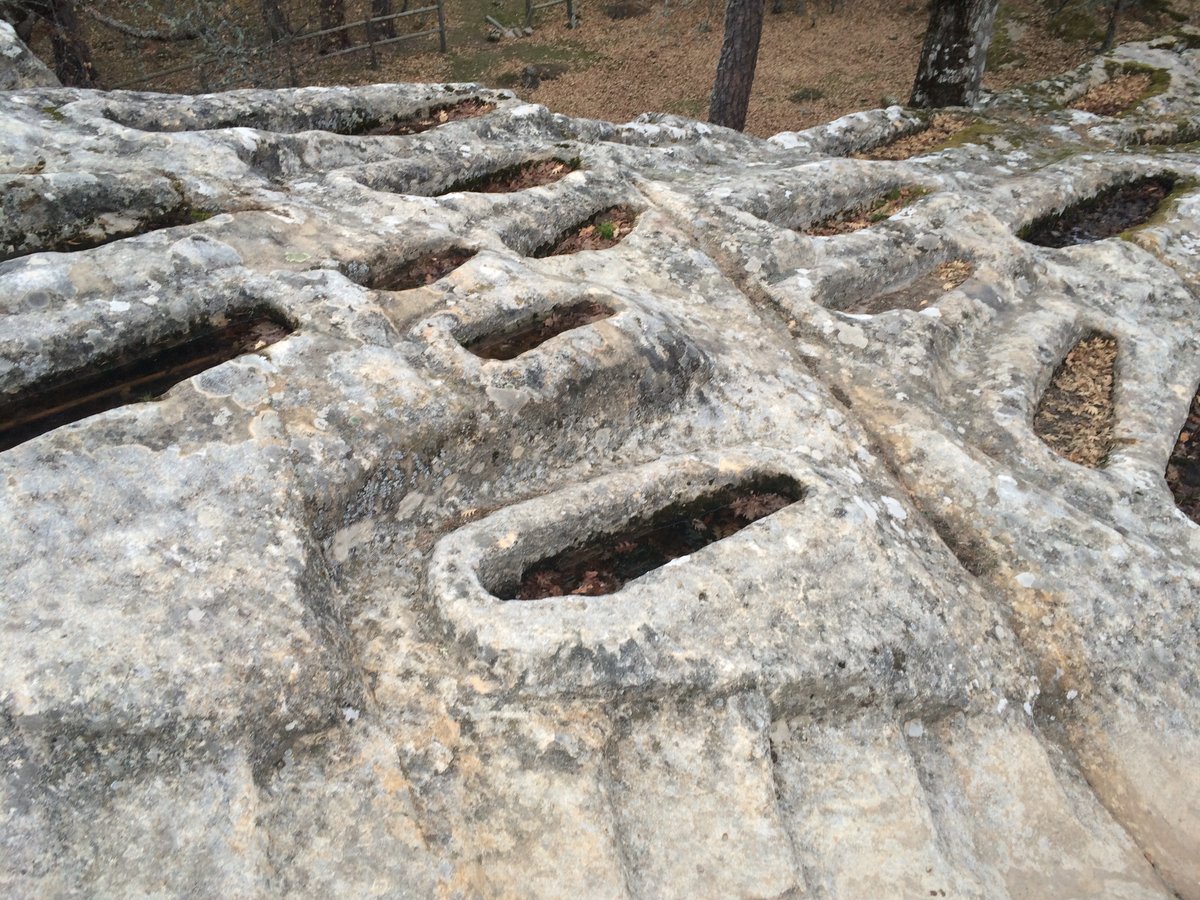

The archaeological site of Cuyacabras, located in the Sierra de la Demanda (Burgos, Spain), is one of the most illustrative examples of medieval Spanish archeology. The professor Alberto del Castillo led excavations between 1969 and 1971, which discovered the monumental necropolis of the era of the Repoblación (9th-13th centuries). The necropolis, with a minimum of 183 documented burials, is distributed around a church and covers the adjacent and prominent sectors.
The majority of the evidence comes from burials excavated in the rock, although there are also burials in the form of slabs in the form of cists and a peculiar type of lateral niche. The burials excavated in the rock correspond to three basic categories: forms and variants of the 'bañera' type, forms of anthropomorphic type, and lateral niches. Among the anthropomorphic tombs, rounded heads and arched heads prevail, while in the 'bañera' type, elliptical forms are the most common.
The groups of ages show some preferences in the use of a specific type of burial. While the use of forms of the 'bañera' type and anthropomorphic forms seem to maintain a relatively even balance among adult individuals, the preferred type for infant graves is, without a doubt, the 'bañera' elliptical form. No church ruins were found, but on the rock, there are imprints that show that the church had a simple rectangular floor plan. To access it, there is a staircase of eight steps on the rock.
Sources: Wikipedia, OpenStreetMap, Wikidata, Wikimedia Commons
Written by Nicolo Ciampini
Discuss this with the author and others
No comments yet. Be the first to start the conversation.