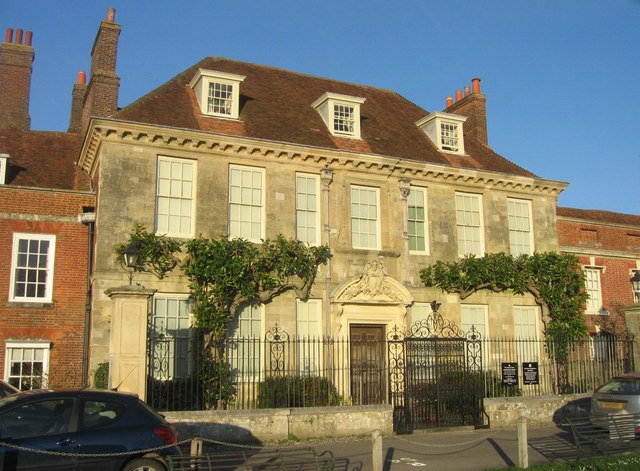

Mompesson House sits in Salisbury's Cathedral Close. It is a Queen Anne house built of ashlar Chilmark stone, with renovations completed by Charles Mompesson in 1701. The house reflects the classic style of the period and shows the influence of Christopher Wren. To the right of the main house stands a brick-built service building, constructed on the site of the old Eagle Inn that closed in 1625.
In 1740, Charles Longueville moved into the house with his widowed sister, Elizabeth. After his death, he attempted to leave the house to his natural-born son, John Clark. Elizabeth refused to administer his will and instead added a codicil to her own will stipulating that Clark would only have the right to use the house for his lifetime, after which the house would pass to Mr Thomas Hayter of Salisbury.
The house was later occupied by several families, including the Townsend family from 1846 to 1939. The flamboyant artist Miss Barbara Townsend lived there for almost all of her 96 years. In 1952, the architect Denis Martineau purchased the freehold and bequeathed it to the National Trust, though he continued to live in the house until 1975. Martineau completed extensive repairs and renovation throughout the property before it opened to the public in May 1977.
Today, visitors can see Georgian plasterwork and carvings of exceptional quality, which the Trust restored by removing many layers of paint. The house contains the Turnbull collection of English 18th-century drinking glasses and the Bessemer-Wright collection of ceramics. The front of the building features a Grade I listed overthrow, iron railings, gates, and iron lamps.
Sources: Wikipedia, OpenStreetMap, Wikidata, Wikimedia Commons

Written by Nicolo Ciampini
Discuss this with the author and others
No comments yet. Be the first to start the conversation.