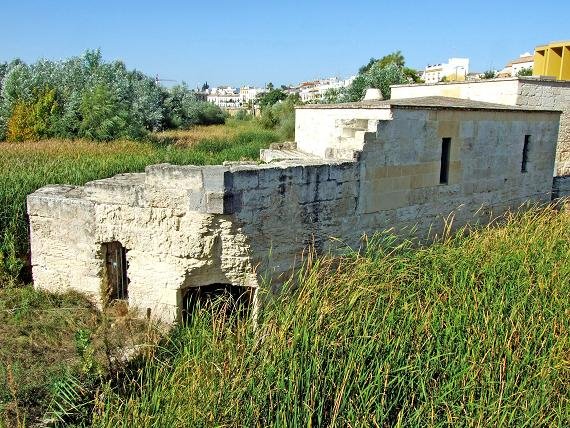

The Molino de Martos stands as a testament to enduring engineering along the banks of the Guadalquivir in Córdoba. Historically, it functioned as the Parada de San Julián, located directly across from the Puerta de Martos. This gateway was an entrance to the city walls for those arriving from the municipality of Jienna.
We can trace its evolution from 1237 to 1550, during which the site operated as a standard medieval watermill comprised of two distinct dwellings. A significant architectural shift occurred between 1550 and 1555 when these structures were unified into a single edifice. During this period, the hydraulic system was changed to a regolfo system. This moved the channels for the water's passage to be under the floor instead of at the side of the mill.
This adjustment supported the installation of eight millstones, which eventually grew to ten. By 1559, the facility transitioned into a batán, utilizing the river's energy to drive wooden machines used to produce the beating of fabrics. Today, the site preserves this legacy as the Museo del Agua. We invite you to explore the history of water management and the use of plants for dyes and fibers in this space rehabilitated in 2001 and opened in 2006.
Sources: Wikipedia, OpenStreetMap, Wikidata, Wikimedia Commons
Written by Nik Frost
Discuss this with the author and others
No comments yet. Be the first to start the conversation.