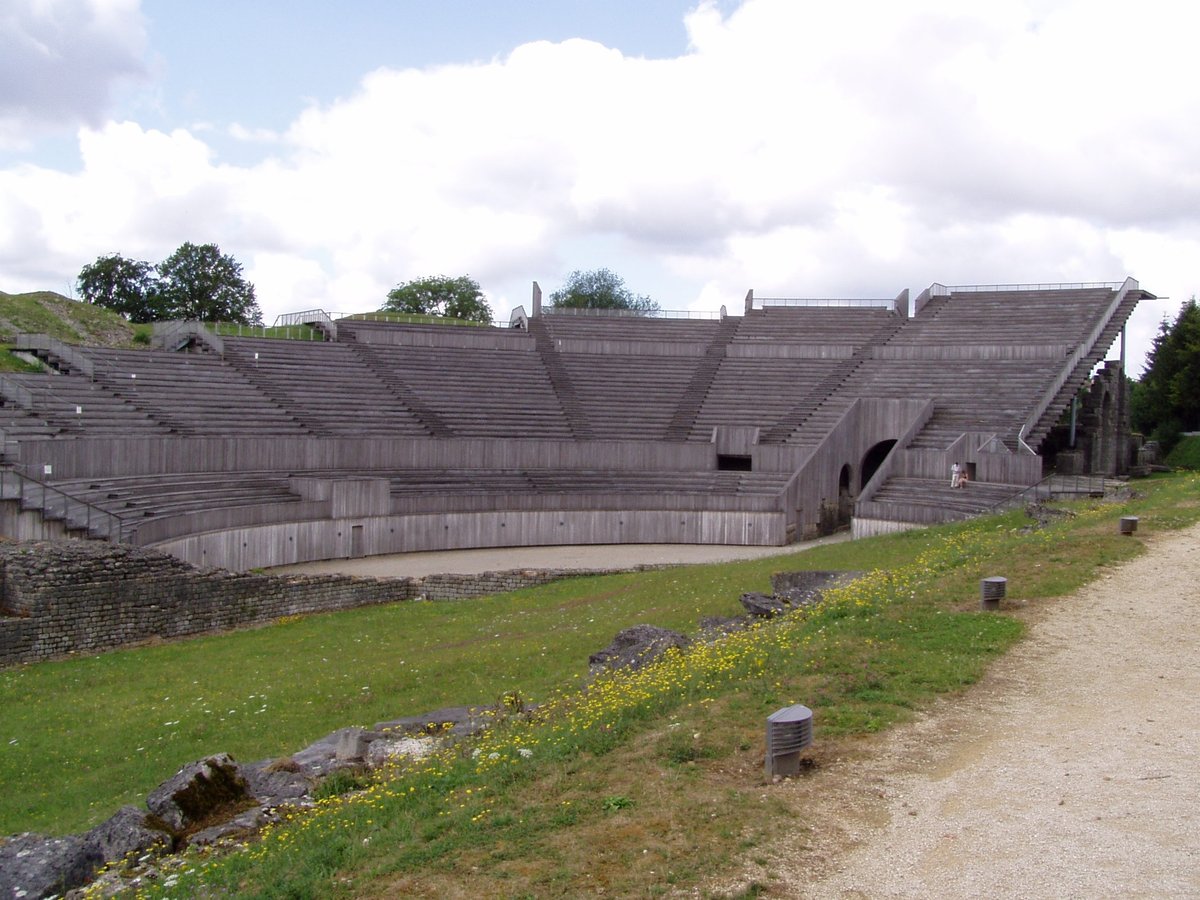

Standing outside Grand in eastern France, it's hard to imagine the treasure hidden under the fields. What lies beneath is a Gallo-Roman theater, one of the largest in the Roman world, waiting in almost perfect preservation beneath the soil. Built at the end of the 1st century AD, it could hold approximately 20,000 spectators. The theater was part of a religious sanctuary dedicated to the Gallo-Roman god Apollon-Grannus, and is believed to be the location of the most beautiful temple of the world mentioned in the panegyric of Constantine.
Jean-Claude Golvin classified it as a semi-amphitheater, but with an elliptical complete arena surrounded by cavea, of which only the southern parts were built. The south cavea is interrupted by a rectilinear facade parallel to the longest axis, which had mid-level seating and five blind arches following the slope of the seating, two of which still remain on the west. The arena sits on natural ground, and is 34 meters long in its shorter axis and 50.80 meters in its longer axis.
The arena is surrounded by a podium in ruins. On each side of the shorter axis are sanctuaries where dedications to Mars, altars to Jupiter Heliopolitan, Diane, and Nemesis were found. The theater was accessed by following the vaulted parodoi, which originally led to a central axial corridor that ended in four service rooms forming aisles. The site is part of the archaeological site of Grand. In 213 AD, Emperor Caracalla visited this 'sanctuary' and had the western part of the theater renovated. The theater was definitively abandoned in the last quarter of the 4th century. In 309 AD, Constantine the Great consulted Apollo at the theater and had a vision of Apollo and Victory offering him laurel wreaths. This vision took place during a journey to Trier.
Sources: Wikipedia, OpenStreetMap, Wikidata, Wikimedia Commons
Written by Nicolo Ciampini
Discuss this with the author and others
No comments yet. Be the first to start the conversation.