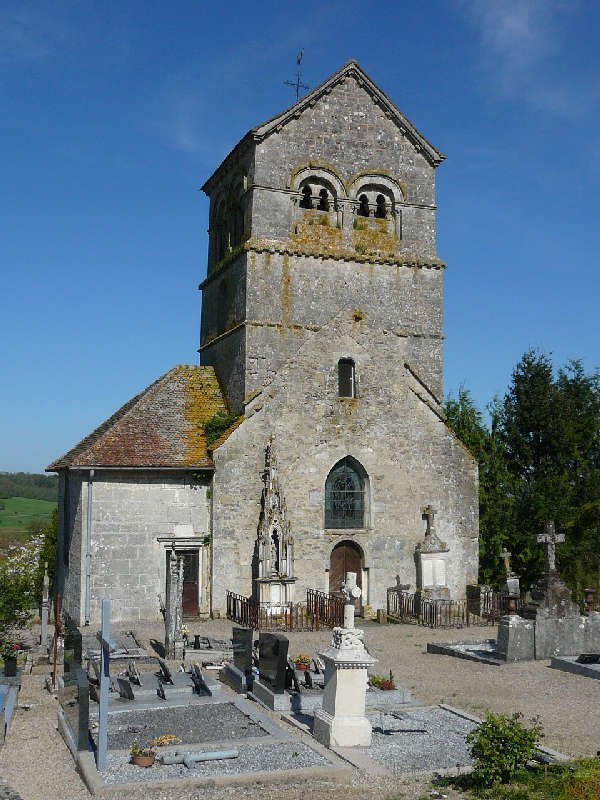

The Ancienne église Notre-Dame de Médonville has a history that stretches back to 1043, when it was first mentioned in the archives of the Toul bishopric. This Romanesque church was completed in the 12th century on a small plateau to the southeast of the village, situated about 40 meters higher than the settlement. Although it served the community for centuries, a fire destroyed the church during the 18th century, after which it was restored.
In the 19th century, a new neo-Gothic church was built in the center of the village. This new construction replaced the old one, and the nave of the original church was demolished. Today, the site of the old church holds the commune's cemetery. A Napoleonic cadastral map from 1841 still shows the church in its entirety, revealing a tower slightly offset from the nave and a much more recent sacristy attached to the north face of the tower.
Only the choir and the bell tower remain today. The building is made of oolitic limestone from the vicinity of Neufchâteau. It is characterized as late Romanesque, dating to around 1200, yet it already features Gothic decorations. The two remaining bays are covered with pointed rib vaults and are separated by a broken pointed arch.
The bell tower rises above the choir bay and shows traces of the former nave roofs on its western face. The apse is decorated on the exterior with a string of arches. The church was officially classified as a historic monument by a decree on April 8, 1914.
Sources: Wikipedia, OpenStreetMap, Wikidata, Wikimedia Commons
Written by Nicolo Ciampini
Discuss this with the author and others
No comments yet. Be the first to start the conversation.