

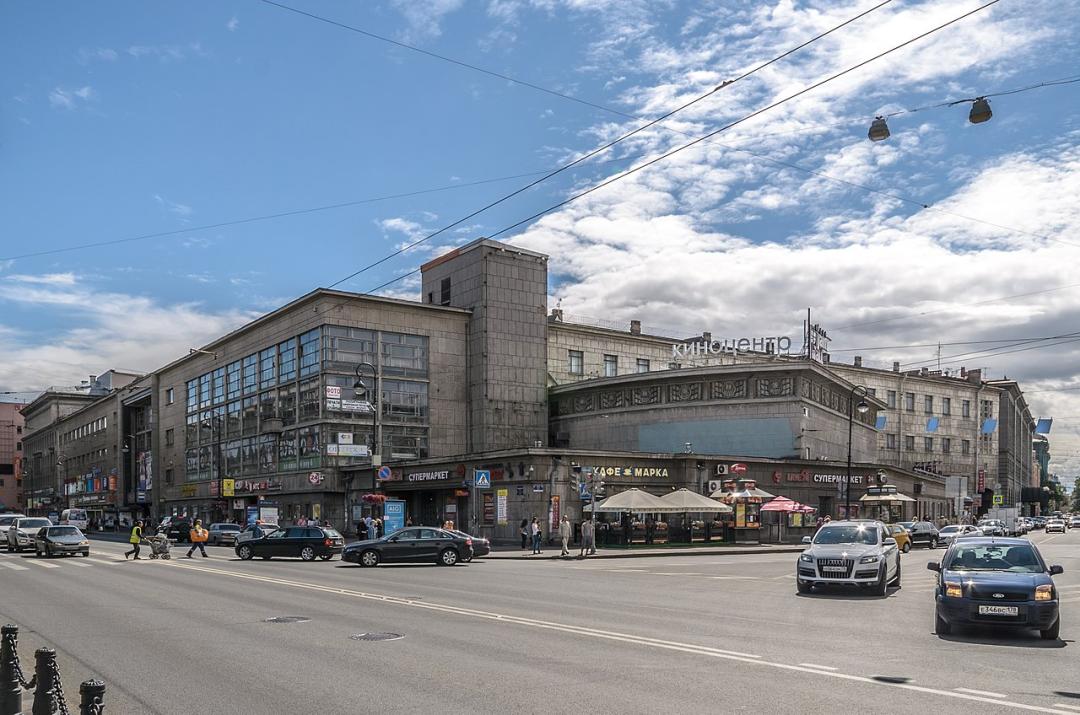
Years of devastation and the Civil War passed, life was improving, and although meager, resources appeared to create visible symbols of the new life. Such symbols became two huge buildings – the Gorky Palace of Culture and the Factory-Kitchen building (now the "Kirovsky" department store). Both buildings were constructed in the style of Constructivism.
Until 1925, a small house stood on the site of the Palace of Culture, which housed a school. In July-August 1917, sessions of the 6th Congress of the RSDLP(b) were held here, where the decision to launch an armed uprising was made.
The first competition in Soviet architecture was precisely for the construction of the Palace of Culture and took place in 1919. The jury, which included workers, architects, and representatives of the People's Commissariat for Education, chose Dubovitsky's project, which turned out to be imperfect. A second closed competition had to be announced, involving representatives of Moscow and Petrograd architectural studios, but this also yielded no results. In 1920, funds and building materials were allocated, but difficulties prevented the start of construction. Based on the results of a new competition in 1925, it was decided to develop the final design of the building based on architect Dmitriev's project and the fourth variant of the Construction Committee presented by Gegello. However, in 1926, when construction had already begun, a new decision was made – to build according to the project by architects Gegello and Krichevsky. Sculptor-caster Gromov created a plaster model in the workshops of the Academy of Arts, which was used to refine the volumes of the rooms and work out the building's facades. As a result, the Gorky Palace of Culture – the first palace of culture in our country and an example of Constructivism – was built in 1927 in memory of the October Revolution. In 1937, architect Alexander Gegello received the Grand Prix at the World Exhibition in Paris.
Attempts by the enlightened part of society to organize more complex types of leisure were made even before the revolution. But this task was solved on a grand scale in the Soviet Palace of Culture. Workers were awaited by libraries and clubs, concerts and performances, often amateur. All this required architectural innovation.
The building, as we see, consists of the main block, almost entirely glazed, and side blocks – for clubs and other leisure rooms. The main block houses an auditorium with 1,200 seats. To emphasize the revolutionary abolition of class distinctions, the architects made it a single amphitheater, without the traditional division into stalls, mezzanine, and boxes. There is practically no boundary between the stage and the hall.
The building was constructed with great enthusiasm, in just two years. To the 500 regular builders, workers joined on weekends for community work days. Building materials were scarce, so one and a half hundred old houses were dismantled, and ownerless rails were used instead of beams. On November 7, 1927, the Moscow-Narva Palace of Culture, as it was then called, was opened; two years later, it was renamed the Gorky Palace of Culture. The classic of Russian literature personally participated in the ceremony of naming the palace after himself.
The Palace operated even during the blockade. Residents of Leningrad in the 1960s-1970s remember the Gorky Palace of Culture for the opera "Juno and Avos" and the legendary singing of Nikolai Karachentsov, as well as for the sharp humor of Arkady Raikin, who toured here from 1976 to 1987. Maestro Yuri Grigorovich and composer Andrey Petrov began their careers at the Gorky Palace of Culture.
Sources:
https://ru.wikipedia.org/wiki/Дворец_искусств_Ленинградской_области_(ДК_Горького)
https://www.citywalls.ru/house1823.html




Written by Jermaine
Discuss this with the author and others
No comments yet. Be the first to start the conversation.